Which dehumidifier to buy in Albox: litres and running cost (2026)
One November morning in a flat in Albox, you get up and the living room windows are weeping on the inside. Misted glass, a trickle of water on the aluminium frame and, if you run a finger along the corner of the ceiling behind the curtain, a grey stain that wasn't there before. You open the bedroom wardrobe and it smells stuffy, of clothes that never quite dry. And the washing you hung out the day before yesterday on the gallery is still damp, because here in winter clothes don't dry in the open air, however sunny it gets at midday.
It isn't something about your house in particular. It's the climate of the Valle del Almanzora and the Levante almeriense: mild winters, but heavy with humidity, especially in areas near the coast and in ground-floor and north-facing flats. The temperature doesn't drop as much as on the central plateau, but the air carries water, and that water condenses on cold surfaces (windows, outside walls, corners) and settles into clothes and wardrobes.
We are a family shop in Albox, open since 1923, and for four generations we have been telling people when something is worth buying and when it isn't. This article is so that you leave knowing how humid your home really is, how many litres a day your dehumidifier needs, how much it will cost you in electricity each month, and when buying one is wasted money because opening a window fixes it.
How humid your home is and how much is healthy
Before buying anything, it helps to know what you're up against. Healthy relative humidity inside a home is between 45% and 55%. In that range the air feels comfortable, clothes dry, wood and fabrics don't pick up a smell and, below roughly 50%, mould doesn't spread because it lacks the water it needs to grow.
The rule of thumb is the 60% one. It's the threshold that tells you whether you really have a problem:
- Below 60%: you normally don't need a dehumidifier. Ventilating well and not creating extra humidity (not drying clothes indoors, cooking with the extractor hood on, airing the bathroom after a shower) is usually enough.
- Consistently above 60%: this is where condensation on the windows, a stuffy smell and mould in the corners and behind furniture pushed against an outside wall begin. This is when a dehumidifier is justified.
- Above 70%: a serious, ongoing problem. The appliance goes from a luxury to a necessity, especially if you already see black spots.
How do you measure it? A tabletop hygrometer costs very little and settles the question. Put it in the worst room (the coldest one, the north-facing one, the one with the wardrobe that smells) and check it first thing in the morning, when humidity is highest. If at eight o'clock it reads 65-70% several days in a row, you have your answer.
Dehumidifier, air conditioning in "dry" mode, or ventilating
Before you spend a euro, here is the comparison almost nobody makes for you, and it could save you the purchase:
- Ventilating (free): opening the windows wide for 10-15 minutes twice a day renews the air and takes out humidity, especially on dry, sunny days. In the middle of a damp Almanzora winter, however, the air coming in is sometimes already full of water and ventilating doesn't bring the humidity down enough. If the hygrometer doesn't drop below 60% when you ventilate, you need something more.
- Air conditioning in "dry" mode: it does dehumidify as a side effect, yes, but it is designed to cool, not to dry. In winter it leaves the room cold and unpleasant, and for the specific job of removing humidity it usually uses more electricity than a dedicated dehumidifier. If your underlying question is about climate control, we cover it in the guide to how many frigorías you need.
- Dedicated dehumidifier: it dries the air without lowering the temperature of the room (in fact the compressor returns the air slightly warm) and it is built for exactly this, so it does more per watt on that job. It is the right choice if your problem is winter humidity, condensation and drying the washing indoors.
Put bluntly: if ventilating gets you below 60%, don't buy anything. If it doesn't, a dehumidifier is better than forcing the air conditioning into cooling mode.
How many litres a day: the two-step method
A dehumidifier's capacity is measured in litres of water it removes per day. The right figure isn't "the bigger the better": an oversized unit wastes electricity and a small one can't keep up. The calculation takes two steps.
Step 1: start from the floor area and how humid it is. This is the rule of thumb we use at the counter:
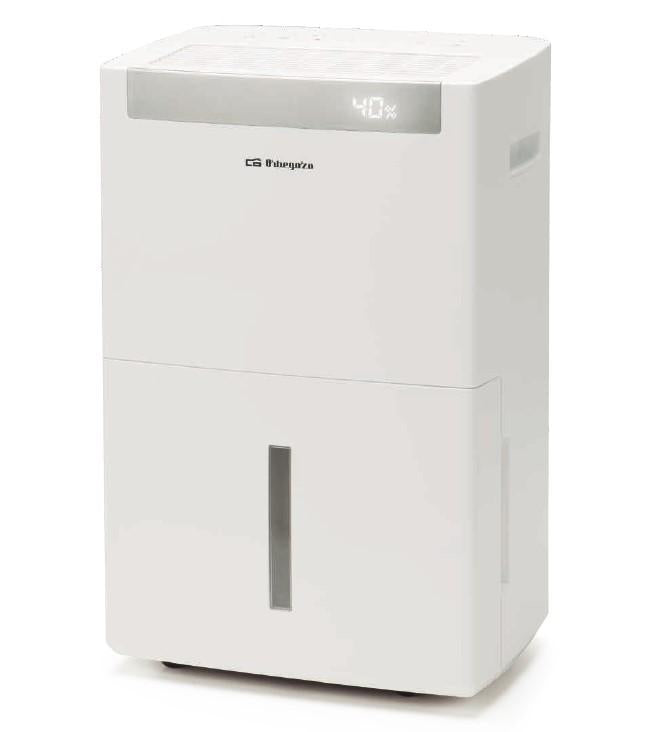
- 10-12 L/day: a normal flat, one or two damp rooms, moderate humidity (60-65%). Right for most homes in the area. For example, the Orbegozo DH 1245 (12 L/day, up to about 50 m², 36 dB), compact and quiet, for a bedroom or living room.
- 16-30 L/day: a large house, a ground floor or a very damp country house, or if you will often dry clothes indoors. Here you will find the Orbegozo DH 1655 (16 L/day, up to about 100 m²) for large flats and the Orbegozo DH 3010 (30 L/day, up to about 140 m², 43 dB) for a whole house that is very damp.
- 50 L/day: this is semi-professional. Warehouses, building work, a newly renovated house that needs drying out, a premises with a serious problem. That is what the Orbegozo DH 5000 (50 L/day, up to about 160 m²) is for. It isn't what you need for a bedroom.
Step 2: add the extra if you dry clothes indoors. A load of washing gives off a good deal of water into the air while it dries. If you will regularly hang clothes indoors in winter, go up one step in the table: if by floor area you got 12 L/day, go to 16; if you got 16, consider 20-30. That way the moisture from the clothes doesn't end up in your walls. And if your underlying problem is really drying the washing, perhaps another machine is what you need: we compare them in the guide to the heat pump, condenser or vented tumble dryer.
The myth of the "X litres/day": why it removes less in your living room
This is the misunderstanding that causes the most disappointment. When the box says "30 L/day", that figure was measured in a laboratory under very specific conditions: around 30 °C and 80% humidity. It is an almost tropical environment, chosen so that appliances can be compared with each other using the same yardstick.
Your living room in November in Albox isn't at 30 °C, it's at 18-20 °C. And at a lower temperature the air holds less water and the appliance extracts it more slowly. In practice, a "30 L/day" dehumidifier at 20 °C will remove quite a lot less than those 30 litres: it can be half or less, and that is completely normal. It isn't faulty and you haven't been misled, it's physics.
The practical consequence: don't buy one that is only just enough. If by calculation you land in the 12 L/day range but your home is cool in winter, lean towards 16. The number on the box is the ceiling in ideal conditions, not what you will see at home on a Tuesday in December.
Compressor or desiccant: which works better in the Levante almeriense
There are two technologies and they don't perform equally depending on the climate:
- Compressor: it works like a fridge, condensing the water on a cold plate. It performs better at mild or warm temperatures, above about 15 °C, and uses less electricity for the same amount of water removed. That is exactly the case in the Levante almeriense and the Almanzora, where winter is damp but not freezing. The Orbegozo DH series use R290 refrigerant gas and are compressor models: a good choice for the climate of the area.
- Desiccant (or Peltier): it uses a material that absorbs the moisture and works better in genuinely cold conditions, below 10-15 °C, but uses more electricity. It makes sense in an unheated storeroom at altitude, in Los Vélez or Chirivel, where it really does freeze. For a normal flat on the coast or in the valley, the compressor wins.
Unless you live in a house that is very cold all winter, a compressor is the sensible choice here.
How much it costs to run each month
A compressor dehumidifier uses somewhere between 280 and 800 W depending on the model and the moment (the compressor isn't always running, it starts and stops according to the humidity). Translated into your bill, and this is an honest range that depends on how many hours a day you run it and on your tariff, it usually comes to between about €5 and €23 a month.
What makes the difference is not so much the appliance as how you use it:
- If you run it for a few hours in the morning and a few at night, you will be in the lower part of that range.
- If you leave it on practically all day because you dry clothes and have serious humidity, you will be in the upper part.
- Almost all of them have a humidistat: you set a target (for example 50%) and the appliance stops only when it reaches it. Use it, it's the way not to pay more than you need to.
Compared with leaving the air conditioning on "dry" all afternoon to remove humidity, cooling your house along the way in the middle of winter, a dedicated dehumidifier works out cheaper for that specific job. And if the plan is to save on heating at the same time, take a look at the sums on heating a room in winter.
Tank or continuous drainage, noise and everyday details
Two appliances with the same litres can give very different experiences depending on how you use them:
- Tank: the water collects in a tank of between 2 and 6 litres that you have to empty by hand. If you have a lot of humidity and use it often, you may empty it once or twice a day. They all switch off by themselves when the tank is full, so it doesn't overflow, but it is a daily chore.
- Continuous drainage: most let you connect a hose so the water runs by itself to a drain, the shower or a sump. If the appliance is going to stay in the same place or you leave it working when you're not at home, this changes everything: you forget about emptying it. It is the convenient option for continuous use or for drying the house over several days.
- Noise: it matters a lot if it is going in the bedroom. Look at the decibels: the DH 1245 is around 36 dB (a whisper, fine for sleeping), the DH 3010 about 43 dB (noticeable but tolerable in the daytime) and the DH 5000 around 51.5 dB (powerful, more for a storeroom or living room than for the head of the bed).
- WiFi and app: if you like controlling it from your phone or scheduling it in time slots, the Orbegozo DHW 2080 (20 L/day, WiFi with app) has it. It isn't essential, but for anyone using it daily it's handy to switch it on before getting home.
When NOT to buy one (we'll tell you anyway)
Not everything is fixed with an appliance, and we don't want to sell you something you will regret:
- If the problem is rising damp or a leak. If the wall is wet from the bottom up, or there is a drip or a leaking pipe, a dehumidifier only takes humidity out of the air, it doesn't fix the cause. What you need there is a builder, not an appliance.
- If you get below 60% by ventilating well. Many homes with occasional condensation can be fixed for free: opening up for 15 minutes in the morning, not drying clothes indoors, putting the hood on when cooking and airing the bathroom after a shower. Try this for a week with the hygrometer before spending anything.
- If it's a very mild problem in a single room. Sometimes it's enough to rearrange things (move the wardrobe a few centimetres away from the outside wall so the air can circulate) before plugging anything in.
If you have tried the free options and you are still above 60% morning after morning, then yes: the dehumidifier is the solution, and a good one.
Why buy it at Híper Ocio
We are a family shop in Albox founded in 1923, now in its fourth generation with Antonio Martínez Rosado. There is no algorithm behind us: we have a hundred years of counter experience telling people what suits them, even when sometimes it is "don't buy it".
A dehumidifier is a small portable appliance, so unlike heavy white goods, it comes with free national delivery from €49.99: it can reach you anywhere in Spain, not just the Almanzora. The legal guarantee is 3 years, as the law requires in Spain. You have 30 days to return it under our policy if it doesn't convince you. And if you prefer to pay in instalments, financing is available at checkout.
If you are unsure which model suits your home, message us on WhatsApp at 623 04 44 20 and we'll tell you how many litres to go for based on your floor area and your humidity. You can also drop into the shop at Avenida 28 de Febrero s/n, in Albox, and see them.
Frequently asked questions
How many litres a day do I need for a normal flat?
For an ordinary flat with one or two damp rooms and moderate humidity, a 10-12 L/day dehumidifier is usually enough. If the home is large, very damp or you will often dry clothes indoors, go up to 16-30 L/day. 50 L/day is for warehouses, building work or drying out a whole home.
How much electricity does a dehumidifier use per month?
A compressor model uses around 280 to 800 W depending on the model and the moment, and in practice it comes to between about €5 and €23 a month depending on how many hours a day you use it. If you use the humidistat so that it stops once it reaches the target humidity, you stay in the lower part of that range.
Why doesn't my dehumidifier remove the litres the box says?
Because that figure is measured in a laboratory at about 30 °C and 80% humidity. In your home in winter, at 18-20 °C, the air holds less water and the appliance removes it more slowly, so it will remove quite a lot less than the box says. That is normal and doesn't mean it is faulty.
Does a dehumidifier help dry clothes in winter?
Yes, and quite well. Hang the washing in the room and put the dehumidifier nearby: the appliance collects the moisture the clothes give off and the clothes dry sooner without a stuffy smell. If you are going to do this often, choose a model with a bit more capacity (16 L/day or more).
Is it better to use a dehumidifier or put the air conditioning on "dry" mode?
For removing humidity in winter, the dehumidifier is better: it dries without cooling your home and uses less electricity for that specific job. Air conditioning in "dry" mode dehumidifies as a side effect but it cools, which is unpleasant in winter, and it isn't designed for this.
Compressor or desiccant for the climate in Almería?
For the Levante almeriense and the Almanzora, a compressor model. They perform better at mild temperatures above about 15 °C and use less electricity, which is exactly the winter in this area. Desiccant models only pay off in very cold homes, below 10-15 °C, such as an unheated storeroom at altitude in Los Vélez.