How to Heat a Room in Winter: The Sum Nobody Does
A January night in a stone house in Arboleas. Half-metre walls that are a blessing in summer and a fridge in winter. The family eats in the kitchen, then moves to the sitting room to watch TV with a blanket over their knees, and the heater they bought in November has been on since six in the evening. The room never quite gets properly warm, and at the end of the month the electricity bill arrives with a number nobody expected. We see that scene repeated every winter at the counter in Albox.
Not long ago a customer came in from a village in the Almanzora, out in the countryside, with no central heating. She had bought the "cheapest" heater on the label, and she came back in January with two complaints: it didn't heat the whole room, and her bill had shot up. She didn't buy badly out of foolishness; she bought by looking at the price of the heater instead of the price of the heat. And that is, by a long way, the sum almost nobody does before paying.
We are not talking here about the quick burst of heat (another guide covers that), but about heating a room continuously: spending the whole afternoon in the sitting room, sleeping warm, working from home without shivering. We are going to compare a panel heater, a halogen radiator, an electric fire, an electric blanket and a butane stove properly, with the sums done and 2026 prices. And you will see why the heater that is cheap in the box ends up expensive on the bill.
The underlying mistake: you compare heater prices, not euros of heat
The mistake starts at the price tag. Two heaters, one at €30 and one at €90, and your hand goes straight to the €30 one. What you can't see is that the €30 one may keep its element at full blast for five hours without switching off, while the €90 one switches itself on and off as soon as the room is warm. One costs less today; the other costs less every month.
And something needs saying plainly here, because it goes against half the advertising. Any electric resistance heater turns practically 100% of the electricity into heat. It is physics, the Joule effect, and no marketing changes it. The blanket, the panel heater, the oil radiator, the halogen and the electric fire all do exactly the same with each kilowatt-hour: they turn all of it into heat.
What does that mean? That they all cost the same per kWh of heat: around €0.15 on an ordinary fixed tariff in 2026 (with the PVPC regulated tariff it depends a lot on the time of day). A 1000 W panel heater at full power for an hour uses the same as a 1000 W fan heater at full power for an hour. No more, no less. Don't let anyone tell you that one heater "uses less per watt" than another, because a watt is a watt.
Why "the panel heater uses less" is only true because of the thermostat
So why, in practice, does a panel heater cost you less per month than a halogen at full power? The direct answer: the panel heater uses less not because it is more efficient, but because its thermostat switches it off when the room reaches temperature and switches it on again when it drops. It cycles. It isn't swallowing current for five hours straight. The halogen, while it is on, runs at full power the whole time.
There is a distinction almost nobody makes, and it changes everything: euros per hour and euros per kWh of heat are not the same thing. The kWh of heat costs the same in every electric heater (about €0.15). The euros per hour depend on the heater's power and on how long it is actually running within that hour. A panel heater with a thermostat, once the room is warm, may be running only half the time: its average cost per hour drops even though the price per kWh is identical. That is the whole difference between a good heater and a bad one, and it has nothing to do with the "efficiency" on the label.
Three ways of not being cold (and why mixing them is the cheap option)
Before the table, get it into your head the way we explain it at the counter. To avoid being cold you have three routes, and each heater suits one of them:
- Heating the whole room: raising the temperature of all the air in the room. This is the most expensive, because there is a lot of air (and a lot of cold wall) to heat. Here the panel heater and the butane stove take the lead.
- Heating your body: you don't warm the air, you warm yourself. This is by far the cheapest. Here the electric blanket leads and, in part, the halogen pointed at you.
- Giving a quick burst of heat: warming a small space quickly for a short while, like the bathroom after a shower. Here the fan heater and the halogen lead.
What is really cheap is mixing them: a panel heater in the background to keep the room liveable, and a blanket on top for the last hours on the sofa, when there is no need to keep heating empty ceilings. Anyone who combines them well takes half off the bill.
A burst of heat and room heat: they are not the same
A ceramic fan heater warms a bathroom in four minutes and then you switch it off. Perfect for that. But for spending the whole afternoon in the sitting room, that same fan heater at full power eats a lot of current non-stop and also dries out the air. For sustained heat in a room you need something else: thermal inertia and a thermostat, not a blast of hot air.
If what you want is the quick burst, warming a small room fast, we cover that separately in our guide to which heater to buy and why the one that uses least is a myth. Here we stay with room heat, which is a different kettle of fish.
One by one, with the sums done at €0.15/kWh
Let's get to the table you are rarely given. Figures at about €0.15/kWh for electricity (your tariff and the time of day decide: with PVPC midday is cheaper and the 8-9 pm peak is the most expensive) and a 12.5 kg butane cylinder at about €18, which gives around 155 useful kWh, or about €0.12/h at full power. All measured with the same yardstick:
| Heater (power) | €/hour approx. (full power) | €/kWh of heat | Thermostat | What kind of room it suits |
|---|---|---|---|---|
| Electric blanket (~60-120 W) | ~€0.01-0.02/h | ~€0.15 | Yes (settings) | Warms the person, not the room. Sofa and bed. |
| Panel heater 1000 W | €0.15/h at full power; under half that when cycling | ~€0.15 | Yes (fine control) | Sitting room/bedroom, long sustained use. |
| Halogen radiator 1200 W | ~€0.18/h | ~€0.15 | No | Direct, instant heat at one spot. Short spells. |
| Electric fire 1800 W | up to ~€0.27/h at full power | ~€0.15 | Depends on the model | Atmosphere and flame effect; heats like any resistance heater. |
| Butane stove 4200 W | ~€0.12/h at full power | ~€0.12 | No | Large rooms, fast and powerful heat. Needs ventilation. |
Panel heater: inertia, thermostat and low contracted power
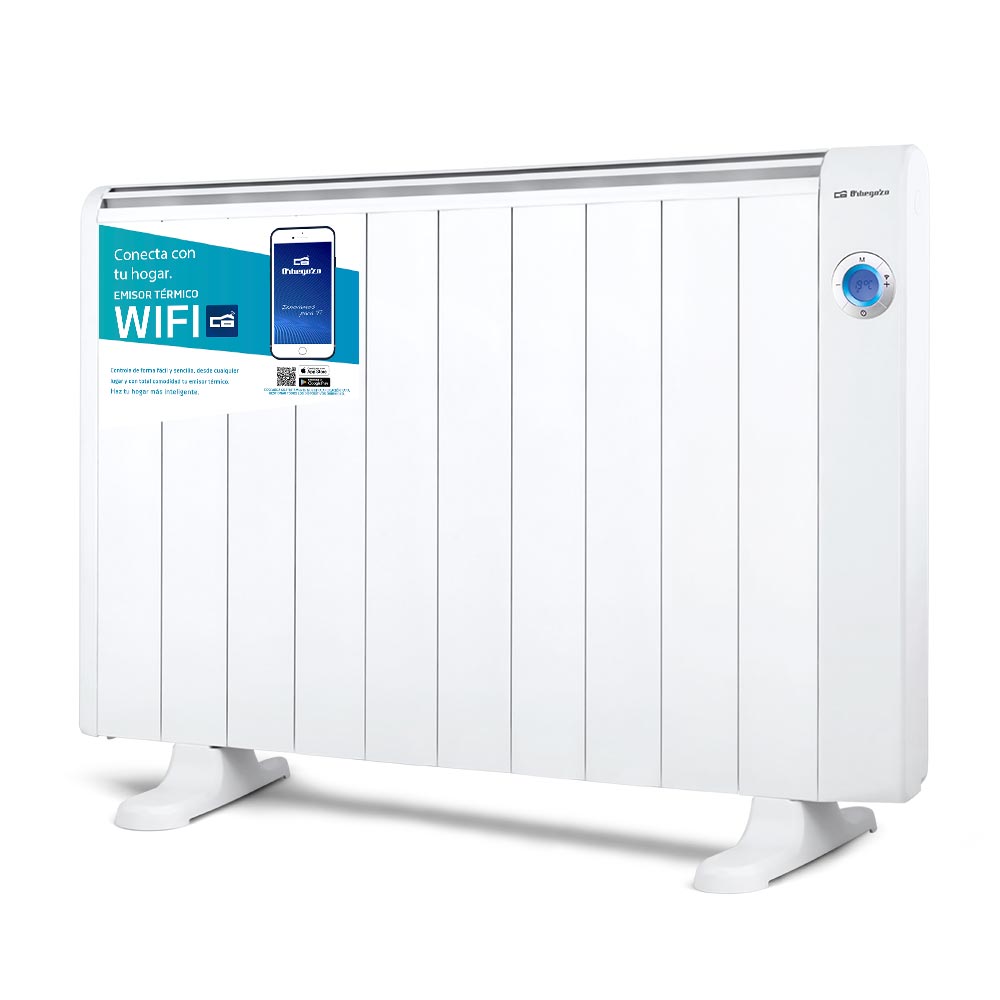
It is the king of sustained room heat. It has inertia (the elements keep giving off heat for a while after switching off), a fine thermostat and programming, so it cycles and doesn't use current needlessly. In addition, an 800 or 1000 W panel heater takes up little contracted power, which matters a lot in country houses with just enough power. For a bedroom or a medium sitting room, the Orbegozo RRW 1000 WiFi Panel Heater (1000 W, 6 elements) is more than enough; if the room is small, the RRW 800 saves you power; and for a large sitting room in a stone house, the RRW 1800 (1800 W, 10 elements) is the background heater you are looking for. Check the current price on each product page.
Halogen radiator: direct heat at once, no inertia
The Ártica 1200 W Halogen Radiator gives you heat the second you switch it on, like the sun: it warms what is in front of it, not the air. But it has no inertia (switch it off and the heat is gone) and no thermostat to moderate it. It is ideal for a short spell pointed at your armchair, for the study or for the bathroom. As continuous room heat it is not for you, because at full power it never stops.
Electric fire: you pay for the flame effect, not for more heat
The Orbegozo CM 8000 1800 W Electric Fire is lovely and gives a fire atmosphere that people like a lot. But let's be honest: as a source of heat it is a resistance heater like the rest, and at full power it reaches about €0.27/h because it is 1800 W. What you pay extra compared with a panel heater is not more heat: it is the flame effect. If you like that atmosphere, go ahead; if you just want cheap heating, there are better options.
Electric blanket: by far the cheapest
This is the one almost nobody takes into account and everyone should. The Daga Softy Single Electric Blanket uses about 60-120 W, which is €0.01-0.02 an hour. Ten times less than any room heater. The reason? It doesn't heat the room: it heats you. And you only need to be warm. For the last hours on the sofa or for bed it is unbeatable. Many homes in the Almanzora would save a fortune using the blanket more and the panel heater less.
The butane stove: the only one that can work out cheaper per kWh
And we come to the exception. The butane stove is the only heater on this list that can work out cheaper per kWh of heat than electricity. A 12.5 kg cylinder costs about €18 in 2026 and gives around 155 useful kWh. At full power (4200 W), an Orbegozo HBF 90 Blue Flame Gas Stove or an Infiniton HG-114 makes the cylinder last about 37 hours: that is about €0.12 an hour of heat at full blast. And it heats large rooms, up to 50 m², quickly and strongly, which no household panel heater can do.
It sounds perfect, but there is small print that the label doesn't tell you. And here safety counts for more than the euro.
The small print on butane (safety first)
Butane gives cheap heat, yes, but it burns the oxygen in the room and releases things into the air. These rules are not optional:
- Always ventilate. Leave a gap open in the room. The stove uses up oxygen and it has to be replaced. Never use it in a completely closed room.
- Never in a closed bedroom or bathroom. It is the golden rule. Not to sleep with it on, and not in the bathroom while you shower. Never.
- Water vapour and condensation. Burning butane produces moisture; you will see the windows steam up and, in time, mould in the corners if you don't ventilate. In an already damp stone house, take care.
- No fine thermostat. It doesn't cycle like a panel heater; you adjust it by settings and that's it. It is for warming up and then switching off, not for leaving on for hours fine-tuning the temperature.
- Rubber hose and expiry date. Check that the flexible hose isn't cracked and look at the expiry date on the rubber. An old hose is a real danger.
- CO detector. A carbon monoxide detector in the room is cheap and saves lives. Genuinely recommended, not just for the sake of saying so.
Two sums that change everything: contracted power and off-peak hours
Don't trip the ICP (contracted power)
In many country houses the contracted power is just enough. If you plug in an 1800 W panel heater while the ceramic hob, the oven or the washing machine is running, the ICP trips and you are left in the dark. That is why an 800 or 1000 W panel heater is sometimes more practical than an 1800 W one: it takes up less power and gets on better with the rest of the house. The butane stove has an advantage here: it uses no electricity, so it doesn't touch your contracted power.
With PVPC, make the most of the cheap midday
If you are on the regulated tariff (PVPC), the price of electricity changes hour by hour. In 2026 the average is around €0.13-0.14/kWh, but midday is usually much cheaper and the 8-9 pm peak is the most expensive. The trick: heat the room hard at midday or early in the afternoon, when electricity is dirt cheap, and at the evening peak rely on the blanket or on the panel heater's inertia. In a home that spends the whole afternoon heating, that move shows on the bill.
How to choose for your room
This is the criterion we apply at the counter, room by room and with concrete actions:
| Your situation | What suits you (with the sums done) |
|---|---|
| Large, poorly insulated sitting room in a country house, all afternoon | Panel heater with thermostat in the background (RRW 1800) + ventilated butane stove for the big burst at the start + blanket for the last hours on the sofa. The mix is what is cheap. |
| Bedroom, for sleeping | Safety comes first: NEVER butane in a closed room. A low-power panel heater (800 W) with a timer to warm the room before you go to bed, and an electric blanket or duvet for the bed. The cheapest and safest. |
| Bathroom, a short burst while showering | Electric towel rail or a halogen pointed at you, just for the time needed. NEVER butane. The Orbegozo THA 315 Towel Rail warms and dries towels without drying out the air. |
| Study / working from home, sitting still | Heat the person, not empty ceilings: a blanket over your legs or a halogen pointed at you. Don't heat the whole room just to sit on a chair. |
| Short spell in any room | Halogen for instant heat, or simply a fan heater for a quick burst (see the fan heater guide). |
You can see the whole range in our heating collection and compare powers and sizes at your leisure.
Why buy it at Híper Ocio
We are a family shop in Albox, fourth generation behind the counter. We know what the houses around here are like because they are our own: stone, countryside, no central heating and winters with cold nights. That is why, before selling you anything, we do the sum with you: the square metres of your room, the hours you use it and your contracted power. Sometimes the answer is that a blanket and a small panel heater will do, and we tell you so.
These heaters (panel heaters, radiators, blankets, electric fires and stoves) come with free nationwide delivery from €49.99 (they are portable, not van delivery or installation), a 3-year legal guarantee and, if it suits you better, financing that we arrange in the shop. And if you prefer to see it and have us work it out for you in person, call in at our physical shop on Avenida 28 de Febrero in Albox before buying: we size up the room and go over butane safety with you. Write to us at info@hiperocio.es and we will sort it out.
Frequently asked questions
What uses least to heat a whole room?
For the same wattage, all electric resistance heaters use the same per kWh of heat (about €0.15). The one that uses least in practice is the panel heater, because its thermostat switches it off when it reaches temperature. And the electric blanket uses ten times less than all of them, but because it warms you, not the room.
Is it true that a panel heater uses less than a halogen?
Yes, but not because it is more efficient. Both turn 100% of the electricity into heat. The panel heater uses less per month because its thermostat switches it off and on (it cycles), while the halogen is at full power the whole time it is on.
Is a butane stove cheaper than an electric one?
Per kWh of heat, yes: a 12.5 kg cylinder (about €18, around 155 kWh) works out at about €0.12 an hour at full power, against €0.15 for electricity, and it heats large rooms very quickly. But it needs ventilation, produces moisture, has no fine thermostat and must never be used in a closed bedroom or bathroom.
Can I leave a butane stove on overnight in the bedroom?
No, never. A butane stove uses up oxygen and can produce carbon monoxide. It must not be used in closed bedrooms or bathrooms, and always with ventilation. For sleeping, use an electric blanket or duvet and, if need be, a panel heater with a timer.
What is the cheapest way of not being cold on the sofa?
The electric blanket, no contest. It uses about 60-120 W (€0.01-0.02 an hour) because it warms you directly. The ideal is a panel heater in the background to keep the room liveable and the blanket for the last hours on the sofa.
What panel heater power do I need so the ICP doesn't trip?
It depends on your contracted power. In country houses with just enough power, an 800 or 1000 W panel heater gets on better with the rest of the house than an 1800 W one. If you are going to use several appliances at once, choose a lower power or spread their use over different hours.