Which Heater to Buy: Why "the One That Uses Least" Is a Myth
Eleven at night in January in the Almanzora. The house is built of stone, the kind that has been standing since before you were born, and by this hour the cold has settled into the walls. You have an early start tomorrow and the bedroom is freezing. You are not going to knock through walls at this stage to install central heating, and there would be no point anyway. You want one thing: to warm one room, and to warm it now.
So you open Google with the question everybody asks: "which one uses least?". And here is the honest shopkeeper's answer, the one that is sometimes uncomfortable: at the same wattage, none of them. A 2000 W heater uses 2 kWh every hour, whether it is a ceramic fan heater, an oil-filled radiator or a thermal emitter.
That does not mean it makes no difference what you buy. It means the question is the wrong one. The saving does not live inside the appliance, it lives in how and where you use it. In this article I explain first why that is (the physics takes one paragraph), then where you really do save, how to get the wattage right and which type makes sense in each room of your home.
First question: who are you warming, and in which room?
Before talking about watts, be clear about what you want to do, because everything else follows from that. In inland Almería the winter is odd: deceptive days, with sun and a pleasant temperature, and damp nights that get into your bones. Houses of stone and old brick cool down fast as soon as the sun goes, and, worse, they take a long time to warm up again. That is why here inertia (an appliance's ability to keep giving off heat for a while after it is switched off) matters more than in a new, well-insulated flat.
The second golden question is: who are you warming? Warming one person (you, in the office, two hours in front of the computer) is not the same as warming a whole room (the living room, the whole family, all afternoon). An appliance that warms one person instantly is pointless for a living room, and a slow, steady heater is torture if all you want is a quick blast in the bathroom. Be clear on that answer and you have already ruled out half the shop.
"Which one uses least?": the uncomfortable answer
Here is the physics in thirty seconds. All electric heaters work through what is called the Joule effect: they pass current through a resistance and that resistance gets hot. The consequence is devastating for the marketing:
All electric heaters have an efficiency close to 100%: 1 kWh of electricity becomes 1 kWh of heat. There are no losses anywhere, because the "waste" of a heater is, precisely, heat. A car engine wastes energy as heat; a heater cannot waste it, because heat is its product.
From that comes the sentence you should have in mind before buying anything:
At the same wattage, a 2000 W heater uses 2 kWh per hour, whether it is a ceramic fan heater, an oil-filled radiator or a thermal emitter. What changes is how it spreads and holds the heat, not how much it uses per hour.
So when you see "low consumption" on a box, translate it: it almost always means "low wattage" (a 1000 W appliance uses half as much as a 2000 W one, yes, but it also heats half as much) or "has a good thermostat" (which is where you really save, and we will get to that now). No type of resistance is magically more efficient than another. Anyone who tells you otherwise either does not know or would rather you did not.
So where is the real saving?
If the appliance does not save by itself, what does? This does matter:
The saving is not in the type of heater, but in the thermostat, in insulating the room and in heating only where you are.
Broken down, there are four concrete levers:
- Thermostat and timer. A heater without a thermostat blasts away whether the room is at 15 or 24 degrees. One with a thermostat switches the element off when it reaches the temperature and only switches it back on to maintain it. That switching off is, literally, kWh you do not use. A timer goes a step further: it starts warming the bedroom fifteen minutes before bedtime and switches off by itself once you are asleep.
- Insulating the room. Heat escapes wherever it can. Lower the shutters at dusk (the air gap between glass and shutter helps slow the loss), put draught excluders on gaps around doors and windows and close the door of the room you are heating. In a stone house, this makes the difference between warming the room and warming the neighbourhood.
- Heating only where you are. The big saving of portable heating compared with central heating is exactly this: you do not heat six empty rooms to sit in one. Move the appliance with you, or have a suitable one in each area you use.
- Sizing the wattage properly. An appliance that is too small does not get there and runs at 100% all night; a well-sized one reaches the temperature and rests. That is what the next section is about.
How to get the wattage right: the 80-100 W/m² rule
Buying a heater with fewer watts than the room needs is the most common mistake. It seems like you "use less", but it runs flat out without ever reaching the temperature, and you end up worse off. You need a simple reference:
Practical sizing rule: 80-100 W/m² with 2.5 m ceilings in a poorly insulated house in inland Almería.
How to apply it:
- A 12 m² bedroom needs in the region of 1000-1200 W.
- A 20 m² living room goes to 1600-2000 W (here it is often better to split the load between two appliances or fit one large emitter).
- A small 4-5 m² bathroom gets by with 400-1000 W depending on how long you take.
Honest caveats: if your house is well insulated, with modern windows and no draughts, go down towards 80 W/m² or even less. If it is an old house with thick walls, high ceilings or a north-facing wall onto the street, aim for 100 or above. And mind the ceilings: the rule assumes 2.5 m; if yours are 3 m or more, there is more air to heat and you need to add some. It is a guide to avoid choosing the wrong category, not an engineering formula.
The five types, no hype: what each one is for
We already know they all use the same per watt. What sets them apart are five real criteria, and these are the ones to look at: speed (how long it takes to give you heat), inertia (how long it keeps it after being switched off), comfort (dry heat with the noise of moving air, or soft and steady), noise and safety. With that grid, the five types:
Ceramic fan heater (PTC)
- Speed: very high, it heats instantly. Inertia: none. Comfort: it moves and dries the air, the heat rises and goes. Noise: some, it has a fan. Safety: good, there are models with bathroom protection.
- Use it if you want an immediate blast of heat in a bathroom or when walking into a freezing room. Do not use it if you want steady heat all afternoon in the living room.
Halogen heater
- Speed: immediate, but it warms bodies, not the air. Inertia: none (step away and that is it). Comfort: directed heat, orange light. Noise: silent. Safety: the element glows red, so take care with children and pets.
- Use it if you want to warm yourself, in a fixed spot, right now. Do not use it if you want to take the chill off a whole room.
Oil-filled radiator
- Speed: slow, it takes a while to get going. Inertia: a lot, it keeps giving heat for a good while after being switched off. Comfort: excellent, soft and steady heat without drying the air. Noise: none. Safety: hot surface but no element exposed to the air; it is heavy.
- Use it if you want constant heat in a bedroom or a room you use for a long time. Do not use it if you want it for a quick five-minute blast.
Thermal emitter
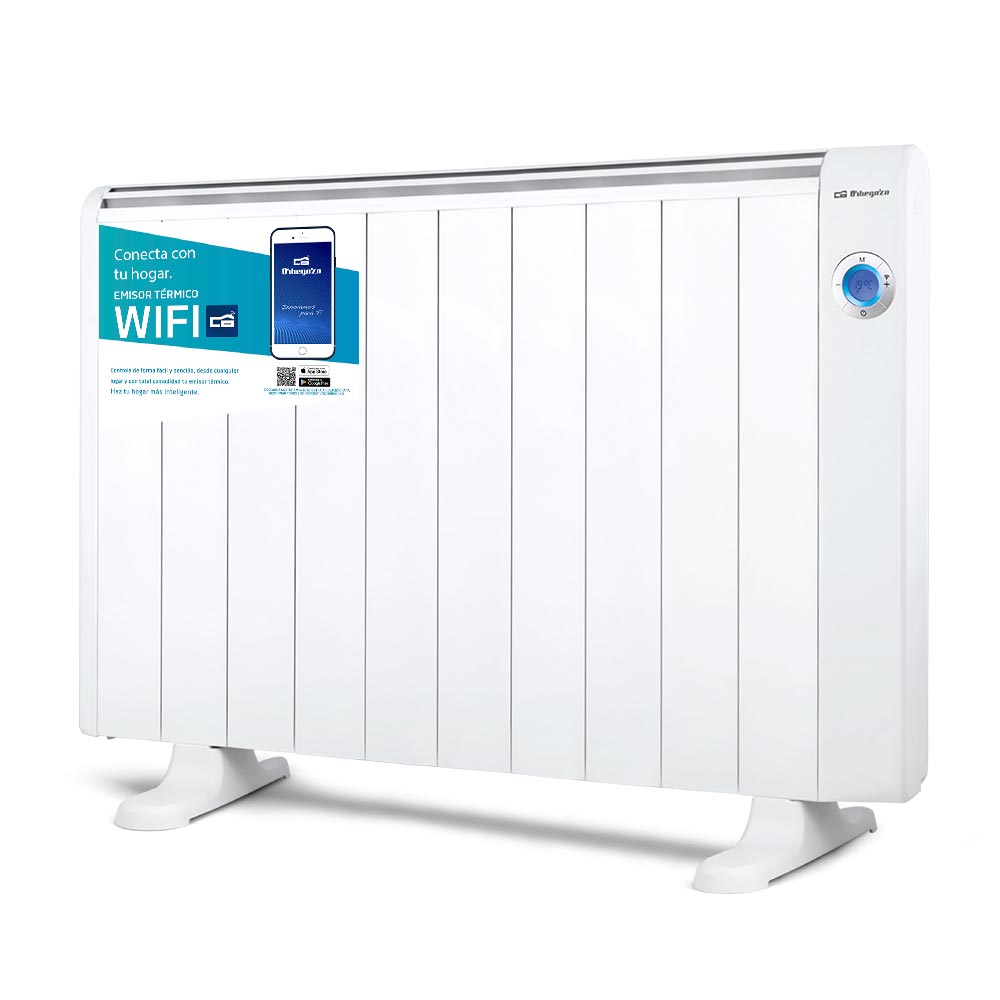
- Speed: medium. Inertia: good. Comfort: very good, steady and adjustable heat. Noise: none. Safety: good. Its real advantage is the precise electronic thermostat, the timer and, on many, WiFi control.
- Use it if you are going to heat the same space for several hours a day and want to program it. Do not use it if you only need occasional heat in short bursts.
Convector heater
- Speed: medium start-up. Inertia: low. Comfort: spreads heat by convection, simple. Noise: silent. Safety: good.
- Use it if you want something simple to take the chill off a medium-sized room. Do not use it if you want inertia to hold the heat in the early hours.
If you look closely, the thermal emitter and the oil-filled radiator are cousins: both give steady, silent heat. The difference is that the emitter adds a brain (precise thermostat and programming), and that is where you win back part of the running cost. You can see the range of emitters in models such as the Orbegozo RRW 500 WiFi or the RRW 800 WiFi for small rooms.
Which heater to buy for each room
This is the mental table we use at the counter when someone tells us which room it is for. Keep it handy:
- Bathroom → ceramic PTC or towel warmer. You want instant heat for the ten minutes you are showering and dressing, and safety near water. A towel warmer like the Orbegozo THA 315 dries your towels and warms the room; if you prefer to mount it on the wall and free up floor space, the Orbegozo SP 6200 PTC wall heater gives you that blast of heat straight away, and if you want it with a timer, the programmable SP 6000.
- Bedroom → oil-filled radiator or thermal emitter. You are looking for steady, silent heat all night, with no fan noise and no dry air. The oil-filled radiator does the job; the thermal emitter does it just as well and can also be programmed to switch itself off. Take a look at the Orbegozo RRW 1000 emitters for an average-sized room.
- Living room / long use → programmable thermal emitter. It is where you spend the most hours, so comfort and programming come first. A large emitter with WiFi like the RRW 1800 is the most comfortable for several hours in a row.
- Office / corner → halogen. It is just you, in a fixed spot, and you want heat on your body now, without waiting for the room to warm up. The Ártica AH1201 1200 W does exactly that.
If you want a single portable solution for several areas, a horizontal ceramic heater like the Orbegozo FH5033 gives you versatility, though without the inertia of an emitter.
When you cannot depend on the mains: the butane gas heater
There are cases where the plug socket is not the best option: country houses with limited supply, power cuts in winter or large rooms where you need a lot of heat at once. That is where the butane gas heater comes in. It heats a great deal and works without depending on the electricity grid. Models such as the Infiniton HG-114 4200 W or the Orbegozo HBF 90 blue flame (up to around 50 m²) are the ones that sell most around here.
Now the downsides, which have to be said: a gas heater uses up oxygen from the air and produces moisture and carbon monoxide. That calls for three rules that are not optional:
- Always ventilate. Leave a gap for air in the room. Do not switch it on in a sealed room.
- Never in closed bedrooms and never leave it on while you sleep.
- Watch the damp. In houses that are already damp, the steam from the heater can end up as condensation on the walls.
Used properly, in a large, ventilated living room or as a backup for when the power fails, it is a fine tool. A battery-powered carbon monoxide detector, which costs little, is the best peace of mind you can buy if you are going to use it regularly.
Safety, and how you buy at Híper Ocio
Before plugging anything in, four safety rules that apply to all electric heaters:
- Tip-over and overheat protection. Buy appliances that cut out by themselves if they fall over or get too hot. It is the basics, and every one we stock has it.
- Do not cover them. No clothes drying on a convector heater, no curtain brushing against the halogen. The heat has to get out.
- No cheap power strips or extension leads with 2000 W. A powerful heater draws a lot of current; plug it straight into the wall. A poor-quality power strip is one of the silliest causes of a scare.
- Take care with children and pets near the halogen. Its element glows red hot. Place it high or out of their reach.
And now, the buying part:
- 3-year legal guarantee on everything we sell, as the law requires in Spain. We do not sell you "extended warranties" that you already have by right.
- Delivery. Portable heaters, emitters, halogens and towel warmers come with free nationwide delivery from €49.99: they are small appliances and travel well. The large gas heaters, on the other hand, we only deliver with our own van in the Valle del Almanzora, Levante Almeriense and Los Vélez, because they are bulky and we prefer to deliver them ourselves.
- 30-day returns under our returns policy.
- Financing available if you prefer to spread the payment; we explain it in the shop without small print.
Why Híper Ocio
We are a family shop in Albox, open since 1923: more than a hundred years behind the counter, and we are now on the fourth generation, with Antonio Martínez Rosado at the helm. That is not a slogan, it is the reason why, instead of selling you the most expensive appliance, we first ask which room it is for and who it is going to warm. When you have been behind a counter for that long, you know that a customer you sell what they need to comes back, and one you push what they do not need to does not.
If you have doubts about the type or the wattage, drop by the physical shop at Avenida 28 de Febrero s/n, Albox, or message us on WhatsApp at 623 04 44 20 and we will tell you honestly what suits your home.
Frequently asked questions
Which heater uses the least?
At the same wattage, none of them. All electric heaters have an efficiency close to 100%, so a 2000 W appliance uses 2 kWh per hour whether it is a ceramic fan heater, an oil-filled radiator or a thermal emitter. What changes is how they spread and hold the heat. The real saving is in the thermostat, in insulating the room and in heating only where you are.
How many watts do I need for my room?
A practical rule is 80 to 100 W per square metre, with 2.5 m ceilings in a poorly insulated house in inland Almería. A 12 m² bedroom needs in the region of 1000-1200 W. If your house is well insulated, go down towards 80 W/m²; if it has thick walls or high ceilings, go up.
Which heater is best for the bedroom?
An oil-filled radiator or a thermal emitter, because they give steady, silent heat for hours with no fan noise and without drying the air. The thermal emitter adds a thermostat and timer, so you can let it switch itself off once you are asleep.
Can I use a heater in the bathroom?
Yes, but only with appliances designed for it, such as a ceramic fan heater with suitable protection or an electric towel warmer. They give instant heat and are designed to work near water. Never use an ordinary heater without protection in the bathroom.
Is a butane gas heater dangerous in the home?
Used properly, no. But it uses up oxygen and produces moisture and carbon monoxide, so it always needs ventilation and must not be left on in closed bedrooms or while you sleep. It is very useful when you cannot depend on electricity, always with those precautions.
Do heaters come with a guarantee and delivery?
Yes. All of them come with a 3-year legal guarantee. Portable heaters, emitters and halogens have free nationwide delivery from €49.99. The large gas heaters we only deliver with our own van in the Valle del Almanzora, Levante Almeriense and Los Vélez.
Updated in September 2026: if you want to work out the fine detail of what it costs to keep a room warm all afternoon (euros per hour for each appliance, electricity versus a butane bottle, and how your contracted power and off-peak hours come into it) you will find it broken down with tables in How to heat a room in winter: the sum nobody does.