Which electric water heater to buy in the Almanzora, and how many litres
A neighbour from Zurgena came in with the plumber's receipt in her hand and an eight-year-old water heater that had died the evening before. The plumber had taken it apart and shown her the heating element: it wasn't broken or burnt, it was wrapped in a white crust as thick as a finger. Limescale. The well and mains water in the valley is excellent to drink, but inside a water heater it behaves like slow sandpaper, gradually blocking the element until the appliance chokes on its own sediment.
If you live in Albox, Cantoria, Arboleas, Huércal-Overa or any other town in the Almanzora, the scene will sound familiar. Here water heaters don't die of old age: they die of limescale. So choosing well isn't about brand or price alone, but about two concrete things: how many litres you really need and which components will stand up to our water without giving in by the third winter.
I'll tell you what I tell anyone who walks into the shop, with the numbers that matter, and saying what I would want someone to tell me. We start with the limescale, move on to the litres, and then to the two parts that make the difference in hard water. Maintenance and installation come last, because that is where it is decided whether the appliance lasts ten years or four.
Why Almanzora water eats water heaters before their time
Limescale is calcium carbonate dissolved in water. While the water is cold it stays in suspension and does no harm. As soon as you heat it, it precipitates and sticks to the hottest surfaces of the tank, which are the element and the walls around it. In a soft-water area this happens slowly. In the Almanzora, with very hard water, it happens fast.
The problem isn't cosmetic. That crust acts as insulation between the element and the water: heat has a hard time getting through it, so the element has to run for more minutes to reach the same temperature. That drives up consumption and, at the same time, overheats the element itself until it burns out. The limescale insulates, the appliance uses more, the element suffers more, and one day it gives up.
That is why, in our area, the underlying technical decision isn't only how many litres, but which type of element and which anode sit inside. A badly chosen water heater here lasts four or five years; a well chosen one, with a little maintenance, lasts more than twice that. And there is a consequence you won't see on the label: every millimetre of limescale on the element is money leaving your bill every month. In hard water, consumption and limescale are the same conversation.
How many litres you need: the 30-40 L per person rule
This is where most people get it wrong, and in both directions. Some buy a small water heater to save money and run out of hot water the second person showers. Others buy a huge one just in case and pay every month to heat litres they never use.
The practical rule is simple: allow between 30 and 40 litres per person for a daily shower. From there, this table will help you place yourself:
- 1 person: 30-50 litres. A small flat or a couple who shower at different times.
- 2 people: 50-80 litres. The best-selling size for flats and couples.
- 3-4 people: 80-100 litres. The typical family in the valley.
- 5 or more, or with a bath: 100-150 litres. Large houses, or if you fill the bath often.
The nuance: better to go a little over than to fall short, because falling short means cold showers and arguments. But don't oversize for no reason. A water heater that is too big keeps a lot of water hot that you don't use, and you pay for that standing loss all year round, not just when you turn on the tap. The right point is the one that covers your peak use with a small margin.
One fact that helps you decide: a 1500 W water heater takes roughly two and a half to three hours to heat 80 litres from cold, and in winter the water coming in here is cold, so it leans towards three. It doesn't heat instantly; you programme it so the water is ready when you need it. That is why sizing goes hand in hand with your routine: if several of you shower one after another in the morning, you want the tank to cover that peak in one go.
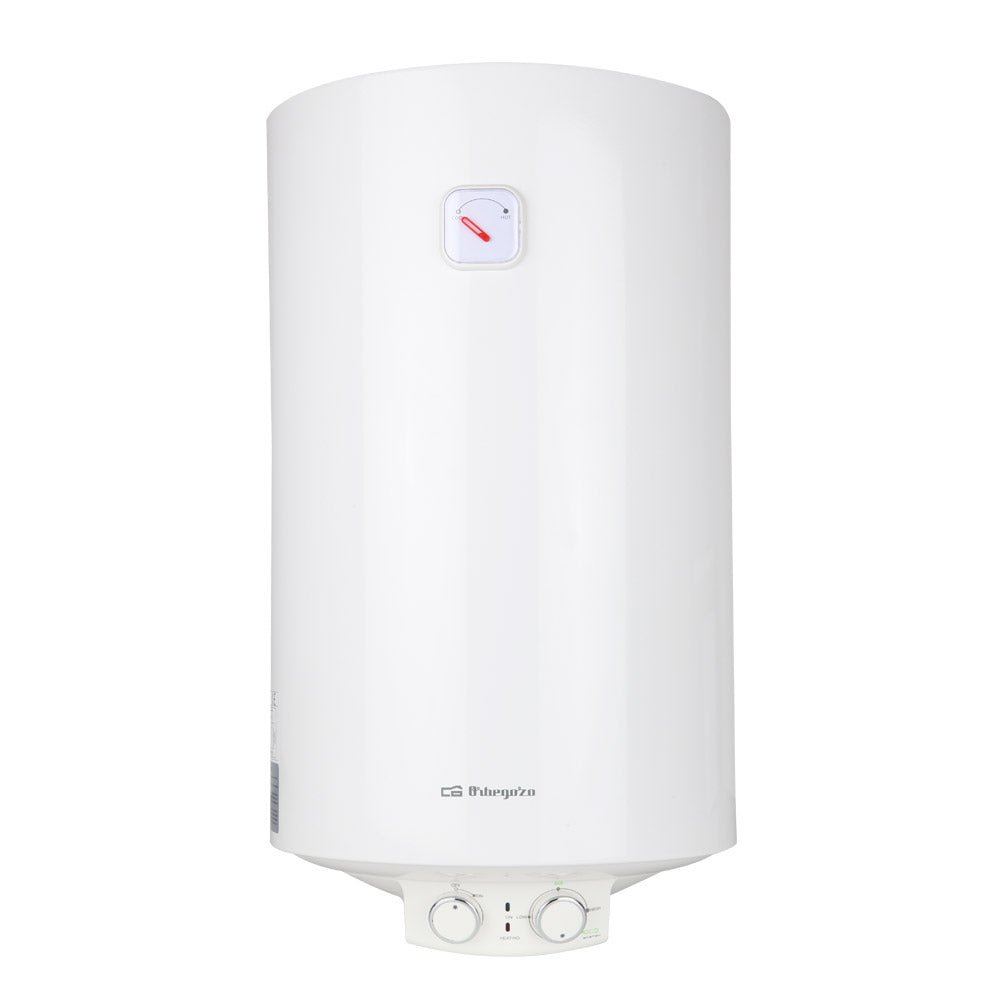
For a family of 3-4 people, which is the most common case around here, the Orbegozo TRM 84, 80 litres, vertical, 1500 W falls right in that 80-100 litre range. It is one of the models we fit most in houses across the valley, precisely because the capacity suits the average family. If there are one or two of you and you want something more compact, our catalogue also has the 30-litre Infiniton with dual positioning, useful for small flats or second homes.
Sheathed or ceramic element: the choice you notice most here
For our water, this is the point that costs or saves the most over the years. There are two main types of element.
Sheathed or armoured. The classic and the cheapest. It sits submerged directly in the tank water. It heats well, but being in contact with the water, limescale sticks to it without fail. In soft water it lasts more than long enough; in the Almanzora it is the first to fill with crust and the first to fail. If you choose one for budget reasons, expect maintenance to come sooner.
Ceramic, dry or steatite. Here is the trick. The element sits inside a ceramic sleeve, so it doesn't touch the water: it heats the sleeve and the sleeve heats the water. Because the electrical element doesn't touch the water, limescale can't stick to it, and you can also change the element without emptying the tank. It costs a little more up front, but in very hard water like ours it lasts considerably longer and gives fewer nasty surprises.
In a soft-water area I would tell you: buy the sheathed one and save. Here in the Almanzora, the dry or ceramic one pays for itself, because our water punishes the submerged type without mercy. The TRM 84 we fit has a magnesium anode and a protected element, and with the check we cover below it performs well in the valley; if the budget stretches to a steatite one, better still.
The sacrificial anode: magnesium that wears away, or titanium
Inside the tank there is a part almost nobody has heard of until their water heater starts to leak: the sacrificial anode. Its job is to corrode itself before the steel of the tank does, so that the tank doesn't pit. It wears away on purpose so the water heater doesn't have to.
Magnesium anode. The classic, fitted to most mid-range water heaters, including the Orbegozo TRM 84. It works very well, but it is consumed, and in hard water it is consumed faster. That is why here it pays to check it every one or two years: if it is badly worn, it is replaced (it is a cheap part) and the tank stays protected. The most expensive and most avoidable failure we see is from people who never checked it: the anode was used up completely, corrosion went for the tank and the water heater ended up pitted and dripping. A few euros of anode would have saved the whole appliance.
Titanium or impressed-current anode. The high-end version. It doesn't wear away, because it protects the tank with a small electric current instead of sacrificing material. For very hard water it is ideal, because you can forget about checking it. It makes the water heater more expensive, but if you want to fit it and forget about it for many years, it makes sense here.
For the valley, the rule is short: if it has a magnesium anode, which is normal, put the check in your calendar. If you can afford it, titanium takes that maintenance off your hands.
Temperature: why 55-60 °C is the balance
The thermostat is more involved than it looks, and in hard water even more so. The general recommendation is to set it between 55 and 60 degrees, and it isn't a random number:
- Below 55 °C you use a little less, but there is a higher risk of bacteria such as legionella growing in the stagnant water of the tank.
- Above 60-65 °C you use more energy and, above all, far more limescale forms: the hotter the water, the faster the carbonate precipitates. Turning the thermostat to the maximum in the Almanzora speeds up the crust on your element.
That range of 55 to 60 degrees is enough for health safety without driving up consumption or limescale formation. Many water heaters also have an anti-legionella function that raises the temperature occasionally to sanitise the tank and then returns to the normal setting: you get the everyday balance and the cleaning when it is due.
Vertical, horizontal or reversible: where it fits in your home
The position isn't just a question of space; it affects performance.
Vertical. The normal installation and the one that performs best. Hot water rises and cold water stays at the bottom, with a clean separation, so you use almost the whole tank before it starts to come out lukewarm.
Horizontal. Used when there is no height: false ceilings, lofts, spaces under the stairs. Lying down, the hot and cold water mix more inside the tank, so it gives slightly less useful hot water than the same capacity installed vertically. It isn't a disaster, but if you are tight on litres, better not to fit it horizontally.
Reversible. Many current models accept both positions, which gives you room if you aren't sure about the space or if you are going to renovate. The Orbegozo TRM 84 is vertical, which is how it works best, and the 30-litre Infiniton has dual positioning, designed for awkward spaces. Before buying, measure properly where it will go: often the ideal capacity doesn't fit in the available space, and it is better to know before than after. When we go to install, it is the first thing we measure.
Consumption and your bill: always tied to limescale
Many guides treat consumption separately, as if it were a loose fact. In hard water you can't: consumption is tied to limescale and to sizing.
Start with the label. Water heaters carry an ErP energy label with a class (from A to G) and a load profile (M, L, XL...) that indicates the volume of hot water the appliance is designed for. Choose the most efficient class you can within the capacity you need, not the other way round: a good letter is no use if the profile doesn't match your real use. The TRM 84, for example, is class C, a simple, unpretentious element water heater that does the job for the average family.
The second factor is insulation. A good water heater has a thick layer of polyurethane foam around the tank, which reduces standing loss, that is, the heat that escapes while the water waits for you to use it. The better it insulates, the less often the element switches on just to keep the temperature. And here sizing comes back: an oversized water heater has more water to keep hot, so it penalises you twice if the insulation is weak.
The third factor, and the one that counts most around here, is limescale. The crust on the element forces the appliance to work longer to heat the same amount, so a water heater with a scaled-up element can use quite a bit more than the day you installed it, without any change in your habits. In the valley, maintenance isn't just about extending the life of the water heater: it is about keeping your bill in check.
A concrete saving tip: if you have a tariff with off-peak hours, use the water heater's timer or programmer so it heats in the early hours, when electricity is cheaper. You combine a full tank for your morning shower with the kilowatt at its best price. Many mid-range models already include it.
Maintenance in hard water: the part people skip
The good news is that maintenance is simple and cheap compared with what a new water heater costs. The essentials are three actions:
- Drain the sediment from time to time. A sludge of limescale and rust builds up at the bottom of the tank. Flushing the water heater removes that sediment before it compacts and damages the element or the thermostat. In very hard water, do it more often than in soft-water areas.
- Check the magnesium anode every one or two years. It is the part that sacrifices itself; replacing it in time saves the tank. One of the most worthwhile things you can do.
- Watch for the signs: the water takes longer than usual to heat, comes out cloudy or with particles, you hear cracking or bubbling (usually limescale breaking away) or the bill goes up for no reason. Any of these calls for a check.
None of this requires you to be a DIY expert: it is a technician's job and takes a short while. Most water heaters that die young in the valley die because these three actions were skipped.
Installation and safety: what isn't negotiable
An electric water heater isn't a plug-in-and-go appliance. It needs a water supply, a drain and a proper socket, and an installation done with care. The points that are never skipped:
- Safety or non-return valve. Mandatory. When heated, water expands and the pressure inside the tank rises; this valve releases the excess. Without it, it isn't installed.
- Its own stopcock. Highly recommended, so you can shut off the water to the water heater without cutting off the whole house when maintenance is due.
- Expansion vessel in areas of high mains pressure, to absorb the expansion and avoid stressing the installation.
- Adjustable thermostat and overheating protection, which any decent water heater already includes.
Because we are dealing with water and electricity together, the installation is done by a technician. It isn't to sell you the service: a leak or a badly fitted valve costs far more than a properly done installation. A water heater is a large appliance, one that is fitted, not a parcel left at the door.
Why Híper Ocio
We are a family shop in Albox, on Avenida 28 de Febrero, and we have been at this since 1923: nearly a hundred years in the trade and now in the fourth generation, with Antonio Martínez Rosado at the helm. Applied to a water heater, that means something concrete: we don't sell you the most expensive or the biggest, but the one that suits your space, the people in your home and the water that comes out of your tap.
We deliver and install the water heater ourselves with our own van across the Valle del Almanzora, the Levante Almeriense and Los Vélez. It isn't an appliance we send by courier to the other end of Spain: it is a large appliance that is fitted in your home, with its safety valve, its stopcock and a check that everything works before we leave. We work the area we know and where we can stand behind what we do.
All our appliances carry the 3-year legal guarantee, and if something doesn't suit you, you have 30 days under our returns policy. If you need to spread the payment, we arrange financing for appliances at the physical shop in Albox, by appointment. And if you prefer to see it in person, come and look at our heating and efficient comfort section, the Spanish Infiniton appliances or the 80-litre Orbegozo TRM 84 that so many families in the valley already have fitted. For specific questions, message us on WhatsApp at 623 04 44 20 and we'll tell you which capacity suits you.
Frequently asked questions
How many litres of water heater do I need for the people in my home?
Allow about 30-40 litres per person. As a guide: 1 person, 30-50 L; 2 people, 50-80 L; 3-4 people, 80-100 L; 5 or more or with a bath, 100-150 L. Better to go a little over than fall short, but without oversizing, because a water heater that is too big uses more keeping hot the water you don't use.
How long does an electric water heater last in the Almanzora with such hard water?
It depends mainly on the type of element, the anode and the maintenance. One with a sheathed element and no care can last four or five years; one with a ceramic or dry element, a good anode and maintenance (draining sediment and checking the anode) can last considerably more than twice that. In hard water, maintenance makes the difference.
Does an electric water heater use a lot of electricity?
Consumption depends on the energy class (ErP label), the polyurethane insulation, the temperature set and, in our area, very much on limescale: a scaled-up element uses more to heat the same amount. Setting the thermostat to 55-60 °C and heating in off-peak hours with the timer helps bring the bill down.
Which element is better for water with a lot of limescale?
The ceramic, dry or steatite one, because it sits inside a sleeve and doesn't touch the water directly, so limescale doesn't stick to it the way it does to a submerged sheathed element. It costs a little more, but in very hard water like the Almanzora's it lasts longer and breaks down less.
Is a vertical or horizontal water heater better?
Vertical performs better because hot and cold water separate more cleanly. Horizontal is used when there is no height (false ceilings, lofts), but it mixes the water more and gives slightly less useful hot water. There are reversible models that accept both positions.
Can I install the water heater myself?
It isn't recommended. It needs a water supply, a drain, a socket, a stopcock and a mandatory safety valve, and you are working with water and electricity at the same time. A technician installs it; we deliver and install it with our own van in the Valle del Almanzora, the Levante Almeriense and Los Vélez.