Which Scooter to Buy for a Child: 3 Wheels or 2, Age, Height and Safety (2026 Guide)
Every September the same thing happens in the shop: a parent walks in holding a child's hand and says "I'd like a scooter". And the first question we ask is not what colour the child wants, but how old they are and how tall. A scooter that doesn't suit the child's age ends up in the storeroom within two weeks, and that's no use to anyone.
The scooter is probably the toy with the best fun-per-euro ratio that we sell. For €25-40 a child gets months of afternoons outdoors, real exercise and better balance. But it is also one of the products where it is easiest to get it wrong: a 3-wheeler is too small for an 8-year-old on day one, and a 2-wheel aluminium scooter for a 3-year-old is a guaranteed fall.
This guide is what we tell people at the counter in Albox, put in writing: when to choose 3 wheels and when 2, what aluminium, ABEC bearings and PU wheels really mean, what the 2026 regulations say (which are NOT the ones for electric scooters, although everyone mixes them up) and which models we have in stock right now for each case.

First of all: your child's scooter is NOT a personal mobility vehicle (VMP)
This needs clearing up because it causes a lot of confusion, and in 2026 even more. Scooters without a motor that are designed for children are classed as toys, not as Personal Mobility Vehicles. All the rules you may have read about electric scooters (compulsory insurance since January 2026, registration in the Register of Light Personal Vehicles, the minimum age of 15 that comes into force on 1 October 2026, the ban on riding on pavements) do not apply to a push scooter.
A 4-year-old on a 3-wheel scooter is, as far as traffic is concerned, a pedestrian. They can ride on the pavement with an adult. What does apply is common sense: a wide pavement, walking pace and respect for other pedestrians.
The other side of it: what you should check on the box is the CE mark and the manufacturer's recommended age. Children's scooters are made under the European toy safety standard (EN 71), and that minimum age is not a sales suggestion: it relates to the maximum weight the frame can take and the minimum height of the handlebar.
3 wheels or 2: the only decision that really matters
Everything else (the character, the colour, the lights) is secondary. This is not.
3-wheel scooter: roughly from 2 to 5 years old
Two wheels at the front, one at the back (or the other way round). The child doesn't have to keep their side-to-side balance: the scooter holds itself up. Most of them steer by leaning the body, which is exactly the movement that will later help with a bike. They are almost everyone's first scooter.
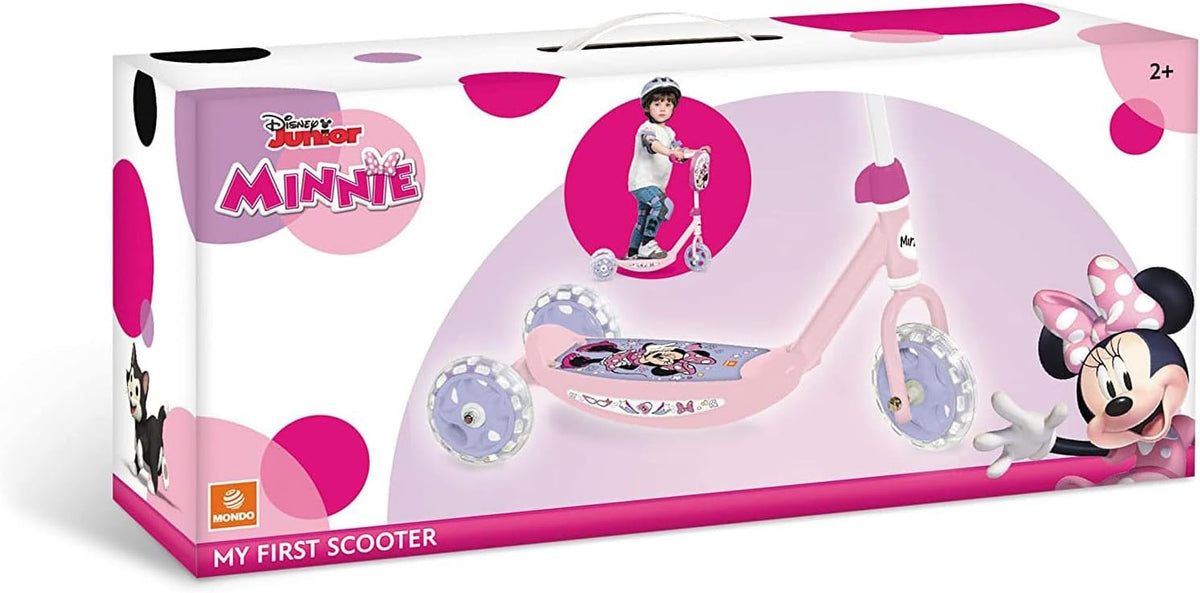
Signs that your child needs a 3-wheeler: they can't yet ride a bike without stabilisers, they are under 5, or they have never got on anything with wheels. In this group we work with the Moltó My First Scooter blue (€23.99), which is the simplest and the one we recommend most from 2 years old, and with the licensed Mondo range: the Minnie Mouse 3-Wheel Scooter Mondo 28690 (€27.99), the First 3-Wheel Scooter Mickey Mouse Mondo 28689 (€26.99), the First 3-Wheel Scooter Spiderman Mondo 28692 (€27.99) and the Bebés Llorones 3-Wheel Scooter Mondo 28722 (€24.99).
Take a look at the figures for the Spiderman 28692, because they are typical of the whole category: handlebar adjustable from 58 to 65 cm, 120 mm polyurethane wheels and a maximum weight of 20 kg. That 20 kg is the real limit: a 6-year-old is usually around 21-23 kg and the scooter starts to be a tight fit.

2-wheel scooter: from 5-6 years old
Here the child already has to balance. In return it goes faster, turns better and, not a small point, a child of 9 won't be embarrassed to take it to the park. Almost all of them are foldable aluminium with a telescopic handlebar, so they last several years and fit in the boot of a car.
The sign that it's time: the child rides a bike without stabilisers with confidence. If that has already happened, the 3-wheeler will be too small for them.
Of the ones we have in stock, the Dragon Ball Foldable Aluminium Scooter Mondo 28705 (€34.99) is the one that sells most this year, followed by the Spiderman Aluminium Scooter Mondo 28687 (€34.99) and the Sonic Aluminium Scooter Mondo 28708 (€34.99). For girls, the Frozen Aluminium Scooter Mondo 28221 (€34.99) and the Unicorn Aluminium Scooter Mondo 28693 (€27.99). And if the child is really going to use it every day, the Moltó City Scooter red (€25.99) is the most "street" one of all: less character, more use.
Compare the Frozen 28221 figures with those of the 3-wheel Spiderman: handlebar from 72 to 76.5 cm, ABEC-5 bearings, rear foot brake and up to 50 kg load. It's a different league. A 10-year-old weighing 35 kg can use it without a problem.

And the unusual case: under 2 years old
For 12-24 months a pure scooter is no good: they have neither the strength nor the control. What works are the convertibles that start as a sit-on ride-on and then turn into a scooter, such as the Chicco 2-in-1 Convertible Scooter (€49.99) or the Chicco Ducati 3-wheel convertible scooter (€36.99). They last two stages instead of one, and that justifies the price.
The quick table: age, height and what to buy
- 1 to 2 years (75-88 cm): convertible ride-on/scooter. Don't look for a "normal" scooter, they won't be able to handle it.
- 2 to 3 years (85-98 cm): 3 wheels with a low handlebar, from 55-58 cm. Wide wheels and a broad base.
- 4 to 5 years (100-115 cm): 3 wheels with an adjustable handlebar up to 65-70 cm. If they already ride a bike well, you can consider a 2-wheeler.
- 6 to 8 years (115-130 cm): 2 aluminium wheels, handlebar 70-80 cm, rear brake essential.
- 9 to 12 years (130-150 cm): 2 aluminium wheels with a handlebar up to 90-95 cm and wheels of 120 mm or more. Always check the maximum weight supported.
A rule of thumb we use in the shop: with the child standing on the platform and arms relaxed, the handlebar should sit between their waist and chest. Higher, and they can't push properly. Lower, and they stoop and brake badly.
Materials and wheels: what matters and what is marketing
Steel or aluminium
Steel is cheaper and takes knocks well, but it is heavy. On a 3-wheel scooter for a 3-year-old it makes no difference, because they won't be carrying it. On a 2-wheeler that the child has to carry up some stairs or put in the car, aluminium makes the difference: between 2.5 and 3.5 kg against 4-5 kg for steel.
Wheels: PU versus PVC
Polyurethane (PU) wheels are softer, roll better on rough tarmac and make less noise. PVC wheels are harder and cheaper, and work well on smooth ground. For the pavements of the Almanzora, which are not very smooth, PU makes a noticeable difference. The usual diameter is 120 mm: the bigger it is, the better it absorbs joints and kerbs.
ABEC bearings
You will see ABEC-5 or ABEC-7 on the boxes. It is a scale of manufacturing precision, not of speed. On a child's scooter anything from ABEC-5 up is perfectly fine; above that you are paying for something an 8-year-old won't notice. What does matter is that it spins cleanly and that you can clean out the sand, which gets into everything here.
Brake
The foot brake on the rear wheel (mudguard) is the standard and is enough. Check it in the shop: it should give way under the child's foot, not need an adult's strength. On 3-wheelers for 2-3 year olds there is sometimes no brake and it doesn't matter: at that speed they stop with a foot on the ground.
The helmet: the part almost nobody budgets for
It will sound like a shopkeeper's sermon, but we say it anyway: the helmet is bought the same day as the scooter, not after the first scare. Children's bicycle and scooter helmets are certified under the European standard EN 1078, and that is what you need to look for on the label.
Three things when trying it on: it must sit level (not tipped back leaving the forehead exposed), the adjustment wheel at the back must close without squeezing, and with the strap done up the helmet should not move more than a finger's width when you shake the head.
In stock we have everything from budget options such as the Unicorn Children's Helmet Mondo 28507 (€11.99), the Paw Patrol Helmet Mondo 28327 (€14.99) or the Stitch Helmet Mondo 28748 (€14.99), to the Moltó ones with a universal adjustment system and more ventilation, such as the Moltó Red Star Helmet (€22.99) or the Moltó Pink and White Helmet (€22.99). For the youngest, the Toimsa Peppa Pig Helmet (€17.99) is one of the few that fits properly on the heads of 2-3 year olds.

And what if they ask for skates?
It happens a lot: the child sees a friend with skates and changes their mind halfway through the conversation. Two honest notes on children's skates.
First: always buy size-adjustable ones, never a fixed size. A child's foot grows 1-2 sizes a year and a pair of skates in a single size is €40 wasted. Adjustable sets cover ranges such as 25-32 or 33-36, which is two or three seasons.
Second: skates without protection don't get used. A fall on skates is backwards or onto the knees, and by the second day of pain the child won't put them on again. That is why we recommend complete sets: the Paw Patrol Skate Set Mondo 28312 with protective gear (€29.99) and the Frozen Skate Set Mondo 28298 with protective gear (€29.99) come with knee pads and elbow pads in the same box. To start from 3 years old, the Moltó My First Skate adjustable sizes 25-32 (€23.99). And if they already skate and want inline, the Frozen Inline Skates Mondo 28314, sizes 33-36 (€41.99).

The five mistakes we see every September
- Buying "so it lasts". A 2-wheel scooter for a 3-year-old doesn't last longer: it lasts zero, because they can't use it, and by the time they can it will already be scratched in the garage. Buy for the age they are today.
- Choosing only by the character. The character helps get them out on the street, yes. But if the handlebar doesn't reach their height, the character saves nothing. Look at the measurements first, then the picture.
- Ignoring the maximum weight. It is the figure people skip most and the one that causes the most breakages. It is on the box and on the product page.
- Leaving the helmet "for later". Later is always after the first fall.
- Not checking the tightness of the lever. On foldable models with a telescopic handlebar, the locking lever works loose with use. Check it once a month; it takes ten seconds.
Why Híper Ocio
We are a shop in Albox founded in 1923, now in its fourth generation with Antonio Martínez Rosado at the helm, and members of the Toy Planet chain. We are not the cheapest on the internet and we don't pretend to be.
What we do offer is this: you can come to Avenida 28 de Febrero and put the child on the scooter before paying for it. We can adjust the helmet for them right here. And if you are torn between two models, we tell you which one comes back to us more often and which doesn't, because we know it from each year's sales, not from a technical data sheet.
For toys, delivery across Spain is free from €49.99, so a scooter plus a helmet usually just reaches that threshold. Returns are within 30 days under our returns policy. If you have doubts about size or age before buying, write to us on WhatsApp at 623 04 44 20 with the child's age and height and we will tell you which model fits.
Frequently asked questions
At what age can a child use a 2-wheel scooter?
There is no exact age, but there is a milestone: when they already ride a bicycle without stabilisers with confidence. That usually happens between 5 and 6 years old. If they still need stabilisers or have never ridden a bike, the 3-wheeler is the right choice even if they are 6 or 7.
Does my child need insurance or a compulsory helmet for the scooter?
No. Scooters without a motor for children are considered toys and not Personal Mobility Vehicles, so the compulsory insurance and the DGT registration that apply to electric scooters since 2026 do not apply to them. A helmet is not legally required on a push scooter, but we recommend it without reservation.
Aluminium or steel for a child's scooter?
Aluminium if the child has to carry or fold it themselves, or if it will go in the car: it weighs between 1 and 2 kg less. Steel if the scooter will always stay at home and price matters most; it takes knocks just as well.
How high should the handlebar be?
With the child standing on the platform and arms relaxed, the handlebar should sit between their waist and chest height. Almost all models are telescopic, so check that the adjustment range covers that height today and a year from now.
What is the difference between PU and PVC wheels?
Polyurethane (PU) is softer: it rolls better on rough tarmac, absorbs vibrations and makes less noise. PVC is harder and cheaper, and works well on smooth ground. For streets with joints and gravel, PU is worth the difference in price.
Can I buy the scooter online and collect it from the shop in Albox?
Yes. You can place the order on the website and collect it from Avenida 28 de Febrero, which is also the best way to try the handlebar height with the child in front of you before taking it home.