

Which gas hob to buy in 2026: burners, sizes and safety
Sunday lunchtime at a country house in Arboleas. The paella pan is on, the oil is starting to sizzle and grandad adjusts the flame by hand: he turns it up to brown the chicken and down to a thread when the rice needs to rest. There is no screen and no setting to programme. There is an orange gas bottle under the worktop ledge and a triple-crown burner spreading the heat across the whole base of the paella pan. This is how people here have always cooked, and how they still cook.
And then there was that night of the power cut. The electricity went off across the whole village. The neighbour was left staring at his switched-off ceramic hob with dinner half done; next door, dinner carried on as normal on a gas stove, with the usual bottle, and everyone ate a hot meal. Gas does not need electricity. It is a truth that people in the Valle del Almanzora know only too well.
So the question is a very specific one: which gas hob should you buy? On this blog we have already explained how to choose between ceramic and induction, which are electric hobs. What nobody had explained to you yet is how to choose a good gas hob: how many burners, what size, what safety features and which gas is right for you. That is what we are going to do here, with four generations of experience behind the counter and without any frills.
Why a gas hob still makes sense in 2026
Induction has become fashionable, and for many homes it is a great option. But gas is not on the way out on a whim: it does three things that induction cannot do.
- Instant heat that you can adjust by eye. You can see the flame. You know at a glance whether it is on full or simmering and you adjust it by hand, without waiting for a number to change. For anyone who cooks seriously, seeing the flame is half the job done.
- It works without electricity. The ignition uses a spark, but once the flame is lit it does not need power. During a power cut, or in a country house without a powerful electrical installation, gas cooks just the same. Induction stops dead as soon as the power goes.
- It takes any pan. Paella pan, wok, clay pot, the big pot used at the pig slaughter, your mum's old stewpot. Gas does not mind what the material is: it heats the base without asking permission. Induction needs a ferromagnetic base, and if the pan is not compatible, it will not heat.
And this is where the local picture really counts. In the Valle del Almanzora, the Levante almeriense and Los Vélez, a great many houses have no mains gas and never will. The gas bottle, on the other hand, reaches everywhere: the distributor delivers it to every country house, every second home and every rural hut. That independence from the grid and from electricity is not a romantic detail; it is the practical reason why gas is still the natural way of cooking for half the district.
How many burners you need, depending on how you really cook
The number of burners should not be chosen to impress, but according to how you cook on an ordinary Tuesday and how you cook on the day everyone comes round. Power is measured in kW per burner (what each burner delivers) and in total kW (the sum). More kW per burner means it comes to the boil sooner and copes better with a large pot. By profile:
- 2 burners (~7.7 kW total): small flats and second homes. For those who cook for one or two people, or for the village house that opens in summer. Two burners used well go a long way without taking up half the worktop.
- 4 burners / 60 cm: the family standard. The classic size and the one that covers the daily needs of a normal household. You can have the sauce simmering, the vegetables boiling, the frying pan and the milk pan going at the same time.
- 5 burners / 70-75 cm: for those who cook big and all at once. Long meals, lots of guests, several pots at the same time. If your family often gets together or you cook for farm workers, the fifth burner (usually the most powerful one) makes the difference.
A tip from the counter: do not buy burners you will not use. Five burners where one person cooks is wasted worktop; just four burners when there are always four pans on the go will leave you fighting for space.
When you need a triple-crown burner
A triple crown is a burner with three concentric rings of flame. Instead of a single ring of fire, it spreads the heat in three circles: the base of the pan is heated more widely and evenly, and it delivers considerably more power. What is it really useful for?
- Wok: strong, enveloping heat for quick stir-frying, without the vegetables stewing.
- Paella: the heat reaches the whole base of the paella pan, not just the centre, and the rice cooks evenly.
- Large pots: stockpots, stewpots and wide casseroles come to the boil sooner and stay there.
Do all the burners need to be triple crown? No. One is more than enough. Normal burners cover your everyday cooking (the saucepan, the frying pan, the sauce) and you keep the triple crown for the big pan. That is why a well-designed hob comes with one triple-crown burner and the rest conventional.
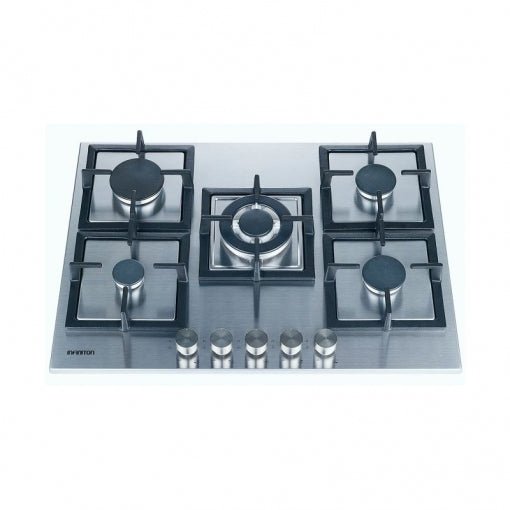
The example we stock and recommend as a main hob is the Infiniton 77MCIXG: a stainless steel gas hob, 5 burners, 70 cm, with a triple-crown burner, for around €227. It suits the household that cooks big and has the powerful burner for the Sunday paella. A note that links to further down: all the Orbegozo FO portable gas stoves also have a triple crown, so you get that power even in the standalone unit.
Sizes: 60 vs 70-75 cm and the golden rule
Here is the most expensive mistake we see at the counter: buying the hob without measuring the cut-out in the unit. Typical built-in hobs are 60 cm (4 burners) or 70-75 cm (5 burners), but the catalogue figure is not the cut-out size. Before deciding anything, take these measurements:
- Width of the unit where the hob will go.
- Depth of the worktop.
- Cut-out: the exact size of the opening where the hob sits and rests. This is the one that really matters.
If your existing cut-out is for a 60 cm hob, the sensible choice is 4 burners, unless you are going to change the unit. A 70-75 cm hob will not fit into a 60 cut-out, and enlarging the cut-out means building work. Measure with a metal tape, write down the three numbers and bring them in: with that, we can tell you in a minute which formats will work for you.
As examples of what is available on the market, there are 4-burner hobs with a triple crown such as the Infiniton GG-429, 4-burner 60 cm models such as the Artica AXG6040 or the Teka HLX540, and 5-burner glass hobs with a wok zone such as the Artica ACG7050. I mention them only so you can see the range of widths and configurations; we do not have them in stock at the moment, so they are not a price offer, just a reference to show that the format exists.
Butane, propane or natural gas: which one is right for you
Not all gases are the same, and they are not chosen at random. It depends on where you live and how your supply is set up:
- Butane (the classic orange bottle): the usual choice in most homes in the district. Practical, delivered by the distributor and, for most people, the natural option.
- Propane: butane struggles below about 5 °C; in very cold weather it has trouble vaporising and loses strength. That is why in high, cold areas such as Vélez-Rubio or Chirivel, propane is used, as it copes better with low temperatures. If your house is up high and the winters are cold, propane is your gas.
- Natural gas: mains gas, where there is a network. It does not reach much of the valley, but where it exists it is convenient because you do not have to change bottles.
The important point: each gas uses different injectors and a different regulator. You cannot switch from butane to propane just by changing the bottle. Many hobs come factory-set for butane and include a conversion kit to adapt them to another gas; the installer carries out that conversion by changing the injectors. Tell us from the outset which gas you will be cooking with and we will prepare the right equipment for you.
Two maintenance points that are not just for show: the hose or flexible pipe must be approved and it expires (the date is printed on it), so it has to be replaced when the time comes; and a gas hob needs ventilation in the room. This is not exaggerating: it is common sense that prevents trouble.
Safety that matters in a home with children
Today's gas hobs are not the ones from forty years ago. They have two features that change the picture:
- Thermocouple (safety valve): if the flame goes out on its own, because of a draught or because something boils over, the thermocouple cuts off the gas automatically. Gas is not left escaping without a flame. In a home with children, this is essential, not an extra.
- Piezoelectric ignition: the spark that lights the burner without matches or a lighter. Turn the knob and it lights.
Is gas dangerous?
It is the age-old fear and it is worth facing head on. A modern hob with a thermocouple cuts off the supply if the flame goes out; with adequate ventilation in the room there is no build-up; and with an approved, in-date hose there are no leaks through the pipe. The real risk comes from old installations, expired hoses and poor ventilation, not from the gas itself. That is why we insist that the connection is made by an authorised installer: it is not red tape, it is exactly what makes the difference.
Built-in hob or portable gas stove: the real decision
For many customers, this is the real question. Not everyone needs (or wants) a built-in hob that involves building work. The two options, side by side:
| Built-in hob | Portable gas stove | |
|---|---|---|
| What it is | Hob fitted into the worktop, fixed installation | Standalone stainless steel unit that sits on any surface |
| Installation | Connected by an authorised gas installer | Connects to the gas bottle with its regulator, no building work or installer needed |
| Ideal for | Main home, everyday cooking | Village house, country or hunting hut, terrace, second home, plan B during a power cut |
| Mobility | Fixed | Can be taken wherever it is needed |
For built-in, the Infiniton 77MCIXG mentioned above (5 burners, triple crown, ~€227) and, if you are looking for a standalone gas cooker without an oven, the Infiniton CC3WO (3 burners, ~€221).
For Orbegozo portable stoves, all in stainless steel, for use with a gas bottle, with a triple crown and piezoelectric ignition:
- Orbegozo FO 1700: 1 burner, triple crown, 4.3 kW. ~€35. For a single pan: the plan B for power cuts or the coffee at the hut.
- Orbegozo FO 2710: 2 burners, triple crown, 7.7 kW. ~€95. For the second home or the terrace.
- Orbegozo FO 3500: 3 burners, triple crown, 8.45 kW, with lid. ~€102. Serious outdoor cooking.
- Orbegozo FO 3510: 3 triple-crown burners, 8.45 kW. ~€105.
The portable stove is also the best insurance against power cuts. If you want to prepare your home so you can cook even when the electricity goes off, you will find our companion article useful on how to keep cooking without interruptions.
Gas or induction: an honest comparison
We are not going to tell you that gas always wins, because it is not true. Each system has its strengths. Here is the table so you can decide:
| Criterion | Gas | Induction |
|---|---|---|
| Pans | Any: clay, paella, wok, aluminium | Only compatible ferromagnetic bases |
| Depends on electricity | No (cooks during a power cut) | Yes (does not work without power) |
| Control | You see the flame, adjust by eye | Very precise and quick, by levels |
| Cleaning | More parts (pan supports, burners) | Smooth glass, one cloth |
If your real dilemma is between the two electric hobs, read our companion article ceramic vs induction, where we go into it in depth, so we will not repeat it here.
Does gas cost more to run?
No tall tales: gas gives instant heat, there is no need to preheat, and the heat is where you want it as soon as you light it. Every type of energy has its price and that changes over time, so saying that gas "costs more" or "costs less" without qualification is an oversimplification: it depends on what, how and where you cook. What does not change is its independence from electricity, and in the countryside that is worth a great deal.
Why buy it from Híper Ocio
We are a family shop in Albox founded in 1923, now in its fourth generation. We have spent a hundred years advising people in the valley on which cooker suits them, with our feet firmly on the ground. We are not going to sell you five burners if you cook for two.
And now the delivery distinction, which is important and which we want to make clear:
- The built-in hob and the gas cooker without an oven are cooking appliances: we deliver and install them only in our area (Valle del Almanzora, Levante almeriense and Los Vélez), with our own van. The gas connection is made by an authorised installer. We do not offer nationwide delivery for these.
- The portable gas stove is a small appliance that connects to the gas bottle without installation: this one does have free nationwide delivery on orders from €49.99. The FO 1700 at ~€35 does not reach that threshold on its own, but the FO 2710 and FO 3500/3510 do.
The legal guarantee in Spain is 3 years. You have 30 calendar days from receipt for returns, in line with our returns policy. If you need it, you can finance your purchase (Klarna at checkout and Santander Consumer for household appliances, which is arranged at the Albox shop by appointment). You can see the full range in our hob collection. An honest clarification: Híper Ocio does not supply or deliver gas; your gas bottle comes from your local distributor (Repsol, Cepsa…).
If, after reading this, you still have doubts about how many burners you need or which gas is right for you, send us a WhatsApp message on 623 04 44 20 and we will go through it with you calmly.
Frequently asked questions
How do I measure the cut-out in the unit for a gas hob?
With a metal tape, take three measurements: the width of the unit, the depth of the worktop and, above all, the cut-out (the exact opening where the hob rests). Write down all three numbers before buying; that cut-out is what matters and it avoids the most expensive mistake we see at the counter.
Can I switch from butane to propane or natural gas?
Yes, but changing the bottle is not enough: each gas uses different injectors and a different regulator. Many hobs come set up for butane and include a conversion kit; the installer changes the injectors and adjusts the regulator for the gas you are going to use.
How often should the gas hose be changed?
The hose or flexible pipe must be approved and has an expiry date printed on it. It must be replaced when that date arrives, even if it looks fine. An expired hose is one of the real risks with gas, so do not skip it.
Do I need a triple crown or will a normal burner do?
For everyday cooking (saucepan, frying pan, sauces) normal burners are enough. The triple crown is for wok, paella and large pots, because it spreads more power across the whole base. Having just one triple-crown burner on the hob is sufficient.
Gas or induction for everyday cooking?
Gas takes any pan and cooks without electricity (key during power cuts or in homes without a good electrical installation); induction is very precise and easy to clean, but it needs ferromagnetic cookware and depends on electricity. If you are torn between the two electric hobs, see our ceramic vs induction article.
Who installs the hob and where do you deliver? Does the portable stove have nationwide delivery?
We deliver and install the built-in hob and the cooker without an oven only in our area (Valle del Almanzora, Levante almeriense and Los Vélez) with our own van, and the gas connection is made by an authorised installer. The portable gas stove, on the other hand, does have free nationwide delivery on orders from €49.99 and connects to the gas bottle without installation.

