

Electric blanket: heat the person, not the stone house
There is a scene we see every winter from behind the counter. Someone comes in looking for "something so I'm not cold at night", looks at the heater, roughly works out what it would cost to leave it on until morning, and leaves without buying it "because of the bill". Then they get into bed cold, take half an hour to warm up with their own body heat, and in the morning the first thing they touch is a set of sheets as cold as marble. The heater, switched off in a corner, couldn't care less.
What we are going to tell you here is pure common sense, the kind you learn from selling the same things for a hundred years: in winter, quite often, there is no need to heat the whole room. It is enough to heat the person. And for that, the electric blanket is the most honest appliance there is, because it uses roughly fifteen times less than a heater while doing the only job you actually care about, which is keeping you warm. We explain what it really uses, what types there are and who each one suits, how to use it without any scares, and the only model we have in our catalogue, the Daga SOFTY, described exactly as it is.
Heat the person, not the 60 cubic metres of air in the room
Think about it with a simple number. An ordinary bedroom, say four metres by four with a ceiling of almost three, holds somewhere in the region of fifty or sixty cubic metres of air. Heating all that volume, and then keeping it warm while the walls steal the heat away, takes a lot of energy. Meanwhile, what you really care about is very little: you are sitting in the armchair or lying in bed, and what needs to be warm is your shoulders, back, legs and feet.
That is the trick of the blanket. It works on just that small surface, right against the body, so almost all the heat it produces ends up where it should: on you. No heat escapes to the ceiling or slips out under the door. That is why a 120-watt appliance keeps you comfortable where a heater needs two thousand to warm the air in the same room. Heating sixty cubic metres of air only to still have cold hands makes little sense if all you want is to be comfortable on the sofa or to sleep without feeling cold.
This does not mean the blanket replaces heating. If what you want is the whole house warm so you can move around it, that is another conversation, and we cover it in our articles on how to heat a room in winter and which heater to buy. Today is about personal warmth: the sofa, the bed, your neck. For that, the blanket.
The sum hardly anyone does: about 2 cents an hour against the heater's 30
Now for the question that really matters: how much electricity does an electric blanket use? Here are the figures, clear and simple, worked out at an approximate electricity price of €0.15 per kilowatt-hour (kWh). They are rounded figures, to give you an idea of the scale, not to argue over the last cent:
- 120 W electric blanket, one hour: 120 W is 0.12 kW, so one hour is 0.12 kWh. At €0.15/kWh that comes to less than 2 cents an hour (€0.018, to be exact).
- 2,000 W electric heater, one hour: 2,000 W is 2 kW, so one hour is 2 kWh. At €0.15/kWh that comes to about 30 cents an hour (€0.30).
- Difference: the blanket uses roughly fifteen times less than the heater doing the same job.
Now apply that to a whole night, which is where you notice it in your pocket. Eight hours of blanket, even if it were on full the whole time, would be about 14 cents; eight hours of a 2,000 W heater, about €2.40. And there are two details that tip things even further in the blanket's favour:
- The blanket is hardly ever on full the whole time. It has a thermostat with several settings: it warms up, reaches the temperature you want and from then on draws far less. In practice, a night with the blanket costs small change.
- The heater, to keep warm the air in a room that keeps losing heat, has to switch back on again and again. Its real consumption shoots up well above the sum above.
In short, so nothing gets lost: the electric blanket costs about 2 cents an hour; the heater, about 30 cents an hour. The same feeling of being warm, fifteen times less spent. That is the sum worth doing before ruling anything out "because of the bill".
What types of electric blanket there are and who each one suits
Not all electric blankets are the same or meant for the same thing. First of all, let us clear up the confusion we hear most often at the counter: a heated underblanket (or mattress topper) is not a bed blanket. The underblanket goes under the fitted sheet, warms the mattress for a while before you go to bed, and normally you switch it off just as you get in: you slip into sheets that are already warm and sleep with no appliance switched on. The bed blanket, on the other hand, goes on top, like an ordinary blanket but heated.
These are the main types and who each one suits:
| If what you do is... | ...this is your blanket |
|---|---|
| Spending the afternoon in the armchair watching television | Single sofa or shoulder blanket: you put it over yourself and it warms your body while you sit |
| Working from home, sitting for hours with cold legs | Single lap or sofa blanket, over your knees while you work |
| Easing back or neck pain with local heat | Single blanket applied to the area: steady, dry heat does tense muscles good |
| Your bed going icy cold in the early hours | Heated underblanket or mattress topper (under the sheet, switch off when you get into bed) if you only want to warm the mattress |
| Two people sharing the bed, each liking a different temperature | Double blanket with dual controls, so each side can be set separately |
A special mention for heated fleece or "sherpa" blankets: they are very pleasant to the touch and wonderful for the sofa, but do not mistake them for an underblanket. They are for putting over yourself, not for sleeping under all night.
And five criteria to get it right when buying, the same ones we check before adding a product to the shop:
- Wattage: a single one is usually around 60-120 W, plenty for one person.
- Temperature settings: the more there are, the finer the adjustment; three is quite enough.
- Auto shut-off: it should switch itself off after a few hours. This is non-negotiable.
- Detachable for washing: the control should unplug so the blanket can be washed.
- Size: single for one person or an armchair; double for a bed for two.
The model we stock: the Daga SOFTY single, inside and out
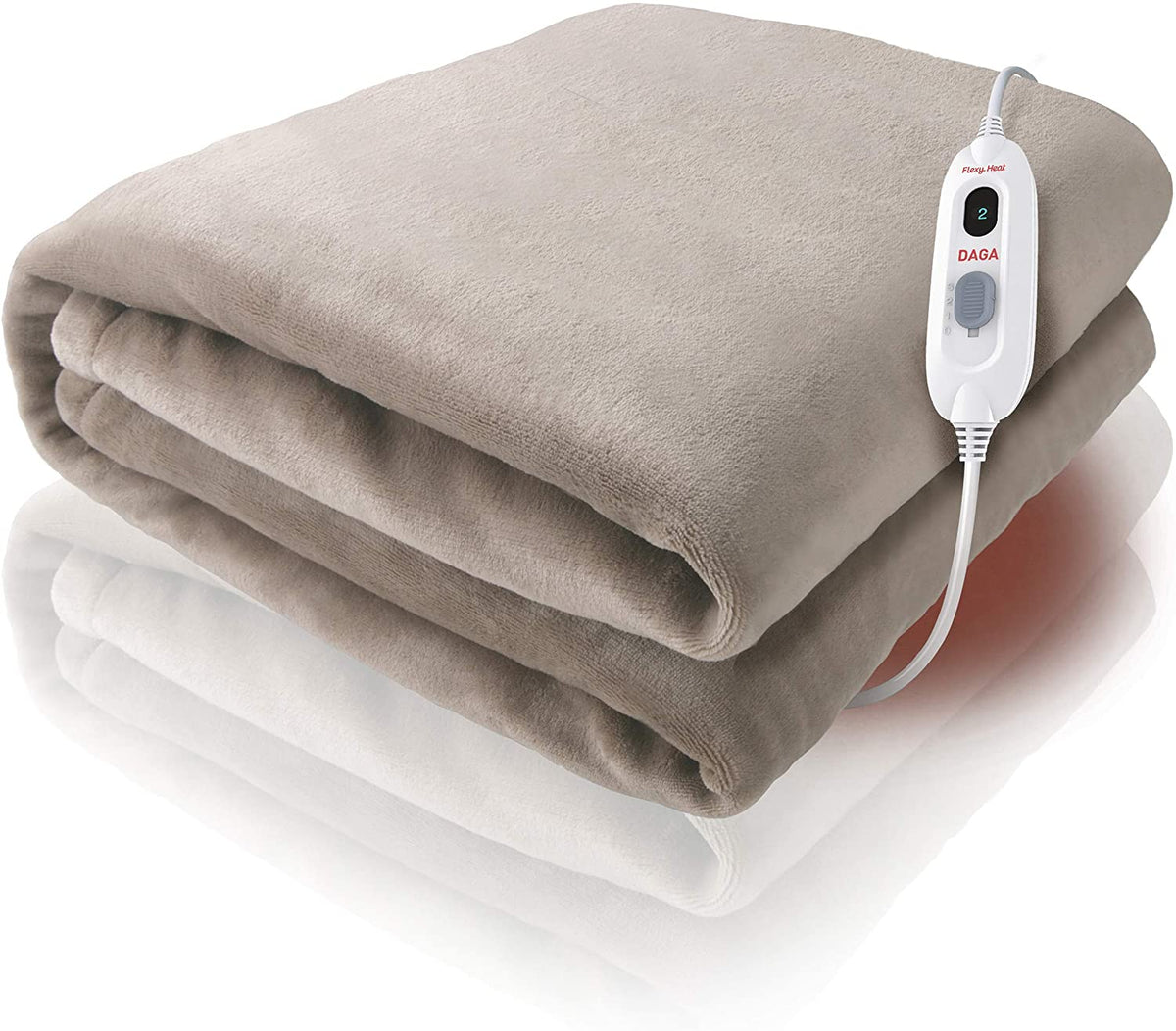
In the shop we are not going to confuse you with twenty products. We have one electric blanket that more than does the job we are talking about, the Daga Manta eléctrica individual SOFTY 160 x 100 cm. Here it is exactly as it is, with its real specifications:
- Power: 120 W. Exactly what we used in the sums above: about 2 cents an hour.
- Size: 160 x 100 cm, single. Good for the armchair, for putting over yourself or for a single bed.
- 3 temperature settings with an electronic control and LED display, so you can see which setting it is on without guessing.
- Detachable connection: unplug the control and the blanket can be washed by hand or in the machine at up to 30 ºC. For an older person this matters, because an armchair blanket gets stained.
- Safety auto shut-off: it switches itself off after 3 hours of continuous use. If you nod off in the armchair, nothing happens.
- It warms up in about 5 minutes and has an ultra-soft fabric that feels lovely to the touch.
We are not going to tell you it is the best blanket in the world or invent star ratings for it. It is an honest single blanket, from a brand that takes this seriously, that does what it should and is easy to clean. For anyone who spends the afternoon in the armchair or works from home with cold legs, it is more than enough. If what you want is to heat the house rather than the person, have a look at our heating collection, where you will find the rest.
Safety, without alarm: the auto shut-off, the cable and who to keep an eye on
An electric blanket is a safe appliance if used sensibly, and today's models, with CE certification and auto shut-off, cause few problems. But it is worth respecting a few things:
- The auto shut-off is there for a reason. The blanket switching itself off after three hours is not a whim. Do not deliberately leave it on all night by resetting the timer.
- Do not fold it or store it crumpled while it is warm. When it is on, keep it spread out. Folded and warm, it can concentrate heat in a crease, and that is not what you want.
- Take care with adjustable beds. If you have a bed that raises at the head or foot, do not use a blanket or underblanket without checking it is compatible: the folds and the mechanism can damage the cable.
- Check the cable from time to time. If it is frayed or crushed, or the plug gets hot, do not use it. A cable in poor condition is the only truly delicate point.
- Unplug it when you go out. A healthy habit with any heating appliance.
- Take care with anyone who cannot feel heat properly. People with certain medical conditions (circulation problems, advanced diabetes, loss of sensation in the skin) or who cannot move by themselves should use it under supervision and on a low setting, because they may not notice they are getting too hot. If in doubt, ask your doctor.
Why buy it from Híper Ocio
We have been doing this since 1923, four generations of the Martínez family in Albox. We are not going to sell you the most expensive blanket or the one that leaves us the biggest margin; we sell you the one that solves your problem, and if your problem is something else, we tell you. That is the advantage of buying from a shop with a name and a face behind the counter, rather than from a search engine full of copied rankings.
An electric blanket is a small appliance, so delivery within Spain is free on orders from €49.99, wherever you are: this is not a large appliance, so you do not need to live in the Valle del Almanzora. The legal guarantee in Spain is 3 years, as with everything we sell, and you have 30 calendar days to return it if you are not happy with it (conditions in our returns policy). For general purchases you can pay in instalments with Klarna at checkout.
And if you would rather see it and feel the fabric before deciding, come into the shop at Avenida 28 de Febrero s/n, Albox, or message us on WhatsApp on 623 04 44 20 and we will look after you like a neighbour, which is what this business has been doing for a hundred years.
Frequently asked questions about electric blankets
How much electricity does an electric blanket use?
A single blanket is around 60-120 W. At an approximate price of €0.15/kWh, a 120 W one costs less than 2 cents an hour. To give you an idea, a 2,000 W heater costs about 30 cents an hour: roughly fifteen times more. And the blanket is rarely on full, because the thermostat turns it down once it reaches temperature.
Can I leave the electric blanket on all night?
Models with auto shut-off, such as the Daga SOFTY, switch themselves off after a while (3 hours in that case). The recommended approach is not to keep it on all night, but to use the heat to warm up and let the auto shut-off do its job. If what you want is a warm bed when you get in, an underblanket that you switch off as you get into bed is the more logical option.
What is the difference between an electric blanket and a heated underblanket?
The electric blanket goes on top, like a warm blanket with heat, and is for the sofa or the bed. The underblanket (or mattress topper) goes under the fitted sheet, warms the mattress before you go to bed and is normally switched off when you get in. They are not the same: one keeps you warm from above, the other warms the mattress from below.
Can you wash an electric blanket?
Those with a detachable connection, yes. With the Daga SOFTY, you unplug the control and the blanket can be washed by hand or in the machine at up to 30 ºC. Never wash the control or put the blanket in the washing machine with the connector attached.
Is it safe for an older person?
Yes, as long as it has auto shut-off and CE certification and is used at a moderate temperature. The precaution applies to people who cannot feel heat properly because of a medical condition: in those cases, a low setting and supervision, and if in doubt, ask the doctor. Unplugging it when you go out and checking the cable from time to time complete the common sense.
Is a blanket cheaper than a heater?
For keeping you warm in the armchair or in bed, without a doubt: about 2 cents an hour against about 30. A heater makes sense if you want to warm the whole room so you can move around it, which is a different need. If you are unsure, for heating rooms we can help with our article on which thermal radiator and how many watts you need for each room.

