
How many frigorías do I need: 2026 guide to choosing an air conditioner (split, portable or multisplit)
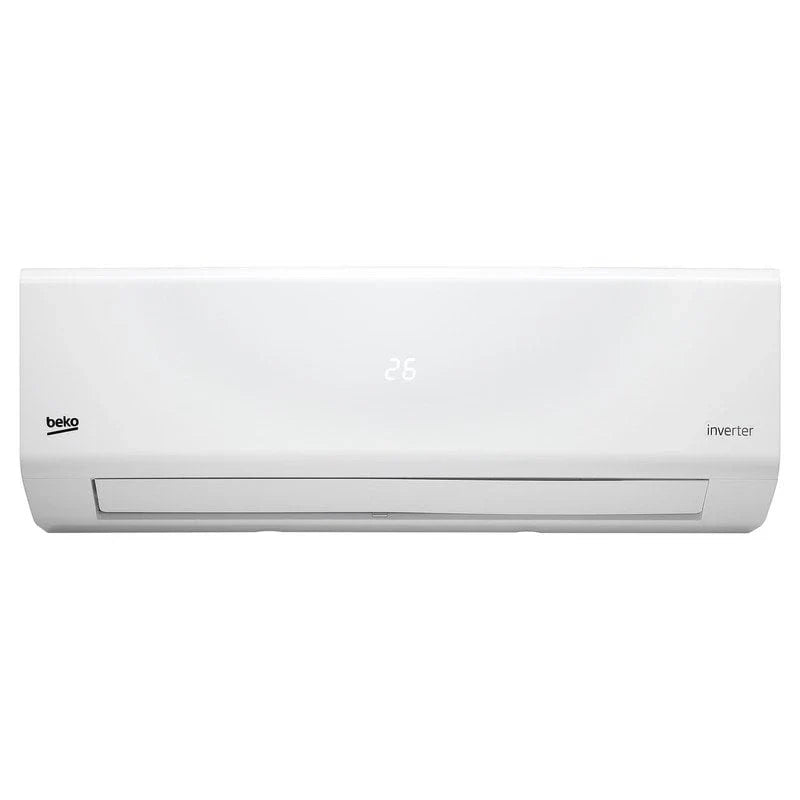
Of all the questions we get at the Albox counter about air conditioning, the number one is not “which brand is best?”. It is “how many frigorías do I need?”. And it is the right question, because getting the power right affects the result more than the brand, the WiFi or any extra in the brochure.
A unit that is too small for the room will run at 100% all day without reaching the temperature, using more electricity and wearing out sooner. A unit that is too big cools in a rush, switches off, starts again, and on an inverter that means losing exactly the advantage you paid for: low consumption at a steady rate. Neither too small nor too big.
Here we explain how we do the calculation ourselves (it does not always match the generic tables you find online, because we are not in Bilbao), which specific models we have in the shop right now for each range, and the things almost nobody tells you before you buy: the gas regulations that change in 2027, the real difference between a split and a portable unit, and why September is probably the best month of the year to have one installed.

Updated in September 2026: this week's real prices and stock
We went over this guide again in September 2026 with what is actually in the Albox warehouse, because air conditioning prices move quite a bit from one season to the next and there is no point leaving you to read figures from months ago.
In the 2,200–2,250 frigorías range (9,000 BTU), the Orbegozo FDI95 is still €275 and is the one with the most units at the moment; the TCL S09F12 at 2,237 frigorías is €289, and if you are after maximum efficiency, the Daitsu Artic DS-9KZ with A+++ stays at €399.
In 3,000 frigorías (12,000 BTU) there is a new option that was not there when we wrote the guide: the Daitsu Artic DS-12KZ, A+++ for €429.99, worth a look if the unit will also provide heating in winter. The most competitively priced alternative in this range is the Infiniton SPTSE12A2 A++ with WiFi, at €349.99.
For 4,500 frigorías we have the Beko BEHPG185 at €599 and the TCL Elite S18F2S1 at €589; and in 6,000 frigorías, the Orbegozo FDI245 at €649.
Two honest warnings for September. The first: several of these models have only one or two units left, so if you are interested in a particular one, ask before counting on it. The second: right now is when the installers in the area have space in their diaries, which does not happen in July. We explain this further down, but if you are reading this in autumn, you are at the best time of year to have it fitted without rushing.
Frigorías, watts and BTU: the same thing said three ways
First of all, let us clear up the confusion over units. In the product listings you will see three different numbers that measure exactly the same thing: the cooling capacity of the unit.
- Frigorías per hour (frig/h): the unit we have always used in Spain. It equals one kilocalorie per hour.
- Watts (W): the international system unit. 1 frigoría ≈ 1.163 W.
- BTU/h: the Anglo-Saxon unit, the one you see in the commercial name of almost every model (9,000, 12,000, 18,000, 24,000). 1 W ≈ 3.41 BTU/h.
Translated into the equivalences you will actually see on the label:
- 2,250 frigorías ≈ 2.6 kW ≈ 9,000 BTU
- 3,000 frigorías ≈ 3.5 kW ≈ 12,000 BTU
- 4,500 frigorías ≈ 5.2 kW ≈ 18,000 BTU
- 6,000 frigorías ≈ 7.0 kW ≈ 24,000 BTU
Note that the “9,000” models are all practically identical in power, whatever the brand. What changes from one to another is not the capacity but the efficiency, the noise level, the quality of the compressor and the after-sales service. That is why comparing only the number of frigorías between two units in the same range tells you nothing.
How many frigorías per square metre (and why here you need to raise the bar)
The rule that circulates online is “100 frigorías per square metre”. It is not bad as a starting point, but it is calculated for an average Spanish home with an average orientation and an average summer. In the Valle del Almanzora, in Los Vélez or in the Levante Almeriense, with high ceilings in old houses, west-facing façades that get direct sun until nine in the evening and forty degrees in the shade in July, that figure often falls short.
Our shopkeeper's rule of thumb, after many years of installing across the area:
- Well-oriented, insulated room with a blind: 90–100 frig/m².
- Ordinary room, east or south facing: 110–120 frig/m².
- West-facing façade, top floor, ceiling under the roof or a large window: 130–150 frig/m².
A well-oriented 15 m² bedroom comes out at 1,500–1,800 frigorías; as the smallest commercial size is 2,250, that is the one you need. A 30 m² living room facing west calls for 3,900–4,500 frigorías, that is, the 4,500 size and not the 3,000, even though the generic tables would tell you the opposite.

The five factors that change the calculation more than the square metres
When someone gives us only the square metres, we always ask five more things. These are the ones that really move the result:
- Ceiling height. The tables assume 2.5 metres. Many village houses have 3 or 3.20. That is 20–25% more air to cool, and it has to be added as it is.
- Orientation and windows. A west-facing window without an awning can let in as much heat as two people and an oven switched on. If the glazed area is more than 20% of the wall surface, go up one size.
- Under the roof or between floors. A bedroom on the top floor, with the roof above it baking all day, needs quite a bit more than the same bedroom on a first floor.
- How many people and what appliances are inside. Each person gives off about 100 W of heat. A living room where six people gather to watch the football with the big TV on is not the same as the empty living room you measured in April.
- Whether it will also be your heating. Almost all the units we sell are heat pumps, and many neighbours heat their homes with them in winter because it is cheaper than butane or an electric radiator. If that is your plan, do not cut it fine: in heating mode the output drops when the outside temperature falls below 5 ºC.
Which unit to buy according to the size of the room
2,200–2,250 frigorías: bedrooms and home offices (up to 20–25 m²)
This is the best-selling size, by a long way. It suits bedrooms, home offices, guest rooms and very small living rooms. Note that this is also where noise level matters most, because you will be sleeping under it.
In this range we have the Orbegozo FDI95 at 2,250 frigorías for €275, which is the most competitively priced entry-level option with inverter and WiFi; the TCL Elite S09F4S1 at 2,200 frigorías for €309, with A++ in cooling and a noticeably quiet indoor unit; and the AUFIT F09K at 2,200 frigorías for €299. All three are heat pumps and use R32 refrigerant.

If you want maximum efficiency because it will be on for many hours (working from home, for example), the Daitsu Artic DS-9KZ with A+++ rating for €399 is a step up in consumption: it costs about €100 more up front and you get that back if the use is heavy. If the unit will run two months a year, on and off, it is not worth it.
3,000 frigorías: the average living room (25–35 m²)
The 12,000 BTU size is the one for the typical living-dining room. This is where most people come up short by buying a 9,000 “because it is cheaper and it will cool in the end”. It does not cool the same: it gets there later and always works at its limit.
We have the Beko BEHPP120/121 at 3,000 frigorías with A++ and Inverter for €319, the Svan SAAS1202 at 3,000 frigorías for €299 and the AUFIT F12K at 3,000 frigorías for €319. All three have WiFi as standard and are heat pumps. If you want A+++ in this same size, the Daitsu Artic DS-12KZ is €429.99.
4,500 frigorías: large living rooms and open-plan spaces (35–50 m²)
If you have an open living room and kitchen, or a large west-facing living room, this is your size. It also applies if you want to cool the living room and have some of it reach the hallway, although it is best to be realistic: a split cools the room where it is, and what passes through an open door is always less than you expect.
The AUFIT F18K at 4,500 frigorías is €489, which for 18,000 BTU with inverter and WiFi is a very reasonable price. If you prefer a brand with a longer track record, the Beko BEHPG185 is €599 and the TCL Elite S18F2S1 €589.

6,000 frigorías: large open spaces and premises (50–70 m²)
Here we are talking about small warehouses, shops, country-house living rooms or double-height spaces. The TCL Elite S24F72S3 at 6,000 frigorías costs €799 and the Orbegozo FDI245 at 6,000 frigorías is €649. From this size up, some honest advice: call us before you buy, because often the right solution is not a 24,000 split but two smaller units placed in different spots, and it works out better in price and in results.
Split, portable, multisplit or cassette: which one is really right for you
The 1x1 wall split: the default option
One outdoor unit, one indoor unit, one pipe between the two. It is the most efficient, the quietest inside the house and the cheapest in terms of power for the price. It needs fitting by a technician (wall core drilling, refrigerant line, condensate drain and gas charge) and it is what we recommend in 90% of cases.
The portable: when you cannot install, not when you would rather not
We have to be clear about this, because it is where we see the most disappointment. A portable unit does cool, but it performs quite a bit worse than a split of the same nominal frigorías, because the compressor is inside the room (it gives off heat) and because the exhaust hose through the window always lets hot air in through the gaps. It is also much noisier: the compressor is two metres away from you.
That said, it is the only real option if you rent, if the residents' association will not let you put the outdoor unit on the façade, if you need cooling in one particular room or if you are going to move the unit around. We have the Artica AAP0929SM at 2,250 frigorías for €229, which also uses R290 refrigerant (propane), with almost zero GWP and no regulatory problem ahead. If that is your case, it is a sensible purchase; if you can install a split, install the split.

The multisplit: two rooms, one outdoor unit
If you want to air-condition the living room and a bedroom, you have two routes: two independent splits (two outdoor units) or a 2x1 multisplit (one outdoor unit and two indoor units). The multisplit wins on façade appearance and on space; independent splits win on price and on the fact that if one fails, the other keeps working.
Our Artica ADM912EX14 2x1 multisplit at 2,268 + 3,024 frigorías is €699 and is supplied to order. A technical point worth knowing: in a multisplit, the outdoor unit is sized for partial simultaneous use, so if you are going to run both indoor units flat out at the same time all day, size it generously or consider two separate units.
Cassette and ducted: building work or a false ceiling
The cassette (recessed in the ceiling, with four-way air distribution) and ducted systems are the most elegant solution and the one that spreads the air best, but they need a false ceiling and a considerably more expensive installation. They make sense in new builds or full refurbishments; they almost never pay off as a replacement for a split in a house that is already finished. We do not list them in the web catalogue because they are projects that have to be quoted at the property, with measurements taken.
Inverter, R32 and the small print of the regulations
Inverter is no longer an extra, it is the standard. An inverter unit regulates the speed of the compressor instead of switching it on and off, so it keeps the temperature steadier and uses quite a bit less in continuous use. All the models we have mentioned have it.
On the refrigerant gas there is news, and it is worth explaining without alarm because there is quite a lot of confusion around. The European F-gas Regulation (EU) 2024/573 sets a timetable of restrictions for new equipment: from 1 January 2027, splits under 12 kW with gases of GWP 750 or higher can no longer be placed on the market (which rules out the old R-410A), and from 2029 the threshold drops to 150, which will also rule out today's R-32 (GWP 675) in favour of gases such as R-454C or R-290 itself.
What does this mean for you if you buy today? Very little, honestly. An R-32 unit bought in 2026 is perfectly legal, will still have maintenance and gas recharging throughout its useful life, and that timetable affects the sale of new appliances, not installed ones. What may happen is that prices of units rise in 2027-2028 during the transition, as happened when R-410A disappeared. If you were hesitating, that is one more reason not to leave it for two years' time.
One last useful note: if your unit does not come with WiFi from the factory or you want to control it from your phone, there is the WIDE Smart Kit USBWIFI adapter for €29.99, compatible with several brands in the group. It is a cheap way to modernise a unit you already have.
Installing in September: the window almost nobody uses
This is pure shop knowledge. In June and July twenty people a day call us with the same problem and the installers in the area are overwhelmed: diaries fill up, there are waits of two and three weeks, and the stock of the most sought-after models flies out.
In September and October the opposite happens. The technicians have room, you can set a day and time with a margin, and the unit is fitted and tested for next year without having to spend a week of August with fans. Also, if your unit is a heat pump, you get to use it for heating in November instead of waiting nine months to use it.
And there is one more practical reason: installing without rushing lets it be done properly. Most of the poor installations we have seen (drains that drip onto the neighbour's façade, pipes that are too long, outdoor units where they cannot ventilate) were done in a hurry in the middle of August.
Why Híper Ocio
We are a family shop in Albox founded in 1923, now in its fourth generation with Antonio Martínez Rosado at the helm. We sell home appliances and air conditioning because we have been doing it for decades, not because it is a fashionable category.
What we offer and what we do not, with no frills:
- Delivery with our own van in the Valle del Almanzora, Levante Almeriense and Los Vélez. Air conditioners and the rest of the white goods are not shipped outside that area: we deliver them ourselves, not an agency. If you are outside the area, you can collect from the shop.
- Installation is quoted separately, and is carried out by a refrigeration technician with a gas-handling certificate. We do not include it in the price of the unit because every house is different (metres of pipe, height, difficulty of access) and promising a fixed price without seeing the installation would be lying.
- We tell you no when the unit you want is not the one you need. We would rather sell you a 12,000 that suits you than a 9,000 that disappoints you.
- Pay in instalments with Klarna. You can find out more on our financing page.
- 30-day right of withdrawal under our returns policy. Please note that a unit already installed by a technician, with the refrigerant line done and the gas charged, does not meet the return conditions required by law; that is why we insist so much on getting the power right before you buy.
- We are at Avenida 28 de Febrero s/n in Albox, with units set up so you can see them and hear them running. If you have doubts about the measurements of your home, message us on WhatsApp at 623 04 44 20 with the square metres and the orientation and we will tell you which size you need.
Frequently asked questions
How many frigorías do I need for a 20 m² room?
Between 2,000 and 2,400 frigorías in normal conditions, and up to 2,800–3,000 if the room faces west, is under the roof or has a ceiling higher than 2.8 metres. The commercial size that corresponds is 2,200–2,250 frigorías (9,000 BTU) in the first case and 3,000 frigorías (12,000 BTU) in the second.
Is it better to go over or under on frigorías?
If you have to choose, go a little over. A slightly oversized unit reaches the temperature sooner and then idles; a small one never gets there and spends the day at maximum. But going far over also has a cost: the unit costs more, uses more at start-up and, on an inverter, causes short cycles that reduce the efficiency and the life of the compressor. One size up is prudent; two sizes is money thrown away.
Does a portable air conditioner cool as well as a split?
No. With the same nominal frigorías, a portable unit performs in practice quite a bit worse, because the compressor is inside the room generating heat and because the exhaust hose through the window brings in hot air from outside. It is also quite a bit noisier. It is the right option when you cannot install an outdoor unit (renting, residents' association ban, protected building), not when you simply want to save yourself the installer.
Is it worth paying more for A+++ over A++?
It depends on the hours of use. If you will have it running many hours a day for several months (a home where people work remotely, or a unit that also heats in winter) the difference in consumption pays back the extra cost in a few seasons. If the use is two summer months, on and off at night, A++ is more than enough and the money is better spent on a good installation.
Can I buy an air conditioner from Híper Ocio if I live outside Almería?
Air conditioners, white goods and televisions are only delivered in the Valle del Almanzora, the Levante Almeriense and Los Vélez, in our own van. We do not ship these products nationwide. You can collect them at the Albox shop if that suits you. For toys and small appliances we do ship across Spain, with free shipping from €49.99.
My unit uses R-32. Will I be left without gas when the regulations change?
No. The timetable in Regulation (EU) 2024/573 restricts placing new equipment on the market (GWP of 750 or higher from 2027 and 150 or higher from 2029 for splits under 12 kW), but it does not prohibit maintaining, repairing or recharging equipment that is already installed. An R-32 split bought today will have technical service and gas available throughout its useful life.