Vacuum cleaner bags and filters: how to find the right one and how often to change them (2026 guide)
Out of every ten people who walk into the shop saying “my vacuum cleaner has broken”, seven have nothing wrong with it. The bag is full, the filter is clogged, or both. They notice because the machine “has gone weak”, gets hot, smells odd or simply switches itself off after ten minutes. What they need is not a new €200 vacuum cleaner: it is a €9 filter and a €11 pack of bags.
The trouble is that finding the right spare part is surprisingly hard. The vacuum cleaner has spent eight years in the hall cupboard, the manual disappeared in the move, the model is written on a half-rubbed-off sticker under the machine, and online you find forty “compatible” bags without knowing which ones fit. This guide is exactly what we tell you at the counter when you arrive with the vacuum cleaner under your arm.
Let’s take it step by step: first, telling a bag from a filter (they are not the same thing and many people mix them up). Then, how to identify yours without the manual. And finally, how often they really need changing and which warning signs show up before the motor pays the price.

A bag and a filter are not the same thing (and your vacuum cleaner usually has both)
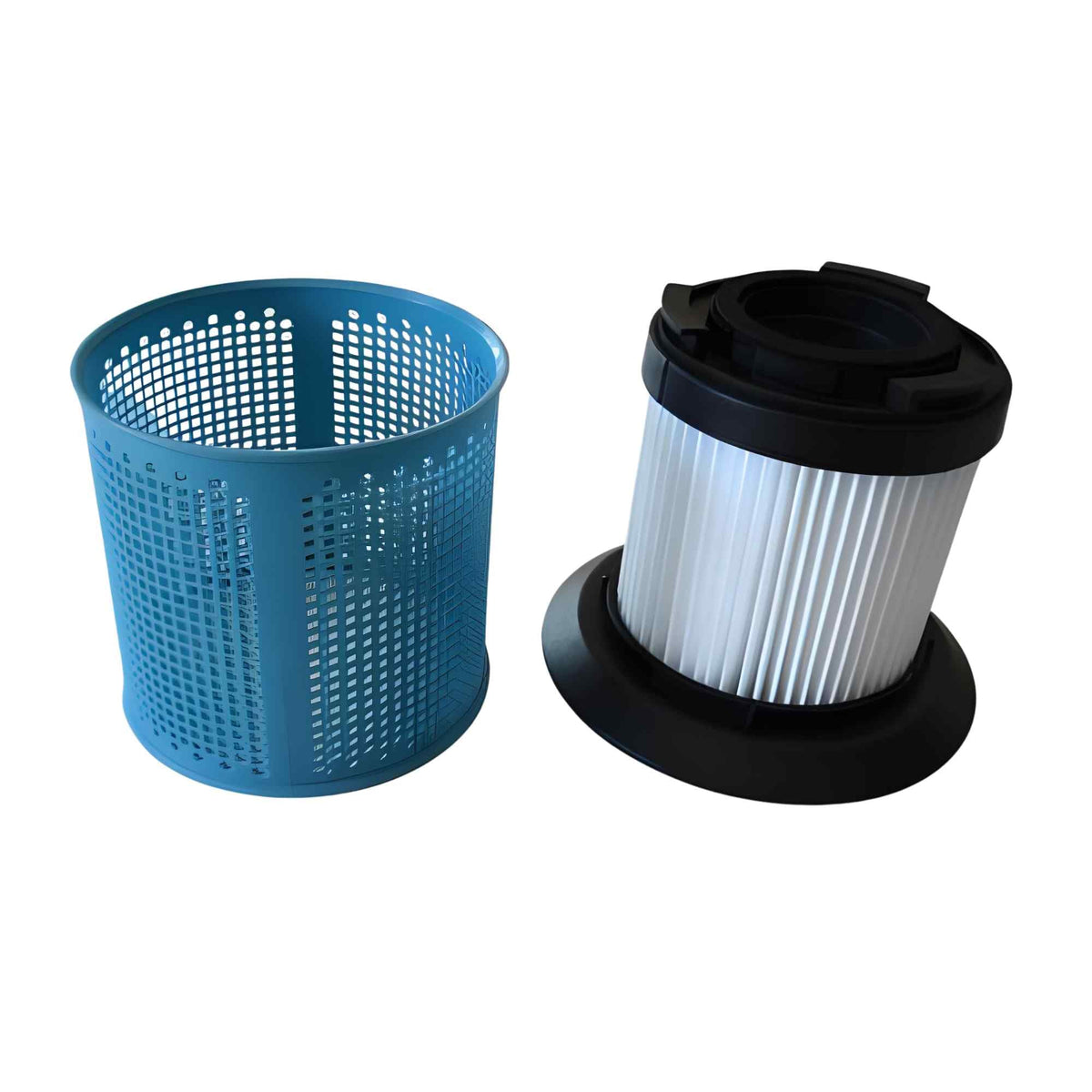
This is the number one mix-up. The bag is the container: it collects the coarse dust, hair, crumbs and sand. The filter is the fine barrier that comes after it, between the container and the motor (or at the air outlet), and it holds back what the bag lets through: microscopic dust, mites, pollen and spores.
A classic cylinder vacuum cleaner normally has three consumable parts:
- The bag, which you throw away when it is full.
- The motor or pre-motor filter, a sponge or grille that protects the motor. It is usually washable.
- The outlet filter (HEPA/EPA), the one that cleans the air returned to your living room. It can be washable or disposable.
Bagless (cyclonic) vacuum cleaners have no bag, obviously, but they have more filters and these get dirty sooner. Many people buy a cyclonic model thinking “that way I save on bags” and then never touch the filter for three years. That is the worse deal: a clogged filter chokes the motor and shortens the life of the machine.
How to tell which bag or filter your vacuum cleaner takes (without the manual)
The method we use in the shop, in this order:
- Look at the sticker on the underside or back of the machine. The exact model is there: “AP 7007”, “APC 7500”, “RC 371BC”. That code is the only thing we need. Take a photo of it with your phone.
- Open the lid and take out the old bag. Almost all of them have the type printed on the cardboard collar: “Type G”, “Type E”, a numerical reference. That cardboard is the key piece: the shape and size of the collar decide whether it fits or not.
- Measure the cardboard collar and the opening if the bag is so battered that nothing can be read. A couple of centimetres of difference and it will not go in.
- Bring the old filter or a photo of it. Filters hardly ever have the reference printed on them, but their shape (round, rectangular, with a tab, with a coloured plastic frame) identifies them quite well.
With the brand and model, we know within two minutes whether we have the spare part. If you would rather sort it out from home, send us the photo of the sticker on WhatsApp at 623 04 44 20 and we will tell you whether we have it before you set off.
Paper or microfibre bags: you can tell the difference
For decades all bags were made of paper. Today most good replacements are made of synthetic microfibre, and the difference is not marketing:
- Paper: cheaper and reasonably good at filtering, but it clogs sooner, loses suction as it fills and tears if you vacuum something damp or with a sharp edge (a piece of glass, a staple).
- Microfibre: holds more without losing suction, filters finer particles (important if there are allergies at home), and is much more resistant to tearing. It usually costs a couple of euros more per pack and lasts a good deal longer.
If someone in your home has a dust allergy or you have a dog that sheds, microfibre is not a luxury. The Orbegozo AP 7007 microfibre bags in a pack of 4 (€10.99) are the typical example: four bags last well over a year in an ordinary home.

For earlier models, the original Orbegozo AP 7006 bags (€10.99) cover the AP 7006 series. And if your vacuum cleaner is one of the classic Bosch models, the Bosch type G bag pack (€11.95) is the standard that a great many models from the brand use: “type G” is a whole family, not a single model, so it usually fits even if your vacuum cleaner is ten years old.
For Daewoo we have two options depending on the series: the Tecnhogar bags compatible with Daewoo (ref. 915621) at €8.50, and the original Daewoo bag for the RC300 and RC371BC at €19.95.
HEPA filters: what H13 means, what E12 means and why almost nobody explains it properly
There is a lot of hot air in the product listings of half the internet, so let’s stick to what the standard says. The European classification of absolute filters is EN 1822, which sets out three families:
- EPA (E10, E11, E12): retention from 85% up to 99.5%.
- HEPA (H13, H14): retention of 99.95% (H13) and 99.995% (H14).
- ULPA (U15–U17): ultra-fine, for laboratories and operating theatres. They are not used in household vacuum cleaners.
The detail that changes things: from H13 upwards, every filter is tested individually and comes with its own report and serial number. E10–E12 filters are validated by sampling. That is why, technically, the vast majority of filters called “HEPA” in mid-range household vacuum cleaners are in fact EPA class E10 to E12. It is not a scam (they filter very well), but it is worth knowing when someone sells you a “certified HEPA H13” for €6 on a marketplace.
In practice: for an ordinary home, a filter of the class the manufacturer fits does its job perfectly as long as it is clean. A clean E11 filters far better than an H13 clogged with dust. Maintenance matters more than the label.

For Orbegozo, the brand whose spare parts we sell most, the practical equivalence is this:
- Orbegozo AP8030 HEPA filter (€9.95) → for the APC5000 and AP8030. Washable.
- Orbegozo APC7000F HEPA filter (€8.95) → for the APC7000, APC7500 and AP8020. Washable.
- Orbegozo filter ref. 14733 (€11.95) → for the AP 6010 and AP 7010.
- Orbegozo filter ref. 15241 (€9.95) → for the AP 7020 and AP 7021. Currently awaiting restock; ask us and we will let you know when it arrives.

How often to really change them (and the signs that warn you beforehand)
Manuals give generic figures. These are the ones we give, based on what we see coming back to the shop:
The bag
Do not wait for it to burst. Change it when it is two-thirds full, not completely full. From that point suction drops sharply even if the indicator has not turned red, because the air no longer passes properly through the surface of the bag. In a 90 m² home without pets, that usually means one bag every 6–8 weeks. With a dog or cat that sheds, every 3–4 weeks.
The pre-motor filter (the sponge)
Wash it every 2–3 bag changes and replace it when it goes stiff, turns yellowish or starts to crumble at the edges. It usually lasts a couple of years.
The HEPA/EPA outlet filter
If it is washable, wash it every 2–3 months and replace it once a year. Yes, even if it is washable. Washing restores part of the airflow, but each wash opens up the weave of the material a little and it gradually loses its ability to retain dust. A €9 washable filter once a year is one of the cheapest bits of maintenance in a home.
The warning signs, in order of appearance: the machine loses power on carpet before it does on a hard floor; the motor rises in pitch and sounds higher; the outlet air smells of hot dust or stuffiness; the body gets hotter than usual; and finally, the thermal cut-out trips and the vacuum cleaner switches itself off after a few minutes. If you have reached that last point, do not force it: switch it off, let it cool down and change the bag and filter before using it again.
How to wash a washable HEPA filter without ruining it
Plenty of people get this wrong, and then the filter lasts half as long:
- Tap it dry first against the inside of a bucket, to shake off most of the dust. If you put it straight under the tap while it is still dusty, it turns to mud inside the pleats and will not come out.
- Cold tap water, always in the reverse direction: the water goes in through the clean side (the outlet side) and pushes the dirt out through the dirty side. The other way round, all you do is push the dust further in.
- No soap, detergent, bleach or scouring pad. Surfactants damage the treatment on the filtering material and a scouring pad tears the pleats.
- Dry it for 24 hours in the shade, standing upright, with air circulating. No radiator, no hairdryer, no direct sun: heat warps the plastic frame and the material.
- Do not fit it damp. Ever. A damp filter inside the vacuum cleaner is the surest recipe for a musty smell for good, and that smell never goes away.
If your filter does not say “washable” anywhere, do not wash it: some disposable pressed-fibre filters fall apart in water. If in doubt, blow on it and shake it, and that is all.
Mistakes we see at the counter every week
- Emptying the bag and putting it back. With paper bags it is money down the drain: the weave is already clogged and the suction does not come back. It only makes sense with reusable fabric bags, which are a different thing.
- Buying “universal compatible bags” without looking at the collar. Universal does not exist. The cardboard fits or it does not.
- Vacuuming fireplace ash or building dust with your household vacuum cleaner. It is the number one killer of filters. Ash is so fine that it goes through the bag and clogs the HEPA filter in a single session. For that you need a wet and dry vacuum.
- Vacuuming up water or a freshly washed carpet. Burst bag and a motor at risk.
- Throwing away the whole vacuum cleaner. It has happened to us more than once: someone comes in to buy a new one, we ask them to bring the old one so we can look at it, and it was the filter. They left with a €9 spare part and the same vacuum cleaner they had always had.
How to buy them and what to know first
Vacuum cleaner spare parts are small, light items, so they are sent to the whole of mainland Spain by courier without any problem. That said, let’s be honest about the numbers: delivery is free on orders from €49.99, and a €9.95 filter comes nowhere near that. If you are ordering online, it makes sense to take the filter and the pack of bags together, which is the whole year’s maintenance, or to add them to another purchase.
If you are in the area, the easiest thing is to drop by the shop with the vacuum cleaner or the photo of the sticker and leave with the spare part in your hand. We are at Avenida 28 de Febrero s/n, Albox.
And one thing worth being clear about: spare parts have the same 30-day right of withdrawal as any other purchase, under the terms of our returns policy. But an opened pack of bags can no longer be returned, so check the reference before opening it. If you are not sure, ask us before tearing the plastic: we will check it for you in a moment.
Why Híper Ocio
We are not going to tell you that we are the cheapest on the internet for vacuum cleaner bags, because we are not: there are marketplaces with generic ones at €4. What we do have is something else.
We have been in Albox since 1923, and the fourth generation is now at the helm, with Antonio Martínez Rosado. In these hundred years we have sold, and seen come back, a great many vacuum cleaners. That means that when you come in with a seven-year-old Orbegozo AP 7010, we know which filter it takes without looking it up, and we know whether the problem is the filter or whether this time it really is time for a new machine. We will tell you even if the answer is “don’t buy anything from us, clean it and get another year out of it”.
We work with original and branded compatible spare parts (Orbegozo, Bosch, Tecnhogar, Daewoo), not unidentified generics. And if you get the reference wrong because the sticker could not be read, we will sort it out: we are here in person and we know your face.
Frequently asked questions
How do I know which bag my vacuum cleaner takes if I lost the manual?
Look at the sticker on the underside or back of the machine: the exact model is there (for example “AP 7007” or “RC 371BC”). That code identifies the spare part. If the sticker is rubbed off, take out the old bag: the type is usually printed on the cardboard collar. As a last resort, measure the cardboard and the diameter of the opening.
How often should I change the vacuum cleaner bag?
When it is about two-thirds full, not completely full, because from that point suction drops even if the indicator does not show it. In an ordinary home without pets that is usually every 6–8 weeks; with a dog or cat that sheds, every 3–4 weeks.
Can a vacuum cleaner HEPA filter be washed?
Only if the manufacturer says it is washable. In that case: cold tap water in the reverse direction, no soap or scouring pad, and a full 24 hours of drying in the shade before fitting it. Never fit it damp. Even if it is washable, it is worth replacing it once a year, because each wash reduces its ability to retain dust.
Is a household vacuum cleaner “HEPA” filter really HEPA?
Under the EN 1822 standard, only classes H13 and H14 are HEPA (99.95% and 99.995% retention), and they are tested unit by unit. Most household vacuum cleaner filters sold as HEPA are in fact EPA class E10 to E12 (85–99.5%). They filter very well and are perfectly good for a home, but be wary of a “certified H13” at a bargain price.
Is a bagless vacuum cleaner worth it to save on spare parts?
You save on bags, but not on maintenance: cyclonic models depend much more on the filter and it gets dirty sooner. If you do not clean it regularly, you lose suction and punish the motor. In annual cost the real difference is small; choose for convenience and for any allergies at home (with a bag, less dust is handled when emptying).
Do you send vacuum cleaner spare parts all over Spain?
Yes, spare parts and small appliances are sent to the whole of mainland Spain by courier, with free delivery on orders from €49.99. Below that amount delivery is charged, so it usually pays to order the filter and the bags together. Large appliances and televisions are different: we deliver those only with our own van in the Valle del Almanzora, the Levante Almeriense and Los Vélez.