Heat pump, condenser or vented tumble dryer: what changed with the new A–G energy label (2026 guide)
There is a question we get almost every day at the counter in Albox: “Why is this dryer class E when that one, which is cheaper, is A++?” The short answer is that they are not being measured with the same ruler. The long answer is what we are going to explain here.
On 1 July 2025, Regulation (EU) 2023/2533 on ecodesign and Delegated Regulation (EU) 2023/2534 on energy labelling came into force, both specific to household tumble dryers. With them, the A+, A++ and A+++ classes disappeared and we went back to a clean A to G scale, much more demanding. A dryer that wore an A+++ under the old label may now be a B or a C. An A++ may drop to a D or an E. The machine has not got worse: the bar has been raised, and class A has been left almost empty on purpose, to leave room for improvements in the coming years.
This causes a great deal of confusion in the shop, because for a while appliances with the old scale (earlier stock, which is legal to sell) will sit on the market next to appliances with the new scale. And customers, quite rightly, look at two stickers and draw the opposite conclusion to the right one. Let us take it step by step.

The three types of dryer, explained without jargon
All dryers do the same thing: they heat air, pass it through the clothes, that air picks up the moisture, and the moisture has to go somewhere. The difference between the three technologies is exactly what is done with that damp air. Everything else follows from that: running cost, price, where you can put it and how long it takes.
Vented dryer (or exhaust dryer)
The simplest and the oldest. It takes air from the room, heats it with a heating element, passes it through the clothes and blows it outside through a hose. It absolutely needs an outlet to the outside: a hole in the wall, a window or a light well. If you put it in a closed room with no outlet, all you will do is turn that room into a sauna.
In return, it is the cheapest to buy, the simplest mechanically (fewer things to break) and it usually dries quickly. Our Infiniton SD-C7V 7 kg vented dryer costs €245, and it is the logical choice for a country house, an outdoor utility room or a second home where clothes are dried four times a year and spending more is not worth it.

Condenser dryer
Here the damp air is not thrown away: it passes through a condenser that cools the vapour and turns it back into liquid water, and that water is collected in a tank that you empty (or, if you have a drain nearby, it can be piped straight to it and you can forget about it). It needs no hose to the outside, so you can put it in a cupboard, a corridor or under a worktop.
It still heats the air with a heating element, just like the vented one, so it uses practically the same energy: the advantage is in the installation, not in the bill. It also gives off heat and some residual humidity into the room, something to bear in mind if you put it in a small, closed room. The Infiniton SD-DG85G 8 kg condenser dryer in stainless steel finish costs €359.99.

Heat pump dryer
This is a condenser dryer taken a big step further. Instead of producing heat by burning electricity in a heating element, it uses a refrigeration circuit (the same principle as an air conditioner) to move heat instead of creating it. That heat is recycled in a closed circuit: it is used for drying, recovered when the moisture condenses and used again.
The practical consequences: it uses roughly half the energy and works at lower temperatures (around 50 °C against 70-80 °C), so it is much gentler on clothes and takes garments you would not have put in a dryer before. In return, it takes longer per cycle (this is normal, it is not faulty) and costs more to buy. It does not need an outlet to the outside either.
What really changed in July 2025
The two European regulations did three things at once, and it is worth keeping them apart:
- They rescaled the label. A+, A++ and A+++ are gone. It is now A–G, with much tougher criteria. Consumption is no longer expressed per cycle but in kWh per 100 cycles of the “eco cotton” programme, which is the one used for measuring (even though hardly anyone uses it at home).
- They raised the minimum efficiency required. The ecodesign requirements are so demanding that, in practice, heating-element dryers find them very hard to meet. The market is shifting towards heat pumps almost completely. The vented and condenser models still in the catalogue are stock made before the date, and they can legally be sold until it runs out.
- They added repairability information. Delegated Regulation (EU) 2025/1353 specified what data on spare parts and repairs must be published. This is good news: it means that seven years from now it should still be possible to find a filter or a drain pump.
Translation for the counter: if you see an A++ dryer, it almost certainly carries the old label. If you see a class E or D on the new scale, that does not mean it is a bad one; it may be exactly the same real level of efficiency. To compare two machines properly, look at the kWh and not the letter, and make sure both figures were measured to the same standard.
What drying really costs, with electricity prices here
Let us use round, checkable numbers, not promises. We take a load of 8 kg of cotton and an electricity price of €0.15/kWh (it varies a lot with your tariff and the time of day; adjust it to your bill).
- Heat pump: around 2.2 kWh per cycle → about €0.33.
- Condenser or vented: around 4.2 kWh per cycle → about €0.63.
The difference is about 30 cents per wash. It seems small. Now multiply it by real use:
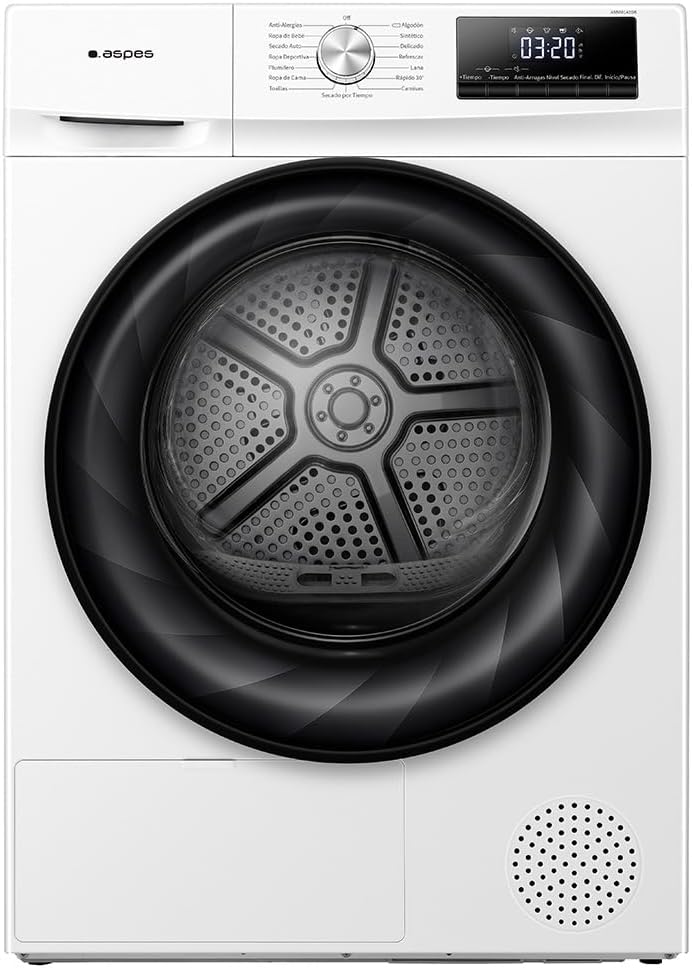
- Family of four, 3 drying cycles a week (156 a year): you save about €47 a year. Between our Infiniton condenser (€359.99) and the Aspes ASB801A2DB 8 kg heat pump (€429) there is a €69 difference. You pay it back in a year and a half. After that, everything you save is yours.
- Couple, 1 drying cycle a week (52 a year): you save about €16 a year. That same €69 takes more than four years to come back. It is still worth it for the way it treats your clothes, but it is no longer an obvious financial decision.
- Country house, 10 drying cycles a year: the saving is €3. Here the €245 vented model is the honest answer.
This is the part an advert will not tell you: a heat pump pays off when it is used. If you are going to dry very little, paying the premium for efficiency is throwing money away.
What capacity you need (almost everyone buys too small)
The classic mistake is to buy a dryer with the same kilos as the washing machine. It does not work like that. Wet clothes take up more room and need space to tumble: if the drum is full, the clothes come out damp inside and creased, and the cycle drags on. The shop rule is simple: the dryer should be 1 to 2 kg above the washing machine.
- 1-2 people: 7 kg is plenty. The Infiniton SCD-E7 7 kg (€229.99) or the 7 kg vented model.
- 3-4 people: 8 kg is the sweet spot. That is where the €429 Aspes sits, and the Infiniton SD-B98G 9 kg in dark stainless steel (€499.99) if you have the space.
- 5 or more, or a lot of bedding and towels: 10 kg. The Beko BM3T30230W 10 kg heat pump (€479) or the Haier I-Pro Series 3 10 kg (€469.99). Note the latter: it is listed as class E on the new scale, and yet it is a heat pump. Exactly the case we were talking about at the start.
- Small flat, studio or rented apartment: there is the Infiniton SD-3M 3 kg (€259.99), designed for very little laundry and very little space.

Where you will put it: the detail that causes the most trouble
Before looking at prices, get out the tape measure. We have seen all sorts, and these are the four checks that avoid 90% of problems:
- The space. A standard dryer is about 60 cm wide and 85 cm high, but the depth ranges from 55 to 65 cm and that is where it does not fit. Measure the depth with the door closed too, and add 5 cm at the back for the connections.
- The door and which way it opens. If you are putting it in a narrow corridor or up against a wall, check the direction of opening and whether it is reversible. A door that hits the frame makes your life miserable every day.
- If you want it stacked on top of the washing machine. It needs a specific stacking kit. You cannot simply put one on top of the other: the vibration from the spin cycle will knock it off. And check that you can reach the controls: 85 + 85 is 170 cm in height up to the top panel.
- Ventilation. Condenser and heat pump models need no hose, but the air does need to circulate. Putting them in a sealed cupboard without a grille makes them work worse and overheat.
And a piece of advice we always give: if you have a drain nearby, ask for the water outlet to be connected directly instead of using the tank. Emptying a tank every other cycle seems like nothing until you have been doing it for a year.
And a washer-dryer instead of two appliances?
It is the obvious question when the utility room is a metre and a half wide. The honest answer has two sides.
For: it takes up a single space, costs less than buying a washing machine and a dryer separately and you do not have to move wet clothes. The Infiniton WSD-A85i washer-dryer costs €379.99, less than many dryers on their own.
Against (and this weighs a lot): the drying capacity is always lower than the washing capacity. If you wash 8 kg, you will probably dry 5. That means you have to take half the load out before pressing the dry button, which loses much of the convenience. Also, while it is drying you cannot wash, and in a house with children that is a real bottleneck. Finally, they are more complex machines: there is more that can go wrong in the same appliance.
Our standing recommendation: if you have room for two appliances, buy two appliances. A Svan SL8203AIDV 8 kg washing machine with inverter motor (€269) plus a heat pump dryer comes out at a similar price and works much better. The washer-dryer is the solution when there is physically no alternative.

Maintenance: five minutes a month and it lasts twice as long
Almost all the dryer faults that come into the workshop have the same cause: dirty filters. The machine cannot move air, it overheats, and the compressor or the heating element ends up paying for it.
- Door filter: clean it every cycle. Ten seconds. It is not optional.
- Condenser filter (heat pump): once a month, rinse it with water and let it dry completely before refitting it.
- Water tank: empty it when it tells you to, and if you do not use it because you have a direct drain, check the hose once a year.
- Humidity sensors: they get dirty with fabric softener residue and make the machine think the clothes are already dry. A cloth with a little vinegar every few months.
- Fabric softener: use it sparingly. It leaves a film that reduces the absorbency of towels and dirties the sensors.
Why Híper Ocio
We are a family shop in Albox founded in 1923. Antonio Martínez Rosado runs the fourth generation of the business. That does not make our dryers dry any better, but it does explain how we work: we are still here, and the person who sells you the appliance is the one who will pick up the phone if something goes wrong.
The specifics, without frills:
- Delivery and installation with our own van. We deliver and connect appliances ourselves in the Valle del Almanzora, Levante Almeriense and Los Vélez. There is no nationwide shipping for white goods or televisions: we would rather tell you in advance than leave a machine on the pavement 400 km away.
- We will measure your space if needed. If you doubt whether it will fit, send us the measurements by WhatsApp on 623 04 44 20 and we will confirm before you pay anything.
- Pay in instalments with Klarna. Full details on our financing page.
- Returns: 30 days in line with our returns policy. We do not promise free returns or collection from your home, because we do not offer them.
- Many models are ordered in on request. We do not have twenty dryers stacked in the warehouse: we bring them in from the supplier within a few days. If you are in a hurry, tell us and we will give you the real lead time, not the one that sounds nice.
Frequently asked questions
Have condenser and vented dryers been banned?
No, buying or using them has not been banned. What happens is that the ecodesign requirements of Regulation (EU) 2023/2533, in force since 1 July 2025, are so demanding that in practice heating-element models are no longer being made. Stock that has already been made can still be sold as normal, and the dryer you have now is still perfectly legal.
Why does a heat pump dryer show up as class E?
Because it is labelled with the new, much tougher A–G scale, while the ones you see with A++ or A+++ carry the old scale. The same machine can go from A++ to E without changing anything. To compare, look at the kWh per 100 cycles and not the letter.
How long does a heat pump dryer take?
Between 2 and 3.5 hours for a full load of cotton, against 1.5-2 hours for a heating-element model. It works at a lower temperature, so it needs more time. It is not faulty: it is how it manages to use half the energy.
Can I put the dryer on top of the washing machine?
Yes, with a specific stacking kit between the two. Without it, the vibration from the spin cycle ends up moving it. Also check that both are the same width and that you can comfortably reach the control panel.
Does the dryer damage clothes?
Heating-element models work at 70-80 °C and over time they dry out fabrics and shrink cottons. Heat pump models run at around 50 °C and are much gentler. Even so, wool, silk and technical garments are still better air-dried, and it is worth using the right programme instead of the longest one by default.
Will you install it for me?
Yes, within our delivery area: Valle del Almanzora, Levante Almeriense and Los Vélez. We come with our own van, put it in place, connect it and take away the packaging. Outside that area we do not supply large appliances.