How to choose a dishwasher in 2026: 45 or 60 cm, place settings, decibels and energy class (an honest guide)
Hardly anyone buys a dishwasher calmly. You buy one when the old one has given up, the plates are piled up on the drainer and you are in a hurry. We see it every week in the shop: someone walks in, points at one and asks “will this one do?”. And the honest answer almost always starts with another question: “how wide is the space?”.
Because with dishwashers the expensive mistake is rarely choosing a worse brand. The expensive mistake is buying a 60 cm model for a 45 cm space, or a built-in when what you needed was a freestanding one. A special offer will not fix that: you fix it by returning the appliance and losing a week.
This guide is about what really changes the result: width, place settings, noise, energy class, type of installation and, very important around here, the hardness of the water. With real models from our catalogue, real prices and no frills. If you still have doubts at the end, we can sort them out at the counter better than on a spec sheet.

1. First things first: measure the space (width, height and depth)
Household dishwashers come in basically two widths:
- 60 cm: the standard. Between 12 and 16 place settings. This is what you want if there are three or more of you at home, or if you cook with a lot of pans.
- 45 cm: the slimline. Between 9 and 10 place settings. Ideal for narrow kitchens, small flats, homes with one or two people and second homes.
And there is a third, lesser-known format: the countertop compact, about 55 cm wide and 44 cm high, with 6 place settings. It sits on top of the worktop and does not need an under-counter space. In our catalogue we have it as the Infiniton DIW-CT6 with 6 place settings, at €298.99. For a rental flat or a country house it is a very sensible solution.
The three measurements you need to write down before you come in:
- Width of the space: 45 or 60 cm. Measure between the units, not the door of the old appliance.
- Height: normally 82-85 cm, adjustable with the feet. If you have a tall plinth or a low worktop, tell us.
- Depth: 55-60 cm, but remember that the water inlet, the drain and the plug also run behind it. If the space is tight on depth, the cabinet door will not close.
Shopkeeper's tip: take a photo of the space with a tape measure resting inside it. With that, in the shop we can tell you in thirty seconds what fits and what does not.
2. Place settings (“servicios” or “cubiertos”): what the number really means
A place setting (“servicio” or “cubierto”, the two words are used interchangeably) is one person's set of tableware according to the test standard: dinner plate, soup plate, dessert plate, cup, saucer, glass, fork, knife, spoon and teaspoon. It does not mean “room for 12 people having dinner at Christmas”, it is a laboratory measure.
In real life terms:
- 6-9 place settings: one or two people, or occasional use.
- 12 place settings: the best-selling size. A couple with a child, or a couple who cook quite a lot.
- 14 place settings: a family of four or more, or people who run a single, well-filled load a day.
- 16 place settings: large families, homes where people often get together.
One important point: more place settings does not mean higher running costs if you make the most of the load. Quite the opposite. Running half a dishwasher twice uses more water and electricity than running one full load once. If you are torn between 12 and 14, and the space allows it, go for the 14.
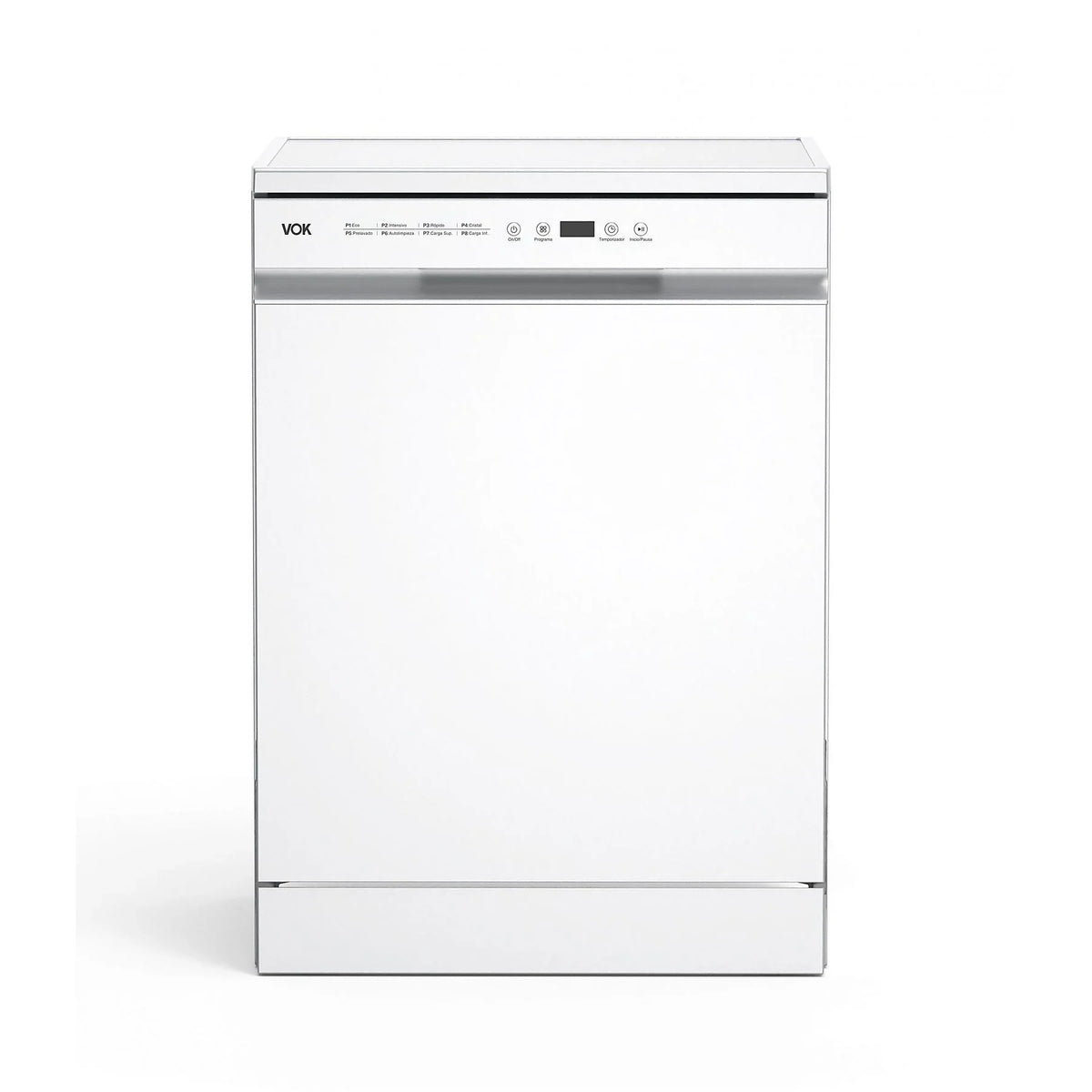
In 12 place settings at 60 cm we have the Artica ALV6601DX in stainless steel at €329.99, one of the best size-to-price ratios. And if you are after 14 in a freestanding model, the white VOK EVD-14FCWAD with 14 place settings is at €299.99, with 8 programmes and class C.

3. Freestanding, integrated or semi-integrated
Three options, and it is worth not mixing them up:
- Freestanding: the whole appliance is visible, with its front in white, stainless steel or black. It goes under the worktop or stands on its own. It is the cheapest option and the easiest to replace in the future.
- Semi-integrated: the cabinet door goes on the front, but the control panel stays visible at the top. Handy for seeing the programme without opening the door.
- Fully integrated: it disappears completely. The controls are on the top edge of the door. It is the cleanest look and what almost all new kitchens ask for. It needs a made-to-measure cabinet front and compatible hinges.
In 60 cm integrated we have the Infiniton DIW-BB606 with 12 place settings and 7 programmes at €329, and in the German own-brand line the Balay 3VF304NP fully integrated with 12 place settings at €389.
A warning we always give: if you are going to integrate it, check the maximum door weight your hinges can take. A 60 cm melamine front weighs little, but a solid wood one or one with a thick handle goes over the limit and the door drops open by itself. It can be solved with reinforced springs, but it is better to know beforehand.

4. The A-G energy label: what you pay and what you save
Since 2021 the scale has gone back to A to G, without the old “A+++”. And it was deliberately rescaled so that reaching an A is difficult: today most of the household market sits between D and E, and a genuine A is a high-end appliance.
What is worth understanding is what is measured: the consumption of the eco programme, not the quick one. That eco programme is long (3 to 4 hours) precisely because it saves: it heats less water and keeps it circulating for longer. If you always use the 30-minute quick cycle, the label you paid for is of no use to you.
Real orders of magnitude per eco cycle:
- Class D/E (60 cm, 12-14 place settings): around 0.9-1.1 kWh and 10-12 litres of water.
- Class B/C: around 0.75-0.9 kWh and 9-11 litres.
- Class A: below 0.7 kWh and 9 litres or less.
The difference between an E and an A, running five loads a week, comes to about €20-30 a year in electricity. With an extra purchase cost of €200, it takes many years to pay back. Our honest opinion: class A is worth it if it also gives you other things (less noise, better drying, a third rack), not just for the energy saving.
If you want an A done properly, the Hisense HS673A90X with 16 place settings, stainless steel and class A is at €599 and is the quietest in the catalogue. And by way of comparison, the Infiniton DIW-6218DD3 Dark Inox with 14 place settings comes in at €459, with a finish that looks very good in dark kitchens.

5. Decibels: the figure most people ignore and most people notice
Noise is measured in dB(A) and the household range runs from about 39 to 52 dB(A). That looks like a small margin, but decibels are a logarithmic scale: every 3 dB less is roughly half the sound energy. A 42 dB appliance compared with a 51 dB one is not “a bit quieter”, it is something else.
Practical reference points:
- 49-52 dB: clearly audible. No problem if the kitchen door is closed and you run it at bedtime.
- 44-48 dB: a comfortable zone for most homes.
- 39-43 dB: practically inaudible with the TV on. It is what you need if you have a kitchen open to the living room or a bedroom next door.
If your home has an open-plan kitchen, this figure matters more than the energy class. Really.
6. Almanzora water: limescale, salt and why your dishwasher lasts less
You will not read this in a national catalogue, but around here it is decisive. The water in the Valle del Almanzora and much of the Levante Almeriense is hard water: high in calcium and magnesium. And limescale is the main reason a dishwasher ends up washing badly or breaking down early.
What to do, in order of importance:
- Always use dishwasher salt. It is not optional here. “All-in-one” tablets contain some anti-limescale agent, but they do not replace the salt reservoir in very hard water. Refill it when the indicator light comes on.
- Adjust the hardness setting of the water softener. Every dishwasher has a hardness setting in its menu, and it comes from the factory at a medium value. In this area it almost always has to be turned up. If you do not know your water hardness, ask your town hall or use a test strip.
- Rinse aid. It prevents white marks when drying and helps a lot with glass.
- Clean the filter every two or three weeks and run an empty cycle with descaler a couple of times a year. We have the Wpro kit of 6 descaler and degreaser sachets at €12.99: it is the cheapest thing you can do to extend the life of the appliance.
A well-maintained dishwasher in hard water will easily last 10-12 years. One that never gets salt starts leaving glasses white in its third year and the heating element fails in its fifth.
7. Extras: which are worth it and which are marketing
Worth it:
- Third rack: the one right at the top, for cutlery and small utensils. It frees up space in the lower basket and is one of the things you appreciate most day to day. Models such as the Bosch SMS46KI01E (€469) have one.
- Inverter motor: brushless. Quieter, more efficient and with longer motor guarantees.
- Automatic door opening at the end (auto-open, half-open): it greatly improves drying without using more energy. It is a simple mechanism and it works.
- Aquastop or overflow protection: a sensor that cuts the water if it detects a leak. Cheap to make, very expensive to be without on the day the hose bursts.
Not needed for most people:
- WiFi and app: it is nice to be able to schedule the start for off-peak hours from your phone, but let's be realistic: almost nobody uses it after two months. If it comes free on the model you already liked, such as the Bosch SMS2HTW06E with Home Connect at €419.01, welcome, but do not pay €80 extra for it.
- Twelve programmes: in practice three get used: eco, automatic and quick. The “delicate glassware” or “baby hygiene” ones gather dust.
- Light projected onto the floor: pretty. Nothing more.
8. What to buy depending on your situation
- Narrow kitchen or small flat → 45 cm. The Infiniton DIW-4513X 45 cm in stainless steel, €369.
- Tight budget, family of four → VOK EVD-14FCWAD, 14 place settings for €299.99. It is where the best euro per place setting is right now.
- You want stainless steel and no complications → Svan Inox 60 cm, €299, or the Artica ALV6601DX at €329.99.
- New kitchen, everything integrated → Infiniton DIW-BB606 (€329) or Balay 3VF304NP (€389).
- Kitchen open to the living room, you want silence → Hisense HS673A90X, €599.
- A long-established brand and wide technical service → Bosch SMS25AI05E or Balay 3VS5011IA, both at around €459-469.
Prices are the catalogue prices at the time of writing and some models come in and out of stock. If a particular one interests you, ask us about availability before coming in: we bring many of them in within 48-72 hours.
9. Installation, delivery and payment options
A dishwasher needs three things: a cold water supply with a stopcock, a drain (preferably with an anti-odour trap) and an earthed socket. If the kitchen already had one, it is a simple replacement. If it is a new installation, the plumbing has to be brought to the space.
On delivery, let us be clear about this because there is a lot of confusion: we deliver household appliances and televisions only in the Valle del Almanzora, Levante Almeriense and Los Vélez area, with our own van. We do not offer nationwide delivery of large appliances. For toys and small appliances we do deliver throughout Spain, with free delivery from €49.99.
If you would like to split the payment, you can pay in instalments with Klarna at checkout. And the returns policy is 30 days, as set out in our refund policy.
Why Híper Ocio
We are not the cheapest on the internet and we are not going to pretend we are. A big marketplace will almost always have that same dishwasher a few euros cheaper.
What we do have: the shop has been open in Albox since 1923 and is now in its fourth generation, with Antonio Martínez Rosado at the helm. That means that if the appliance gives you trouble after eight months, there is a physical door on Avenida 28 de Febrero you can call at, and someone who remembers what they sold you. It also means we will tell you not to buy the €599 one if the €329 one is more than enough for you, because overselling once is very costly when the customer lives ten minutes away.
And it means we know the water here. When we tell you to turn up the hardness setting on the softener, it is not textbook advice: it is because we have seen what Almanzora limescale does to a badly set-up dishwasher.
If you would like to ask about measurements or availability before dropping by, message us on WhatsApp at 623 04 44 20 with a photo of the space.
Frequently asked questions
How much water does a dishwasher use compared with washing up by hand?
A modern dishwasher uses between 9 and 12 litres per eco cycle with a full load. Washing the same amount of crockery by hand with the tap running comes to around 40-100 litres. The machine wins clearly, as long as you run it full.
Why does the eco programme take three hours if it uses the least?
Precisely for that reason. Instead of heating the water to 65-70 °C, it heats it to about 50 °C and makes up for it with more circulation and soaking time. Heating the water accounts for 80 % of a dishwasher's electricity use, so lengthening the cycle to heat less is the trick that lets it drop from class E to class A.
Do I need to add salt if I use “all-in-one” tablets?
In soft water you can get by without it. In the Valle del Almanzora, where the water is hard, yes: add dishwasher salt and set the hardness in the appliance menu. It is the difference between it lasting twelve years or five.
45 or 60 cm if there are two of us?
If the space allows for 60, go for 60 even if there are only two of you. It holds two or three days of dishes, so you run it full, which is when it pays off. The 45 makes sense when the space cannot take more, not as a way of saving money.
How many decibels is truly “quiet”?
Below 44 dB(A) it no longer bothers you in an open kitchen. Below 42 you can hardly hear it. From 49 dB it is quite noticeable, although it is still perfectly usable if the kitchen is closed or you run it at night.
Can you install it?
For replacements within our delivery area (Almanzora, Levante Almeriense and Los Vélez) we bring it in our own van and can take care of the changeover. For new installations that need plumbing, tell us when you buy and we will say which installer to arrange it with and what it costs. Outside that area we do not supply large appliances.