Chest or Upright Freezer: How to Choose in 5 Questions (2026)
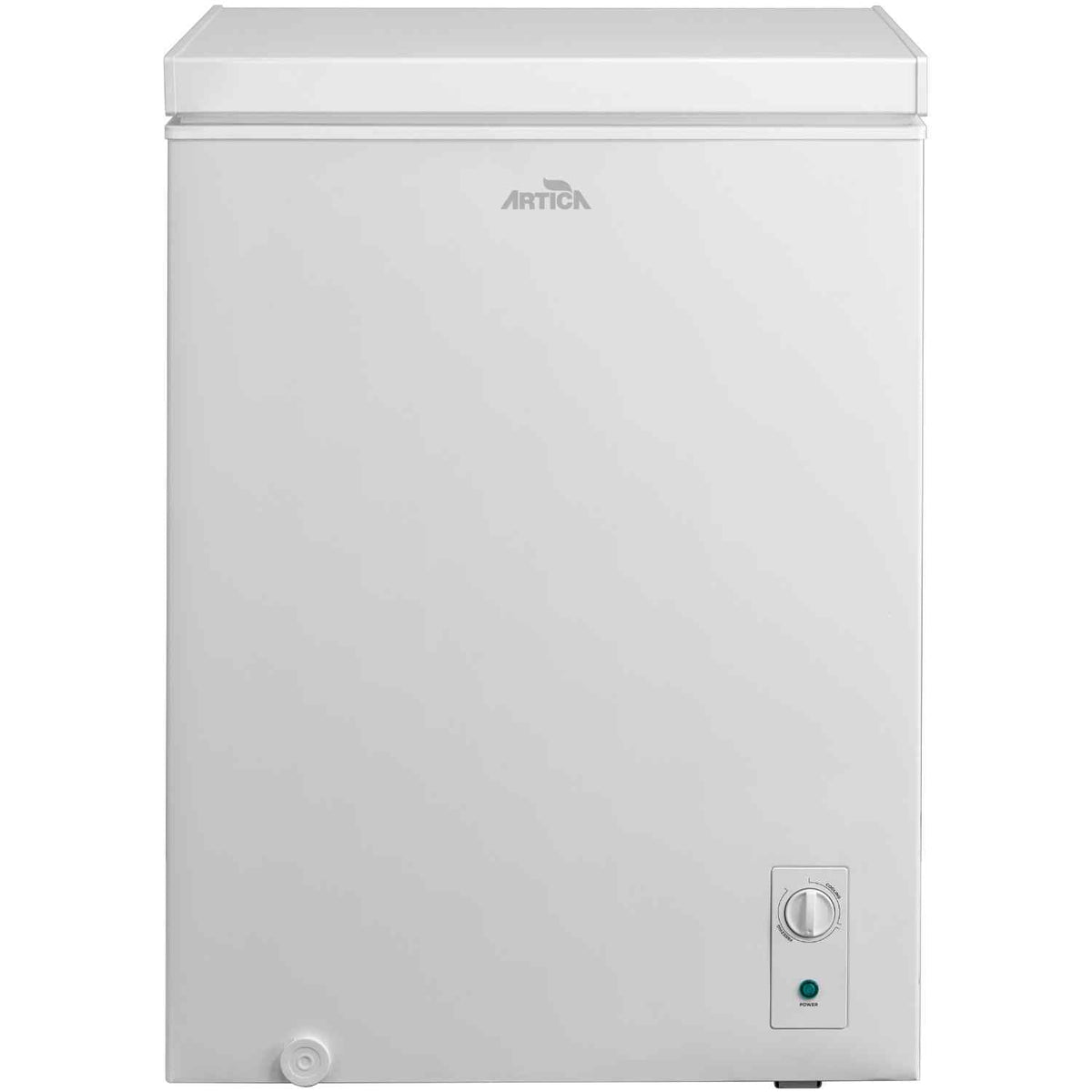
A August midday in a garage in Albox: between the old bike and the sack of animal feed, a chest freezer hums quietly. You lift the lid and there is the pantry for the whole year. The loins and black puddings from the pig slaughter. A couple of rabbits from the last hunt. The fish the brother-in-law brought from Garrucha in a polystyrene cool box. And bag after bag of tomato and pepper from the vegetable garden, frozen at their best so that in January they taste of July. The top basket is so full you have to balance things so nothing falls when you close the lid.
That scene repeats itself every summer in the Almanzora, the Levante region of Almería and Los Vélez. And behind it lies a decision many people make blind: chest freezer or upright freezer? Both freeze equally well. The difference is in how it lives with you, how much it holds, where you are going to plug it in and what happens when the power goes off.
Here are five concrete questions. Answer them in your head as you read and by the end you will know which one is for you. Let's get on with them.
The quick answer in 30 seconds
If you are in a hurry, this table settles the choice at a glance. If you then want to fine-tune it, go down to the five questions.
| Criterion | Chest freezer (horizontal) | Upright (with drawers) |
|---|---|---|
| Cold and consumption | Holds the cold better and usually uses a little less energy | Loses a little more cold each time the door is opened |
| Autonomy without power (full and unopened) | Around a day or more | Considerably less, a few hours |
| Access and organisation | You have to "dig" to reach the bottom | You see everything at a glance, drawers and shelves |
| Floor footprint | Wide and deep, needs space across the width | Narrow (~55-60 cm), fits in a kitchen or utility room |
| Litres per euro | More capacity for what you pay | You pay for the convenience of organising it |
| Wins when… | It is a back-up second freezer in a garage or pantry | It is the everyday freezer in the kitchen |
In one sentence: a chest freezer for storing a lot and riding out power cuts; an upright for tidy day-to-day use in the kitchen. Now let's fine-tune.
Question 1 — How much space do you have?
The first question is not about litres, it is about square metres. Some people choose a chest freezer out of habit and then find it will not fit down the corridor; others choose an upright and have depth to spare. Before anything else, measure the space: width, depth and height, and leave room to open the lid or door.
When the upright wins
- Little width available. An upright is around 55-60 cm wide, so it slips in next to the fridge, in a utility room or in a corner of the kitchen where a chest freezer would not even show its face.
- You want to see everything. Drawers and shelves at eye level: you open the door and know at once whether there is any breadcrumb left or whether you need to buy peas. No digging.
- It is the everyday freezer. If you are going to open it several times a day for dinner, ease of access matters more than anything else.
When the chest freezer wins
- You have plenty of depth. In a garage, a country house or a large pantry, the chest freezer is at home and gives you more litres for the same money.
- You store by season. Half a pig slaughter, the year's hunt or the garden harvest fit better in a wide opening than in narrow drawers.
- You want cheap capacity. For the same litres, the chest freezer usually works out cheaper and uses a little less energy.
Question 2 — How many of you are there? Litres per person and the second freezer
For a main freezer, the practical rule is about 50 to 60 litres per person. A couple gets by with 100-150 L; a family of four or five needs 250-300 L of total freezing capacity, counting the one in the fridge-freezer. But here, in this part of the world, the calculation almost never stops at the kitchen freezer.
Pig slaughter, hunting, Levante fishing and surplus from the garden
The typical case in the Almanzora is the second, back-up freezer: the one in the kitchen for day-to-day use, and another in the garage just for large quantities. That second appliance usually falls somewhere between 200 and 400+ litres, depending on what comes into the house over the year:
- Pig slaughter. Loins, chorizo, black pudding, pork belly… they take up a lot of room and arrive all at once. A chest freezer of a good 200 L breathes more easily.
- Hunting. Rabbit, partridge or a jointed wild boar need space and staying power for the whole season.
- Levante fishing. When a good catch comes in from Garrucha or Villaricos, or you buy in bulk, you want to freeze it quickly and in one block.
- Vegetable garden. Tomatoes, peppers, broad beans, green beans… what is left over in summer feeds the winter if you have somewhere to put it.
If you recognise yourself in two or more of those points, do not look for a "normal" freezer: look for a second appliance of 200-400 L, and it will almost always be a chest freezer.
Question 3 — How do you cook? No Frost or static, and why the chest freezer uses less
Two things get mixed up that are best kept apart: the cooling system (No Frost or static) and the belief that "the chest freezer always uses less".
- No Frost (frost-free): no need to defrost it by hand, ideal if you take out meat or fish often and open it a lot. In return it uses a touch more energy and gives slightly less autonomy without power.
- Static (cyclic): cheaper to buy and with better autonomy, but it builds up frost and has to be defrosted once or twice a year. Perfect for a second freezer that you open rarely.
Why the cold air stays at the bottom of the chest freezer
The chest freezer using less is not magic, it is physics. Cold air is denser than warm air, so it "lies" at the bottom of the chest. When you open the lid, that heavy cold air hardly escapes over the top: it stays where it is. In an upright, when you open the door, the cold air falls towards the floor like a waterfall and is lost, and the warm air from the kitchen comes in to replace it.
That is why, all else being equal, the chest freezer usually uses a little less and lasts longer through a power cut. The chest freezer wins, yes, but because of how air behaves, not because an upright is bad. If your upright is the one in the kitchen and you open it twenty times a day, that advantage of the chest freezer shows even more.
Question 4 — Where will you put it? Climate class, A-G label and power cuts
This is the question most people skip and the one that causes the most grief. A freezer does not perform the same in an air-conditioned kitchen as in a garage that goes over 40 degrees in August and gets freezing in January.
The garage is not the kitchen: climate class SN, N, ST, T
On the data sheet of every freezer there is a climate class, which shows the ambient temperature at which it is guaranteed to work properly:
- SN (subnormal): copes with cold surroundings, suits you if the garage gets cold in winter.
- N (normal): designed for a home kitchen at a mild temperature.
- ST (subtropical) and T (tropical): cope with a lot of ambient heat, the ones you want for a garage or porch in inland Almería in summer.
If the appliance is going to live in an unheated garage, check that its climate class covers the heat of August (ST or T) and, if possible, the cold of winter too (SN). A freezer that is "N only" put in a garage at 42 degrees may not reach the right temperature and could spoil half a year's work. The garage is not the kitchen, and the appliance has to know it.
Reading the new A-G energy label
Since 2021 there has been a new energy label with an A-G scale, and it is easy to get confused. The old A+, A++ and A+++ no longer exist: they were rescaled to leave room for future improvements, so today's A is extremely hard to reach.
- Today, with freezers, it is normal to see class D or E. It is not that they are "bad": the scale has become very demanding.
- A and B are rare and expensive in this type of appliance.
- Do not compare the letter on a new model with one on an old model: they do not speak the same language. An E on the new scale is not the old "bad E".
When the power goes off: autonomy is the criterion nobody tells you about
And now we come to the figure that almost no shop mentions. On the data sheet there is a number, the "temperature rise time", measured in hours: it is how long frozen food holds if the power is cut and you do not open the appliance.
In a full, well-insulated chest freezer, with the lid unopened, we are talking about around a day or more. In an upright, considerably less, more like a few hours. Here, where a storm or a fault can leave you without power for half a day, that difference is what saves the pig slaughter. If this worries you, our guide on power cuts and how to keep cooking without interruption will be useful. Golden rule for a power cut: do not open the freezer, every opening eats into its autonomy.
Question 5 — What budget do you have?
We are not going to invent prices down to the cent, because they change and it would be misleading. But we can guide you with honest ranges, by capacity:
- Small chest freezer (around 78-100 L): the most economical option, perfect as an occasional back-up or for a flat.
- Medium chest freezer (196-200 L): the garage classic for a normal family with some pig slaughter or garden produce.
- Large chest freezer (299-400 L): the one that handles slaughter, hunting and harvest without complaint. More investment, but more litres per euro.
- Upright with drawers (around 88 L): compact and tidy for the kitchen, where you pay for easy access.
And if you want to pay for it at your own pace: at the web checkout there is Klarna for general purchases, and for appliances there is Santander Consumer financing, arranged at the Albox shop by appointment.
Your answer in a table: which model in the catalogue suits each profile
With the five questions put together, this is how it matches up with what we have in the real catalogue:
| Your profile | Recommended model |
|---|---|
| Flat or occasional back-up, little space, tight budget | Infiniton CH-80H84WEH Chest Freezer 78 L White |
| Normal family, second garage freezer with some garden produce | Hoover HOCH200EE Chest Freezer 196L (class E) |
| You want flexibility between fridge and freezer depending on the time of year | Artica AECH1980EW 198L DUAL Horizontal Freezer |
| Large family with frequent pig slaughter, hunting or fishing | Infiniton CH-30H86WEH Chest Freezer 299 L White |
| A serious seasonal store, the one that lasts the whole year | Infiniton CH-40H86WEH Chest Freezer 400 L White |
| Kitchen or utility room, you want order and to see everything at a glance | Artica AECV8555W Upright Freezer 88L White |
That Artica DUAL deserves a note: the word DUAL means it can work as a freezer or as a fridge depending on how you set it. Very useful if one year you need more above-zero cold (for drinks or vegetables) and another year more freezing. You can see these and other models in the appliances collection. And if you are also mulling over your main fridge, have a look at our guide to the combi fridge-freezer or American fridge.
Why buy from Híper Ocio
We are a family shop in Albox, in business since 1923 and now in the fourth generation. We have spent our whole lives selling in this area, and there is something we want to tell you plainly about white goods: we deliver, install and set up freezers ourselves with our own van in the Valle del Almanzora, the Levante region of Almería and Los Vélez. We do not ship freezers nationwide, because we would rather take it to your home, put it where it goes and make sure it starts up properly, than hand it to a courier and cross our fingers.
All our appliances carry the 3-year legal guarantee that applies in Spain. If something does not suit, you have 30 days under our returns policy. And if you would like us to advise you in person, compare two models or prepare the financing for you, drop by the shop or message us on WhatsApp at 623 04 44 20.
Frequently asked questions
Chest freezer or upright for the garage?
For the garage, almost always a chest freezer. It gives more litres per euro, holds the cold better and lasts much longer through a power cut. The upright shines more in the kitchen, where you value quick access and order by drawers.
How long does a freezer last without power?
It depends on the type and whether it is full. A full, well-insulated chest freezer, with the lid unopened, keeps food for around a day or more. An upright lasts considerably less, more like a few hours. The key is not to open it during the power cut.
No Frost or static for a second freezer?
If it is a second garage freezer that you open rarely, the static one is cheaper and gives better autonomy, in exchange for defrosting it once or twice a year. If you open it daily to take out meat or fish, No Frost is worth it even though it uses a touch more energy.
How many litres of freezer do I need?
As a rule, about 50-60 litres per person for the main freezer. If you also store meat from a pig slaughter, game, fish or surplus garden produce, consider a second back-up freezer in the range of 200 to 400+ litres.
What climate class do I need for an unheated garage?
In a garage in inland Almería, which gets very hot in summer, look for climate class ST or T so that it works properly at a high ambient temperature. If it also gets very cold in winter, one that includes SN covers you for both seasons.
Do you bring it to my home and install it?
Yes, within our area. We deliver and install freezers with our own van in the Valle del Almanzora, the Levante region of Almería and Los Vélez. Outside that area we do not ship white goods.