

Science toys for kids: microscope, telescope, robots and nature kits (2026 guide)
Every year, as a birthday or Three Kings' Day letter approaches, there is a child at home who doesn't ask for a toy: they ask for "something science". A microscope, a telescope, a robot that moves. And almost always the adult is left with the same doubt: will they really use it, or will it end up in the cupboard after two weeks?
At Híper Ocio we have spent time since 1923 watching which toys stay in people's homes and which go back in the box. Science toys are curious that way: the kits that work best aren't the ones promising "a hundred experiments", but the ones that give the child a question they want to answer for themselves. In this guide we go through the ones we have in the shop right now, what age they suit and what is worth knowing before you buy.

Before you buy: what makes a science toy work
After years of recommending this kind of toy, we have seen that the ones that succeed do three things. First, the result shows up quickly: if the child has to wait three weeks to see anything, they need an adult to keep them company. Second, it can be repeated with things from around the house: a microscope that only looks at the samples in the box wears out fast; one that lets them look at a leaf, a hair or a grain of salt does not. Third, the adult can join in without being a scientist.
And an honest warning: no kit replaces curiosity. If your child isn't interested in creepy-crawlies, an ant farm won't wake that interest. It is better to look at what they already watch closely (the sky, the insects in the yard, how a car works) and buy in that direction.
By age: what to expect and what to choose
From 6 years: watching nature
At this age children want to see living things and touch them. Observation kits are the best fit because they need no long reading or assembly. In the shop we have two from the Italian brand Clementoni that work especially well.
La Casa de los Insectos (€19.99, recommended from 6 years) is a transparent observatory with compartments, capture tools and a magnifying glass. The idea is simple and good: you go out to the garden, the park or the countryside, catch insects, watch them for a while and put them back where they came from. That teaches something no video teaches: to look patiently and to respect living creatures. It is also a weekend afternoon plan that needs no screen.

La ciudad de las hormigas (€21.99, from 7 years) is a transparent habitat with substrate, tools and a manual for watching a colony dig tunnels and organise its chambers. It is a kit for patient children: results come in days, not minutes. It works very well with the habit of keeping an observation notebook with drawings and notes, and it is a great way for a child to learn responsibility by looking after something alive. If your child gets bored quickly, they may prefer to start with the insect house, which is more immediate.

If what they like is creating something of their own, the Harry Potter Terrarium (€21.99, from 7 years) mixes science and fantasy: container, seeds, substrate and themed decorations to build a mini ecosystem and learn about photosynthesis and the water cycle by watching real plants grow. Note: only a few units are left right now.
From 8 years: looking further and closer
Around the age of 8, an interest in real instruments appears. A magnifying glass is no longer enough: they want a microscope and a telescope. Here it pays to be realistic about expectations, because these are starter toys, not observatory equipment.
The Clementoni NASA Telescope (€49.99, from 8 years) includes a telescope with tripod and instructions, with an official licence from the space agency. It is a starter telescope designed for the Moon and the night sky. A shopkeeper's tip: on the first night, start with the Moon. It is easy to find, it looks good even with simple equipment and it hooks the child. If you start by hunting for distant planets with no experience, frustration is almost guaranteed. One more thing: here in inland Almería, with such dark skies, it is far more enjoyable than in a city with light pollution.
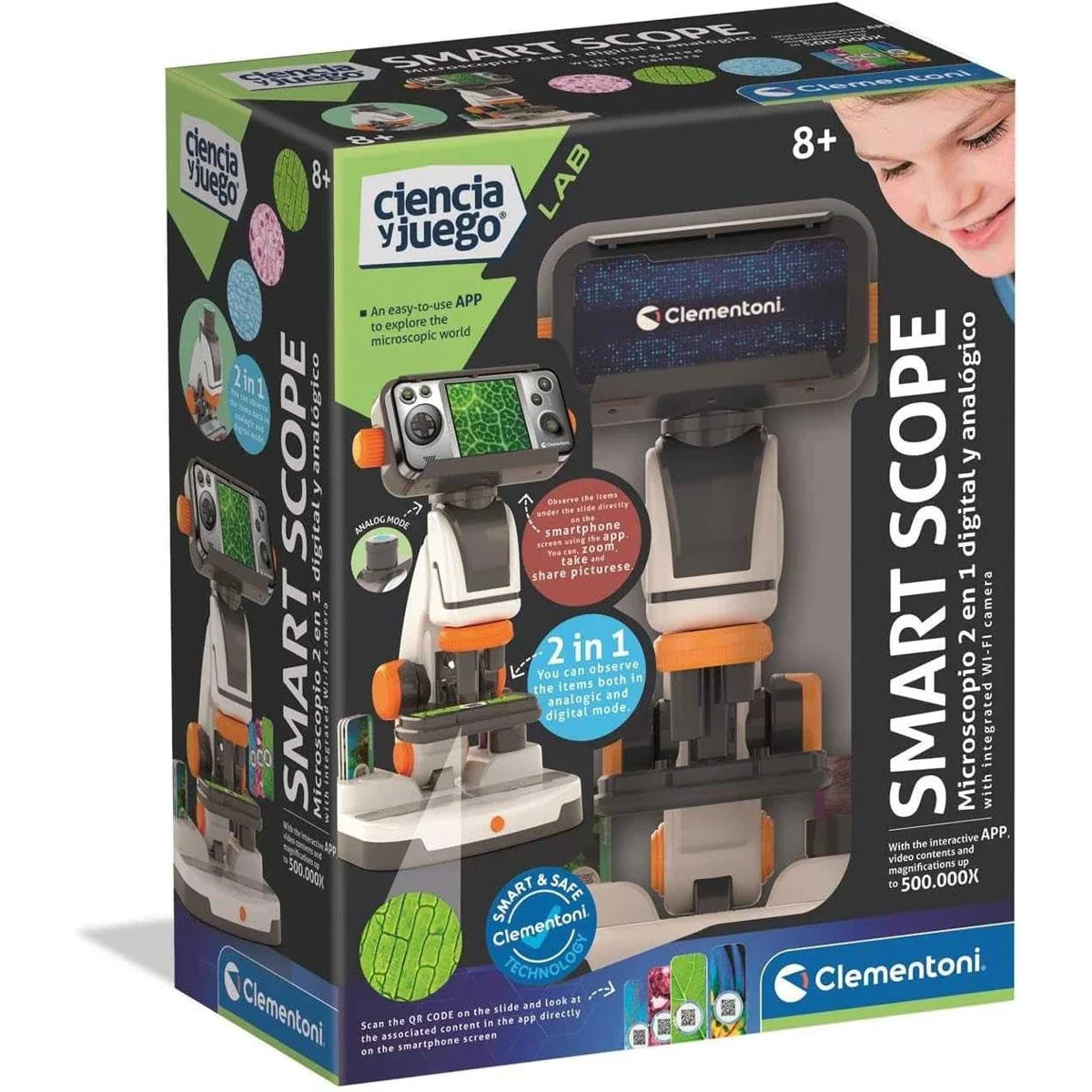
The Smart 2-in-1 Digital Microscope (€63.99, from 8 years) combines a classic optical microscope with a WiFi digital camera: it connects to an app and the sample shows on your phone screen, so several people can look at once. It includes digital samples with QR codes (with videos and quizzes) and slides for preparing your own samples. A common question is whether it needs a phone: no, it also works as a normal optical microscope, and the WiFi adds the digital mode.

From 8 years: robotics and building
For the child who likes building more than observing, robotics is the natural way into programming. The Clementoni programmable R2-D2 (€63.99, from 8 years) has more than 50 parts to assemble the droid, with LED lights, the original sounds from the saga and a head that turns 180° as in the films. With the app you drive it in real time, and there is a block programming mode. The good thing is that the child learns for a reason that matters to them: they want their R2-D2 to do things.

If you are looking for something cheaper, the Airo Robot from the Mechanics range (€39.99, from 8 years) is a buildable STEM starter robot. Note: it is a discontinued edition from the manufacturer, so it is sold only while current stock lasts and will not be restocked. It runs on batteries.
How to choose by type of child
Summing up all of the above in a quick mental table:
- They love animals and the countryside: the insect house to start; the ant city if they are patient.
- They look at the sky at night: the NASA telescope, using the Moon as the first target.
- They want to see "what can't be seen": the digital microscope, which also lets you share the image with the whole family.
- They prefer building and having something move: R2-D2 if they are a Star Wars fan; Airo Robot if budget comes first.
- They like fantasy and plants: the Harry Potter terrarium.
As a price guide, the range goes from about €20 for the nature kits to about €64 for the most technological ones. If the budget is tight, there is no need to go for the most expensive: a well-used observation kit teaches more than a robot that sits on the shelf.
Tips so it doesn't end up in the drawer
A science toy only works if someone takes it out of the box and sits down with the child the first time. After that, they manage on their own. Some ideas that have worked for us:
- Spend the first half hour playing with them yourself. Then let them get on with it.
- Have a notebook ready. Drawing what you see turns play into the scientific method without anyone saying so.
- Ask a question and don't give the answer: "what will happen if we look at a dry leaf?". Let them find out.
- Batteries and space: the robots and the telescope need batteries or a stable spot; it is best to have everything ready on the day of the gift.
- Take care of living creatures: insects are watched for a while and put back; ants need simple, constant care.
And a safety note: all these toys have a minimum age set by the manufacturer (6, 7 or 8 years). Respect it, and with the youngest children in that range an adult should supervise.
Why Híper Ocio
We are a family shop in Albox founded in 1923, with Antonio Martínez Rosado, the fourth generation, now at the helm, and a Toy Planet point of sale. We don't sell everything that exists: we sell what we have seen work and what we can keep in stock. If you still have doubts about which to choose, write to us on WhatsApp at 623 04 44 20 and we will guide you according to the child's age and tastes.
Toy orders have free delivery across Spain from €49.99, and if you order before 15:00 you receive it the next working day, barring transport mishaps. You have 30 days to return, according to our returns policy. And products carry the 3-year legal guarantee against manufacturing defects.
Frequently asked questions
At what age can a child start with a microscope?
The one we have, the Clementoni Smart 2-in-1 Digital Microscope, is recommended from 8 years. Before that age, a magnifying glass and an observation kit such as the insect house usually work better.
Is the NASA telescope really good for seeing the Moon?
Yes, it is a starter telescope designed for the Moon and the night sky. Don't expect to see detail on distant planets, but to start looking at the sky it does the job.
Does the digital microscope need a phone?
No. It also works as a classic optical microscope; the WiFi adds the digital mode with the app.
Can R2-D2 be used to learn programming?
Yes, the app includes a block programming mode, as well as real-time control. It is an introduction, not a full course.
What do I do with the insects or ants when the game is over?
The insects from the observation house are put back in their habitat after being watched for a while. With the ants, the kit manual explains how to look after the colony.
Can they be returned?
Yes, you have 30 days according to the shop's returns policy.

