Which wine cooler to buy for your home: a 2026 guide by situation
Christmas Eve in a house in the Almanzora. The cava has spent the whole afternoon in the living-room cabinet, next to the radiator, and comes out almost lukewarm: when it is opened, the fizz has already gone and what is left is a flat wine with no bubbles. The crianza red has been put in the kitchen fridge «so it doesn't get warm» and reaches the table at four degrees, tasting of alcohol, closed, without giving off a single aroma. It is not bad luck or bad wine: it is temperature. A cava served at 6-8 °C and a crianza red at 16-18 °C would have saved the dinner, and that is exactly what a wine cooler does: it keeps each bottle at its ideal temperature. If you have come here looking for which wine cooler to buy for your home, let us work it out case by case.
At Híper Ocio we have been selling household appliances in Albox for a century, and we know that the best wine cooler is not the most expensive one or the one with the most lights: it is the one that suits what you drink, how much you drink and, above all, the corner of your home where you are going to put it. Here is the guide to getting it right. You can browse the full wine cooler collection as you read.
The five questions that decide the purchase
Almost every question about which wine cooler to buy comes down to five decisions. Answer them in order and the choice makes itself. We go through them one by one, and at the end you will find a specific recommendation for each profile.
- Cooling system: compressor or thermoelectric? This is what matters most for getting it right, and it depends on how hot your home gets.
- Temperature zones: one (single zone) or two at the same time (dual zone)? It depends on whether you drink a bit of everything or almost only red.
- Real capacity: how many bottles actually fit, not the number in the brochure.
- Noise: the decibels and where you are going to put it. A storeroom is not the same as the head of your bed.
- Location: the space, the ventilation and why the kitchen fridge will not do.
Compressor or thermoelectric: the decision that matters most
This is where almost everything starts. Most online guides recommend thermoelectric wine coolers because they are quiet and cheap, and they are, but they leave out their limit: they stop cooling properly when the room goes above roughly 28 °C. Those guides are written with mild climates in mind; in the south-east, in a proper summer, that recommendation could leave your wine warm in August.
So, before choosing the technology, ask yourself one question first: what is the highest temperature reached in summer in the spot where you are going to put it?
- Living room with air conditioning: the room does not go above 24-25 °C. A thermoelectric model works comfortably.
- Kitchen without air conditioning, enclosed utility balcony, hallway: in July these can climb above 28-30 °C. Doubtful territory for a thermoelectric model.
- Storeroom, garage, utility room: the hottest places, where a thermoelectric model simply fails. Here, it has to be a compressor.
What each technology does:
- Thermoelectric (Peltier plates): very quiet, cheaper and with almost no vibration. Its drawback is that it cools «by difference» from the surrounding air: if the room goes above ~28 °C, it loses power and cannot bring the wine down to the set temperature. Its useful range is narrow. A good option for a few bottles in an air-conditioned living room where complete silence is the priority.
- Compressor: the same system as a fridge. It cools however hot the room is, with a typical range of 4-18 °C, and copes with an Almería summer. They used to be noisy; not any more: the models we stock run at between 39 and 42 dB. This is what we recommend here, with few exceptions.
The rule, in one line: compressor almost always; thermoelectric only if it is going in an air-conditioned living room, for a few bottles, and silence matters a great deal to you.
The south-east case: a flat without air conditioning at 32 °C in July
Imagine a flat in Albox, Huércal-Overa or Vera, without air conditioning, where the living room sits at 32 °C on a July afternoon. Inside a thermoelectric wine cooler set to 14 °C, the Peltier plates cannot «take away» that many degrees from the surrounding air: the inside temperature rises, the wine drifts away from its ideal point and, if stored long term, it suffers. The same wine cooler that would work perfectly in an air-conditioned house in Madrid does not do the job in that flat. A compressor, on the other hand, gets down to 14 °C just as well in August as in January. That is why, in our area and in any home where the heat really bites, we recommend a compressor practically every time.
Single zone or dual zone: do you drink a bit of everything or almost only red?
The second decision is how many temperatures you need at once.
- Single zone: the whole wine cooler keeps one temperature. Ideal if your household mainly drinks one type of wine (reds, for example) or if you use it as a cellar for storage at a constant temperature.
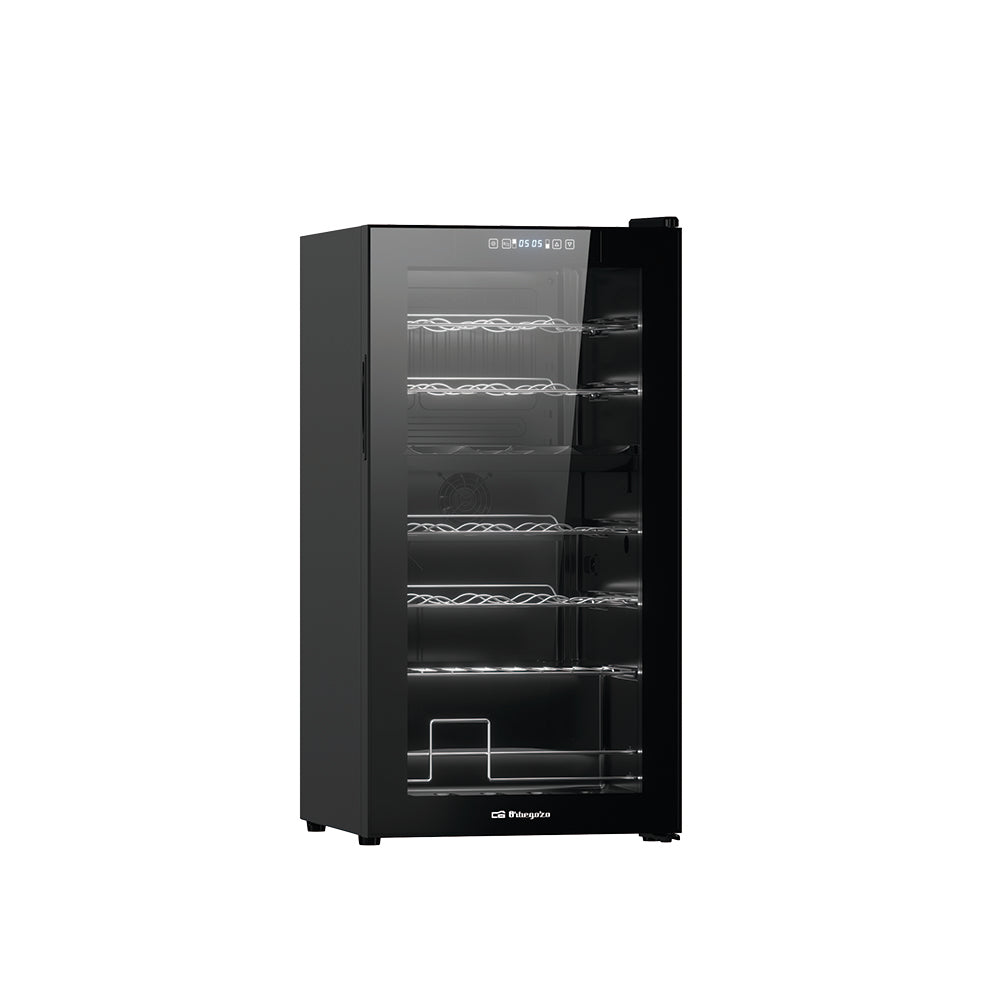
- Dual zone: two compartments at different temperatures at the same time. Below, colder, for sparkling wines, cava and whites; above, milder, for reds. The Orbegozo VCO 2850, 28 bottles with dual zone and compressor (€284.99) is the typical example: it keeps the cava ready to serve and the crianza reds at the right temperature without moving anything.
Decision rule: if whites or cava regularly share your table with reds, go dual zone; if you almost always drink the same thing, go single zone and save.
The table that prevents a dinner disaster
Let us go back to the lukewarm cava and the ice-cold red from the start. All of it could have been avoided with this table. Keep it: it shows the approximate serving temperature for each wine and is the reference for setting your wine cooler.
| Type of wine | Serving temperature |
|---|---|
| Sparkling wines and cava | 6-8 °C |
| Young whites | 7-10 °C |
| Full-bodied whites and rosés | 10-13 °C |
| Young reds | 13-16 °C |
| Aged reds (crianza) | 16-18 °C |
| Long-term storage | ~12-14 °C constant, without vibration and in the dark |
If you are going to keep bottles for months or years, what matters is not hitting the exact serving temperature, but keeping a stable temperature of around 12-14 °C, without vibration and without light. That is where a compressor wine cooler makes the difference compared with leaving the bottles in a cupboard.
How many bottles actually fit (not the number in the brochure)
The nominal capacity that any brand advertises is measured with standard 0.75 L Bordeaux-style bottles, all identical and neatly fitted together. In real life you mix formats: wider Burgundy bottles, cava bottles with thick necks, the odd magnum. As soon as you add variety, fewer fit.
Rule of thumb: if you are not going to fill it only with Bordeaux-style bottles, allow for between 20% and 30% fewer than the advertised figure. A wine cooler rated for 28 bottles will comfortably hold around 20-22 real ones if you mix formats.
With that in mind, here is our range by size:
- 6 bottles: Infiniton WCL-6B, 20 L (€144.99), thermoelectric and very quiet. To get started or as a second wine cooler for serving.
- 12 bottles: Infiniton WCL-12L, 32 L (€177.99).
- 16 bottles: Orbegozo VCO 1600, 42 L, compressor, 41 dB (€179.99).
- 18 bottles: Infiniton WCL-18T, 52 L (€220.99).
- 20 bottles: Orbegozo VCO 2000, 53 L, compressor, 42 dB (€187.99).
- 28 bottles: Orbegozo VCO 2800, 74 L, compressor, 39 dB (€219.99); Infiniton WCL-28T, 52 L (€266.99); or the Orbegozo VCO 2850 dual zone (€284.99).
A shopkeeper's tip: buy one size up from what you think you need. A home cellar always ends up growing, and running out of space after six months is the most common regret.
Noise in decibels: when you notice it in the living room
The compressor wine coolers we stock run at between 39 and 42 dB: a soft hum, similar to a modern fridge, that starts and stops every so often. A thermoelectric model is even quieter, practically a constant whisper because it has no motor. Does that difference matter?
- It does matter if the wine cooler is going in a bedroom, in a study where you work in silence or in an open-plan kitchen-living room where you spend many hours next to it. There, with a few bottles and a controlled climate, a thermoelectric model is welcome.
- It makes no difference if it is going in a through kitchen, a breakfast area, an enclosed utility balcony, a storeroom or a garage. At 39-42 dB you will not notice it running, and in return you can be sure it will cool in the middle of August.
Where to put it and why the fridge will not do
Many people try to do without a wine cooler by putting the wine in the kitchen fridge. It is a mistake for three specific reasons: the fridge runs at around 4 °C, too cold to serve almost any wine, and over time it dries out the cork and lets air in; it vibrates constantly, which stirs up the sediment and makes the wine age badly; and it passes food smells through the cork. A wine cooler, on the other hand, keeps a stable temperature, the right humidity and stillness. That is what it is for.
As for placement, four things to check before buying:
- Measure the space. Height, width and depth, including the door when open if it is going under a worktop. This is the mistake that causes the most returns.
- Leave ventilation space behind and at the sides. The compressor gives off heat and needs to breathe; a wine cooler squeezed into a tight space works less well and uses more energy.
- Away from the oven and from a sunny window. Do not put it right next to a built-in oven or opposite a sunny window; any external source of heat forces it to work harder.
- A firm, level floor, so that it does not vibrate or make extra noise.
Choose according to your situation
Putting the five decisions together, these are the clear-cut cases that cover most purchases:
- «I'm just starting out, I have an air-conditioned living room and only a few bottles, and I want silence»: the Infiniton WCL-6B for 6 bottles (€144.99) or the WCL-12L for 12 bottles (€177.99), both thermoelectric and quiet.
- «I have a collection and it's going in a hot spot, a storeroom or a house without air conditioning»: a compressor, no question. Depending on the number of bottles, the VCO 1600 (16 bottles, €179.99), VCO 2000 (20 bottles, €187.99) or VCO 2800 (28 bottles, 39 dB, €219.99).
- «We drink a bit of everything at home and I want two temperatures at once»: the Orbegozo VCO 2850 dual zone (€284.99), whites and cava below, reds above.
- «I want medium capacity without any fuss»: the Infiniton WCL-18T (18 bottles, €220.99) or WCL-28T (28 bottles, €266.99).
A seasonal note: in December a wine cooler is doubly useful. On the one hand, it is a sure-fire present for any wine lover this Christmas and Three Kings' Day; on the other, it solves the question of where to keep all the cavas and reds that pile up at home over the holidays, instead of having them scattered between the radiator and the fridge. If you would like to round off the gift, the Orbegozo CU 4100 rechargeable electric corkscrew with foil cutter (€32.95) goes beautifully with a wine cooler.
Why buy your wine cooler from Híper Ocio?
We are a family shop in Albox (Almería), founded in 1923 and now in its fourth generation, run by Antonio Martínez Rosado. That means that when we tell you «for your situation, a compressor», we are saying it with a century of experience behind us selling appliances to people who live with the same heat as we do, not from reading a generic product sheet online.
We only deliver our large household and cooking appliances with our own van across the Valle del Almanzora, the Levante Almeriense and Los Vélez. Wine coolers are the exception, as is air conditioning: we send them anywhere in mainland Spain via Correos Express, for €19.99 per unit, without installation, because they are plug-and-play. It arrives, you put it in the space you have measured, plug it in and that is it.
Everything else, clearly and with no small print:
- 3-year legal guarantee throughout Spain.
- 30 calendar days from delivery to return it if you are not happy with it (conditions in our returns policy).
- Finance available: Klarna at checkout for general purchases, and finance with Santander Consumer for household appliances, arranged at our shop in Albox by appointment.
And if, after reading this, you are still not sure which wine cooler to buy, email us at info@hiperocio.com with the spot where you would like to put it and the bottles you usually have, and we will tell you which one suits you. Without selling you more than you need.
Frequently asked questions
Compressor or thermoelectric for a home in Almería or without air conditioning?
Compressor. A thermoelectric model is very quiet, but it loses cooling power when the room goes above roughly 28 °C, so in a south-eastern summer, in a house without air conditioning, a storeroom or a garage, it does not hold the temperature properly. A compressor cools within a typical range of 4-18 °C however hot it gets, and current models run at between 39 and 42 dB. Keep thermoelectric models for an air-conditioned living room with a few bottles where you want complete silence.
How many bottles actually fit?
The capacity shown on the product sheet is nominal and is measured with standard 0.75 L Bordeaux-style bottles. If you mix formats (Burgundy, cava, magnum), considerably fewer fit: allow for between 20% and 30% fewer than the advertised figure. A wine cooler rated for 28 bottles will comfortably hold around 20-22 real ones with mixed formats.
Can I use the kitchen fridge for wine?
It is not a good idea. The fridge runs at around 4 °C, too cold to serve most wines, and over time it dries out the cork. It also vibrates, which stirs up the sediment, and passes food smells through the cork. A wine cooler keeps a stable temperature, the right humidity and stillness, which is exactly what wine needs.
Does it need installing? Where should I put it?
It does not need installing: they are plug-and-play. Place it on a firm, level floor, leaving ventilation space behind and at the sides, away from the oven and from a sunny window. Measure the space (height, width and depth) before buying, as this is the most common mistake.
Do you deliver throughout Spain and how much does it cost?
Yes. Although we only deliver our large household appliances by van in the Almería area, wine coolers are the exception, as is air conditioning: we send them anywhere in mainland Spain via Correos Express, for €19.99 per unit, without installation. Delivery is not free, but it reaches anywhere on the mainland ready to plug in.
How long is the guarantee?
The legal guarantee in Spain is 3 years. You also have 30 calendar days from delivery to return the appliance if you are not happy with it, in line with our returns policy.