Toys for babies aged 0 to 2: 2026 guide by stage (what really gets used and what ends up in the drawer)
We have been selling toys in Albox for more than a hundred years, and one scene repeats itself every week: someone comes in looking for a gift for a one-year-old, stands in front of the shelf and says, “I just don't know what you do with a child so small.” It is a fair question. Between 0 and 24 months a baby changes more than at any other point in life: from not being able to hold up their head to running down the hallway. A toy that fascinates them in March can bore them by July.
We see the result too: €60 gifts that were never opened because they were meant for a 3-year-old and the little one was 10 months, and €9 toys that the family ended up buying twice because they were used every single day. The difference is almost never the price. It is whether the toy fits what the baby can do this week.
So this guide is not arranged by brand or by price, but by stages of development: 0-6 months, 6-12, 12-18 and 18-24. For each stage we tell you what the baby is learning, what kind of toy supports that learning and what we have in the shop that fits, with real prices from August 2026. At the end, the most common mistakes and an FAQ with the questions we are actually asked at the counter.

First of all: the age on the box is not marketing
The “3+ years” printed in a corner of the box is not a teaching recommendation, it is a safety warning. It means the toy contains parts that fit inside the small-parts cylinder (the gauge used by the European EN 71 standard to simulate a young child's throat) or has some feature that is not suitable for children under that age.
A baby aged 0 to 2 puts everything in their mouth. It is not bad manners: it is their main way of exploring the world well into the second year. So at this stage:
- No loose piece should fit inside a toilet roll tube. That is the home trick we tell everyone, and it works.
- Watch out for the stitched eyes and noses on soft toys, and for button batteries: they are the two most frequent causes of scares.
- A visible CE mark and an identifiable manufacturer. On cheap bazaar toys, that is exactly what tends to be missing.
- If the toy takes batteries, the compartment should close with a screw. All the ones we sell do, but it is worth checking.
That said, the age on the box is a minimum, not a target. A set marked "2+ years" can be perfectly boring for a very alert 20-month-old, or too big for a 26-month-old. Pay more attention to what they can do with their hands than to the number.
From 0 to 6 months: contrast, sound and mouth
In the first six months the baby does not play in the sense that adults give the word. They are calibrating their sensors: they focus at short distances, tell strong contrasts apart before soft colours, turn their head towards sound and, from three or four months, start bringing their hands and objects to their mouth.
What works here is simple and cheap:
- Teethers and light rattles. The Kitten Teethers 5-piece set (€9.99) is one of the ones we sell most: there are five, so there is always one clean and one on the floor.
- Textured surfaces with soft sound. An activity cushion (€16.99) for tummy time, which is the exercise most often recommended and the one they like least.
- Soft balls that are easy to grip. The Colourful Ball (€7.95) will stay with them well beyond their first birthday.
What you do not need: €90 activity gyms, star projectors with an app and anything that promises “early stimulation”. At this age the best toy is still a human face 30 centimetres away.
From 6 to 12 months: discovering cause and effect
This is where the most important mental click of the first year arrives: if I press this, that happens. The baby sits up alone, passes objects from one hand to the other, throws things on the floor a thousand times in a row (they are not testing your patience, they are checking that gravity still works) and starts to crawl.
Toys that fit this phase:
- Button panels. The Toy Planet Educational Steering Wheel (€19.99) is the perfect example of cause and effect: button, light, sound, repeat two hundred times.
- Toys that move and invite them to chase. The Musical Walking Kittens (€19.99) encourage crawling better than any play mat.
- First instruments. The Guitarra Marchosa (€15) and the Infant Boom Box (€14.99) are noisy, yes, but they teach rhythm and volume control.
- Bath toys. The bath set with watering can (€11.99) turns the bathtub into the child's first physics lab.

From 12 to 18 months: standing up changes everything
This is the stage we are asked about most, because it coincides with the first birthday. The baby holds on to furniture, takes the first steps, starts putting objects into containers and taking them out, and understands simple instructions. Fine motor skills take off: they already use thumb and forefinger in a pincer grip.
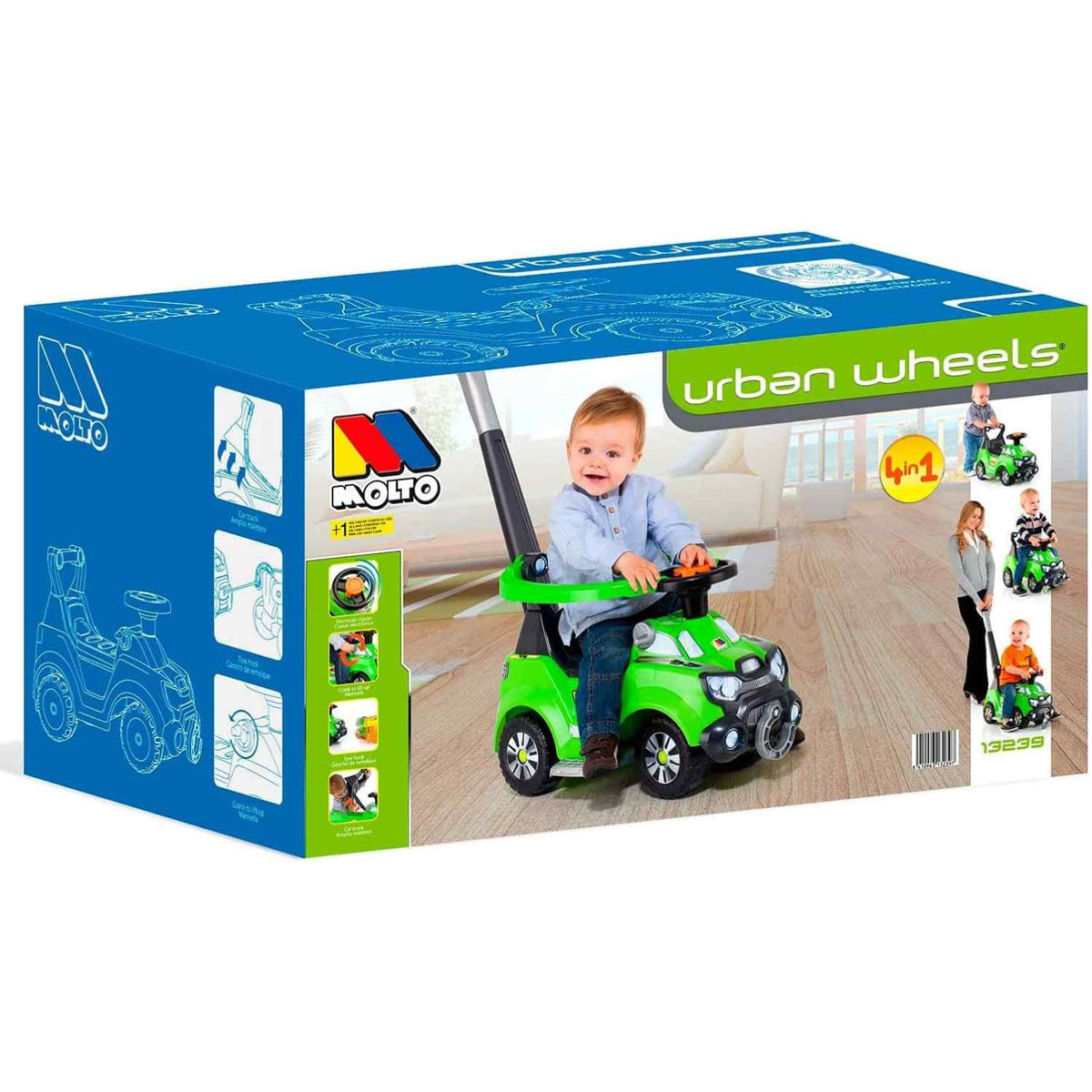
The undisputed king here is the ride-on walker. The Moltó 4x4 Ride-on Walker (€51.99) is by far the one we sell most, for a practical reason: the detachable parent handle means it works from before they walk (you push it) until two and a half, when they propel themselves with their feet. The front tray ends up being where they carry stones, clothes pegs and whatever else they find.
A clarification we often have to make: a ride-on walker is not a baby walker. The baby walker (the harness frame that suspends the child) has a bad reputation among paediatricians and physiotherapists for good reasons. A ride-on walker, by contrast, is a vehicle the child sits on and pushes along with their feet on the ground: a natural posture, nothing forced.
The rest of this stage:
- Nesting and stacking toys. The Stackable Rainbow (€9.99) and the 12 Nesting Eggs (€14.99) work on the pincer grip and the shape-to-hole relationship. The eggs also open: inside there are shapes and colours to match.
- Pull-along toys. The classic Divermóvil pull-along (€9.99) works just as well as it did forty years ago, and for under ten euros.
- First big blocks. The Moltó 35-block tub (€10.99) is the cheapest way into the world of building. If you want something more complete, the 90-piece tub (€21.99) lasts until they are four or five.
- The sleep light. The Moltó Gusy Luz (€16.99) is the Spanish night-time comforter that has always been around and still sells like the first day. Soft, no loose parts and a warm light.

From 18 to 24 months: building, imitating and tidying up
In the second year, symbolic play appears: the child feeds a doll, holds a phone to their ear, sweeps with a toy broom. It is an enormous leap, because it means they can already picture things that are not in front of them. They also start building real towers (three, four, five pieces) and sorting by colour.
What we recommend here:
- First soft dolls. Mi Primer Antonio Juan (€37.90), with a cloth body and 36 cm tall, is designed for exactly this age. It is made in Spain and the bib can be embroidered with the child's name.
- Fine motor skills with gears. The Mosaicolor Gears (€11.99) has large pieces and shows that one wheel turns the next.
- Exploring and imitating. The Infant Binoculars (€5.99) or the Animalitos de Compañía (€14.99) feed make-believe play.
LEGO DUPLO: when it comes in and where to start
We are an official authorised LEGO retailer and this is one of the questions we are asked most. DUPLO is marked from 18 months (some sets from 2 years) and the reason is purely physical: a DUPLO brick is eight times the volume of a regular LEGO brick, precisely so that it does not fit in the throat.
Our advice, after selling many boxes: start with a generic box of bricks, not a themed set. The DUPLO Brick Box 10913 (€27.99) has 65 coloured pieces and comes in a plastic tub that doubles as storage, which at this age is half the battle won. If you want something more complete from the start, the Deluxe Brick Box 10914 (€47.99) adds wheels, windows and figures. And if the budget is tight, the Creative Box in Full Colour 10479 (€17.99) is the cheapest entry in the 2026 range.

After that, sets with characters work very well because the child already recognises who is in front of them. The ones that leave our shelves most: the Mickey and Minnie Birthday Train 10941 (€32.99), the Fire Engine 10473 (€26.99) and, new this year, the Bluey Pizza Makers 10469 (€38.99), which are flying out because the series is hugely popular at this age.

The five mistakes we see most
- Buying ahead of their age “so it lasts”. The toy stays in the cupboard, and by the time the moment comes it no longer has the appeal of something new. Buy for now.
- Too many toys at once. A baby with fifteen toys laid out plays with none of them: they switch every twenty seconds. Put half away and rotate them every two weeks; they look new.
- Mistaking noisy for stimulating. A toy that sings, talks and moves by itself leaves little for the child to do. The ones that last for months are the ones that need the child to do something.
- Batteries included… or not. Always check whether the toy comes with them. Nothing ruins a Three Kings morning like discovering that four AAs are missing at eight o'clock.
- Forgetting the packaging. With babies, a toy that comes in a tub or sturdy box is worth double: tidying up becomes part of the game from 18 months.
How much to spend, sensibly
- Courtesy gift (a friend's birthday, a christening): €10-20. A stacking toy, a small tub of blocks or a musical toy is more than enough.
- Gift from parents or grandparents: €25-55. This is where the DUPLO box, the ride-on walker or a good doll come in.
- Big gift, such as a first birthday: €50-80. A ride-on walker or the DUPLO Deluxe box, and the child has entertainment for a year and a half.
Above €80 at this age, honestly, it is hard to justify. The money goes further spread over two or three well-chosen toys than on one spectacular one.
Why Híper Ocio
We are a family shop in Albox founded in 1923; today it is run by the fourth generation, with Antonio Martínez Rosado at the helm. We belong to the Toy Planet chain and are an official authorised retailer for LEGO, Cayro, Toimsa, Panini, Asmodee, Devir and Ninco.
What that means in practice for you:
- What you see on the website is in our warehouse in Albox. If it says in stock, it is in stock.
- You can come to the physical shop (Avenida 28 de Febrero s/n, Albox) and see the ride-on walker and the DUPLO boxes before deciding. With babies, handling the toy helps more than any product sheet.
- For toys we ship to all of Spain, free from €49.99.
- Returns: 30 days under our returns policy. We do not promise free returns because they are not free; we prefer to say so clearly.
- If you are torn between two options, message us on WhatsApp at 623 04 44 20 and we will tell you what people are taking and what comes back to us.
And one thing you will not see on a big website: if you tell us the child's exact age in months and whether they are walking yet, we will fine-tune the recommendation. It is literally our job, and has been for a century.
Frequently asked questions
How many toys does a baby of this age really need?
Many fewer than they usually have. Five or six well-chosen toys per stage is plenty, as long as they are rotated: putting half away and bringing them out again two weeks later has the same effect as buying new toys, and it costs nothing.
From what age can LEGO DUPLO be used?
From 18 months in most Classic boxes, and from 2 years in themed sets with figures and accessories. A DUPLO brick is twice the size in every dimension of a standard LEGO brick, which makes it too big to choke on. And yes: DUPLO bricks fit with regular LEGO, so the collection does not get thrown away when the child grows up.
Do ride-on walkers delay walking?
There is no evidence that a ride-on walker, the kind the child sits on and pushes along with their feet on the ground, interferes with walking. What does raise doubts among paediatricians is the baby walker, the harness frame that keeps the baby suspended in an unnatural posture. They are different things and it is best not to confuse them.
What is a safe gift for a one-year-old if I barely know the family?
A nesting or stacking toy for €10-15, or a tub of large blocks. These are toys that almost nobody has twice, that do not make noise in someone else's home and that get used for months. If you want to step up a level, the DUPLO brick box is the safest bet there is at this age.
Are toys with lights and sounds bad?
Not bad, but it pays to balance them. A button panel teaches cause and effect and at 8-12 months it is excellent. The problem appears when all the toys in the house make noise: the child gets used to a high level of stimulation and finds it harder to settle into a quiet game. Our rule of thumb: for every toy with batteries, two without.
Do you ship to the whole of Spain? And what if I get the gift wrong?
For toys we ship to all of mainland Spain, free from €49.99. For exchanges and returns you have 30 days from receipt under our policy; return costs are paid by the customer unless the product arrives defective. If you would rather see it first, in the Albox shop we have almost everything on display.