LEGO Marvel: which set to buy depending on who will build it
Last week a gentleman came up to the counter with a box in each hand. Both said "LEGO Marvel", both cost about the same, and he put them down in front of me: "Antonio, which of the two is better?". I turned them over, looked at them for a second and told him what I tell everyone in that situation. These two don't compete. They are not the same kind of toy. And the right question is not which one is better, but what the person receiving it is going to do with it.
One of those boxes was a battle set full of minifigures, the kind a child builds in half an hour and then smashes and rebuilds a hundred times on the living room floor. The other was a buildable figure for adults: you build it once, calmly, and when it's finished it sits still on a shelf. They cost the same, they say the same on the spine, and yet giving one in place of the other is the fastest way I know for a toy to end up at the back of a wardrobe, never used.
Of all the LEGO lines we stock, Marvel is the one that mixes the most different formats under a single name. We see it every season, year after year: people buy the brand, not the format, and that's where the gift goes wrong. So let's separate it calmly, using sets we have on the shelf today, so that you take home the one that fits what you or your child are going to do with it.
Three boxes, three different things
When someone tells me "I want something Spider-Man" or "something Avengers", the first thing I do is not ask about the budget. It's ask who is going to use it. Because inside LEGO Marvel there are three formats that have nothing to do with each other:
- The battle playset. A small or medium scene, two or three minifigures, some accessory to launch, and lots of free play. It builds quickly and gets played with a lot. It is a pure toy.
- The buildable figure or bust. You build it once, it keeps you entertained while you build, and then you display it. It comes with no minifigures to play with and no scene. The piece is an end in itself, designed for the adult who collects or decorates.
- The large model vehicle. The hybrid. A ship or vehicle with lots of pieces that you can play with a little but that, because of its size and detail, almost always ends up on display.
The price doesn't tell you which is which. I have battle playsets for under €20 and display figures for over €120, and the other way round too. What really separates one format from another is the recommended age and what is inside. And that matches fairly well the sub-lines LEGO has created by age range. Let's go through them one by one.
The battle playset: minifigures, scene and play on the floor
This is the heart of Marvel and, by a long way, what we sell most for children. The logic is simple: two sides, a scene, and off you go. The child doesn't build it to leave it looking nice, they build it so that Spider-Man can hit Doc Ock forty times in a row. Breaking is part of the price.
Within the playset there is a very clear age ladder, and it's worth knowing because it shows from what age each thing makes sense.
Ages 1 to 3: DUPLO, big bricks
Here the superhero is the excuse for a chunky piece that can't be swallowed and clicks together easily. The LEGO DUPLO Spidey-Rex vs. Green Goblin (10463), at €18.99, is a good example: a few big pieces, two figures and fine motor skills for small hands, from 2 years. If you are looking for something bigger within DUPLO, the Spidey and His Super Team Spider-Headquarters (10464), at €48.99, already comes with a proper scene.
Ages 4 to 5: Spidey and His Super Team
The bridge between DUPLO and the "grown-up" LEGO. Regular bricks, but simple builds and characters from the cartoon series, not the films. The Spidey: Submarine Vehicles (11207), at €32.99, or the Disney Junior Loki vs. Team Iron Man (11211), at €48.99, belong to this range. Bright colours, easy building, lots of figures.
Ages 6 to 8: the first Super Heroes battle sets
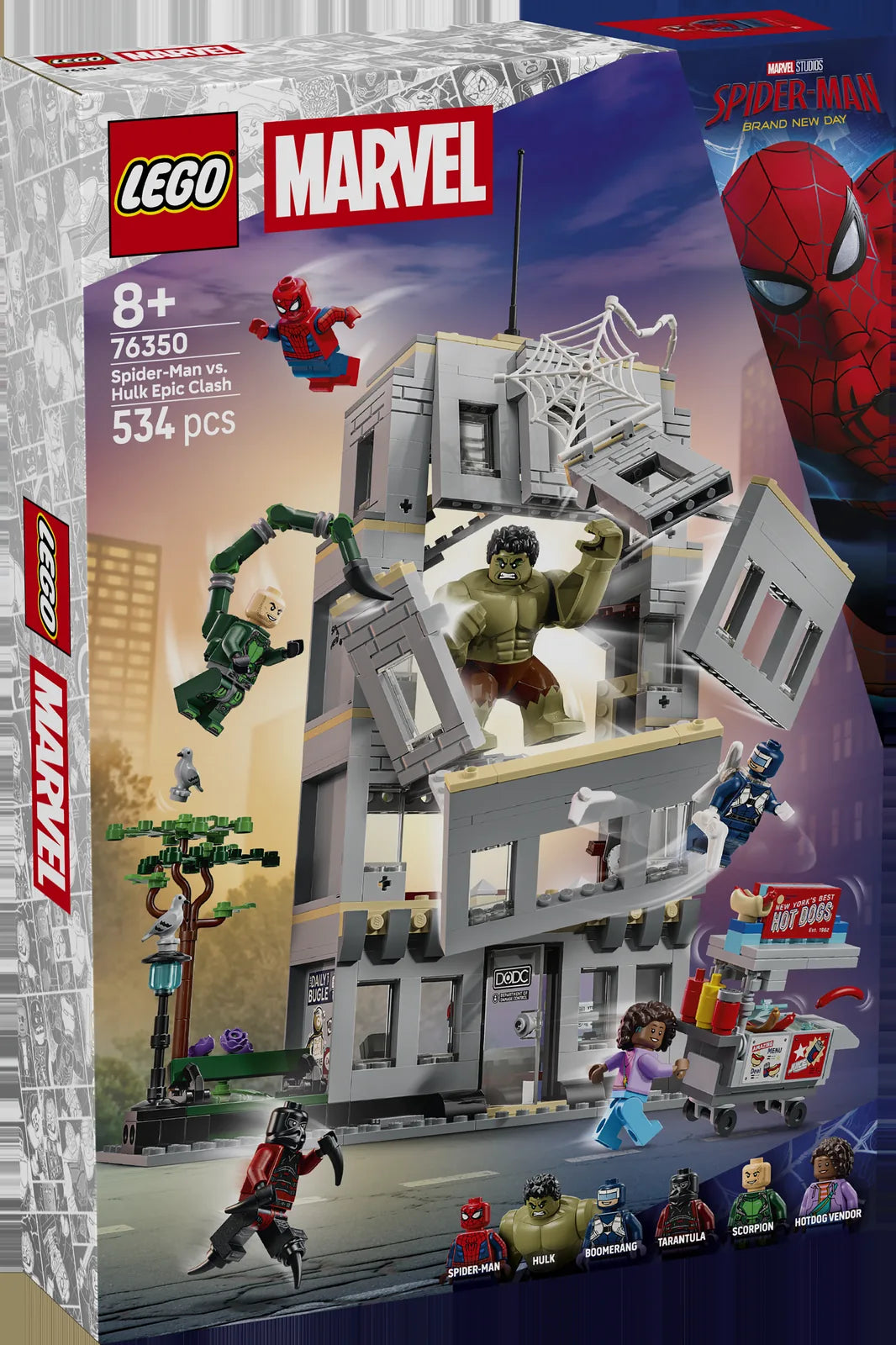
This is where the "real" Marvel begins, with articulated minifigures and the reference films. It is the range where we most often get the gift right. The Captain America vs. Thanos (76319), with its 107 pieces for €32.99, is the perfect example: it starts at 6 years, builds in an afternoon and gives plenty of fighting. In the same range you will find the Spider-Man vs. Doc Ock: robotic armours (76338), at €27.99, and, a step up in size, the Spider-Man vs. Hulk: Epic Clash (76350), at €86.99.
Ages 9 to 12: bigger sets with mechanisms
More pieces, functions you can activate, and builds that already call for patience. The Spider-Man vs. Oscorp (76324), with 808 pieces for €127.99, starts at 10 years and is a large city playset. The Hulkbuster vs. Hulk (76343), at €48.99, is in this same range. They are still for playing, but the child already shows off the build.
The clue for recognising a playset is simple: if the box has two or more minifigures and a scene, it's for playing. And if it's for playing, the age on the box is gospel.
The buildable figure or bust: built once, then displayed
We're changing worlds. This format almost never carries the 6, 9 or 12 years label: it carries a big 18+. And not because it has dangerous pieces, but because it is designed as a decorative object and a relaxed build for an adult, not as a toy to be knocked about.
There are no sides and no battle here. You buy a single thing (a head, a bust, a suit of armour) that is built by following a long manual and that, once finished, stays on the shelf. Examples we have:
- The Doctor Doom Bust (76345), at €48.99, with its nameplate. You build it, put it on the shelf and that's it.
- The Iron Man Mark 3, collector's edition (76344), at €127.99: the classic armour, built for display.
- The Iron Man MK4 Bust (76327), at €57.99, the head of the armour, built to keep in view.
The box says it all: a single figure on the front, no scene, and the 18+ at the top. If someone tells me they are going to buy it for an eight-year-old "because he loves Iron Man", I stop them. It's not that he can't touch it; it's that it isn't made for playing, you can't replay it, and the child gets bored ten minutes after having it built. This format is for people who no longer play with figures and decorate a shelf or a desk. Kidult, they call it now. A grown-up customer all along, I say.
The large model vehicle: between the toy and the shelf
Here is the good trap, the format that confuses the most people because it really does move between the other two. These are ships and vehicles with lots of pieces: you can pick them up, move them and play for a while, but because of size, detail and price they almost always end up on display on a piece of furniture.
The clear case is the Quinjet from Age of Ultron (76325): 1131 pieces, €117.00, 12-year range. A twelve-year-old can build it and play with it, but it is so big and so detailed that most of the people who take it home leave it on show. At the other end of the price scale is the S.H.I.E.L.D. Helicarrier (76354), at €367.99: that is straightforwardly a shelf piece for a committed adult, even if technically it has a hangar and little planes.
The honest way to sell it is this: if you are taking it home for a child of 10 to 12, expect them to play with it first and display it afterwards, and that's fine. If you are taking it for yourself, you already know it goes on the shelf from day one. What doesn't suit this format is the small child: there are too many pieces and they are too fragile for the living room floor.
How to tell which format you are buying before opening the box
You don't need to be an expert. Three things on the box tell you everything, and with them you won't go wrong even if the name is identical:
- The recommended age. If it says 1-3, 4-5, 6-8 or 9-12, it's a toy: a battle playset. If it says 18+, it's a display figure or model. It is the most reliable signal.
- How many minifigures are on the front. Several facing each other means battle, and battle means play. A single large, still figure means display.
- Whether there is a scene or not. A building, a bridge or a base is for playing. The lone figure on a stand with a plaque is for looking at.
With those three clues you already know what you have in front of you. If you still have doubts, that's what we are at the counter for.
Giving the right gift: for the one who plays and for the one who collects
Let's get to the point, which is what people come for. If it's a gift, first decide who it is for.
- For the child who plays (6 to 12 years): a battle playset. The Captain America vs. Thanos (76319) at €32.99 is a perfect gift for 6-8, and the Spider-Man vs. Hulk (76350) at €86.99 for that same range if you want a set with more presence. For 9-12, the Hulkbuster vs. Hulk (76343) at €48.99.
- For the adult fan who collects or decorates: a figure or bust. The Doctor Doom Bust (76345) at €48.99 is a great way into the display format, and the Iron Man Mark 3 (76344) at €127.99 is a wonderful gift for someone who has already started their shelf.
A shopkeeper's tip for testing the interest without spending much. If you don't know whether the child will really get hooked, start cheap. I have small battle sets such as the Spider-Man vs. Venomized Wolverine (76336) at €18.99 or the Spider-Man vs. Doc Ock (76338) at €27.99. For under €30 you see whether the child sits down to build or prefers the football. If they get hooked, you move up a set at the next birthday.
A note on retired editions. The Iron Man Hulkbuster vs. Thanos (76263), at €24.99, is a battle playset that has already been retired from the catalogue: we have the last few units left. When they're gone, they're gone. I mention it not to rush you, but because, if you like that one in particular, don't count on it being restocked later.
The fourth case: the advent calendar
We are on the doorstep of the busy season (today is 23 September and in the blink of an eye we'll be at Three Kings' Day), so it's worth naming a format that is neither a playset nor a figure: the LEGO Marvel Advent Calendar 2026 (76340), at €32.99. It has 24 surprises to open through December, with minifigures and small micro-builds. It is a seasonal consumable: you enjoy opening it day by day more than building it, and it doesn't compete with the other three formats. For December, it's about as welcome as they come.
Typical mistakes when mixing formats
These are the slips I see year after year at the counter:
- Giving an 18+ to a child because "he loves the character". He loves the character; the format is no use to him. A bust can't be replayed. For the child, a playset.
- Buying a thousand-piece model for a six-year-old. They get frustrated, don't finish the build and end up with the father building it. Match the age range honestly, not aiming high.
- Looking only at the price. Two boxes at €120 can be one for playing and one for display. The price doesn't tell the format apart; the age and the contents do.
- Assuming you have to know the films. You don't. The build follows the instructions and the child invents the play. It helps to know the characters, but it isn't a requirement.
- Buying Spidey (4-5) thinking it's the same as Super Heroes (6+). Spidey is the cartoon series, with simple building; Super Heroes is the films line, more detailed. If the child is already eight, Spidey will feel too young.
Why Híper Ocio
We are a family shop in Albox, in the Almanzora, open since 1923 and run today by the fourth generation. We are an authorised official LEGO retailer and members of Toy Planet, so what you see is the company's own stock, not resale. On LEGO, which is a toy, delivery within Spain is free from €49.99, and many of these sets pass that threshold. If you prefer, you can collect it from the physical shop on Avenida 28 de Febrero and see it in person before deciding. At checkout Klarna is available in case it suits you better to spread the payment. And if you're torn between two boxes, like the gentleman at the start, message us on WhatsApp on 623 04 44 20 and I'll tell you, plainly, which one suits the person who will receive it. The legal guarantee in Spain is 3 years and returns are governed by our 30-day policy.
Frequently asked questions about LEGO Marvel
From what age is there LEGO Marvel?
From 2 years, with the big-brick DUPLO line, such as the Spidey-Rex (10463). Then comes Spidey and His Super Team for ages 4-5, the Super Heroes battle sets for 6-8 and 9-12, and finally the 18+ sets for adults. Each range is designed for different hands and a different amount of patience.
Can a child build the 18+ sets?
He can touch them, but they are not made for him. The 18+ indicates a display figure or model meant to be built once and used as decoration, not for playing and replaying. A child gets bored as soon as it's finished. For a child, always a battle playset for their age.
What is the difference between Spidey and Super Heroes?
Spidey and His Super Team is the line based on the cartoon series, for ages 4-5, with simple building and bright colours. Super Heroes Marvel is the line based on the films, for ages 6 and up, with articulated minifigures and more detail. If the child is already eight, Spidey will fall short.
Which LEGO Marvel set should I choose to start without spending much?
A small battle playset under €30, such as the Spider-Man vs. Venomized Wolverine (76336) at €18.99 or the Spider-Man vs. Doc Ock (76338) at €27.99. That way you find out whether the child enjoys building before moving up to more expensive sets.
Is LEGO Marvel good as a gift for Three Kings' Day or Christmas?
Yes, and it's one of the handiest. For a child, a battle set for their age; for an adult fan, a bust or display figure. And as a seasonal format there is the Advent Calendar 2026 (76340) at €32.99, with 24 surprises to open in December.
Do I need to know the Marvel films to build it?
No. The build is done by following the instructions step by step and the child invents the play. Knowing the characters adds to the fun, but it isn't necessary to build it or to enjoy it.