Which Butane Heater to Buy in the Almanzora Valley: 2026 Guide
A stone farmhouse in Arboleas in the middle of October. The walls have spent months storing up the cold and now they release it slowly, especially in the small hours. You switch on the electric heater for a while and soon the trip switch cuts out: the contracted power is what it is, and in many of these houses it is tight. You look at the electricity bill you got last January and you lose the appetite. Then you remember the orange gas bottle in the yard, the one that has always been there, and you think what everyone thinks: a butane heater and that's that.
Well, yes, but with a few caveats. Butane here is not nostalgia or something for the old folk. It is the first logical choice in a lot of homes in the Almanzora Valley because it does not depend on the power you have contracted, it keeps heating when the electricity goes off (and it does go off), and the Repsol or Cepsa bottle reaches every corner of the valley, from Albox to the last farmhouse up in the hills. There is no building work and no electrical installation to reinforce.
What almost nobody explains properly is that inside what we all call a "butane heater" there are three different technologies: catalytic, ceramic (infrared) and blue flame. They do not heat in the same way, they are not suited to the same jobs, and choosing the wrong one for a particular room is the most common mistake I see in the shop. I'll tell you what I tell people who come to the counter, without inflating anything and telling you what goes wrong as well.
Why butane is still the first choice in many homes around here
The Almanzora has a specific reality that does not appear in generic heating articles. Many houses are built of stone or thick walls, with high ceilings and windows that do not close well. And many have an electrical installation designed for another era, with low contracted power and a fuse board that trips as soon as you put two appliances together. In a house like that, electric heating falls short or simply cannot cope.
- It does not depend on contracted power. A 2000 W electric radiator needs you to have that power free. If you have 3.45 kW and the water heater is already running, the trip switch cuts out. The butane heater does not touch the fuse board: it heats with gas.
- It does not push up the electricity bill. There are plenty of retired British neighbours around here who arrived expecting a mild climate and found that the indoor winter in the Almanzora is a serious matter, along with an electricity bill they had not expected. Butane changes the sums for them.
- It keeps heating when the power goes off. A power cut in the middle of a storm and you are perfectly calm. The gas heater does not even notice.
- The bottle reaches everywhere. Butane delivery covers the whole valley, without depending on a buried tank or anything unusual.
To be clear: I am not saying butane is always cheaper or more efficient than electricity. That calculation is longer and we went through it in how to heat a room in winter, the calculation nobody makes, and also in why the heater that uses the least is a myth. What I am saying is that, in the context of these houses, butane solves problems that electricity cannot even tackle.
A note for anyone living higher up, in the cold upland areas of the valley, such as Vélez Rubio or Chirivel: on hard January nights, with the thermometer below zero, butane can falter (I explain below). There propane holds up better, although that is a different bottle. In the coastal and mid-inland Almanzora, ordinary butane is usually more than enough.
Three technologies, one fuel: catalytic, ceramic or blue flame
All three heaters burn butane, but they turn it into heat in three different ways, and that is where the whole difference lies. One burns it without a flame and heats the room slowly and gently. Another sets plates glowing red and throws the heat straight at you instantly. The third heats the air of the whole room with a blue flame behind a glass panel. This is not a brochure detail: it decides whether you will be comfortable or will have bought the wrong appliance. Let's take them one by one.
The catalytic heater: gentle, silent, even heat
The catalytic heater burns the gas without a flame, passing it through a catalytic panel that causes combustion without visible fire. The result is an enveloping, very even heat, without the harsh blast in the face you get from the grille types. It starts slowly and takes a while to reach temperature, but once the room is warm it is thoroughly pleasant. It is the most discreet of the three and makes no noise at all, because it has no fan.
It is ideal for the bedroom (switched on before you go to bed and switched off to sleep, never left running while in bed) and for the living room or the room where you spend the day sitting. At Híper Ocio we have the Orbegozo H 55, a 3000 W catalytic heater with double layer, at around €140. That said, a catalytic heater uses a little more of the room's oxygen than the others, so the rule of ventilating with a window left slightly open matters even more here.
The ceramic or infrared heater: an immediate blast of heat
The ceramic heater is the classic one, the one that has always been around: plates that become incandescent, that grille glowing orange. It gives off infrared heat, directional and instant. It heats whatever is in front of it at once, just as the sun warms your face. It does not heat the air of the whole room, but you, the armchair, the area it points at.
It is perfect for the kitchen while you cook, the workshop, a reading corner or for a quick warm-up when you get up. It usually has two or three power levels to adjust. We have two almost identical models: the Orbegozo HCE 73, a 4200 W ceramic heater weighing 13 kg (about €106) and the Orbegozo HCE 74 (around €100). Do not ask it to heat a thirty-square-metre living room evenly, because that is not what it is designed for.
The blue flame heater: when you really need to heat a whole living room
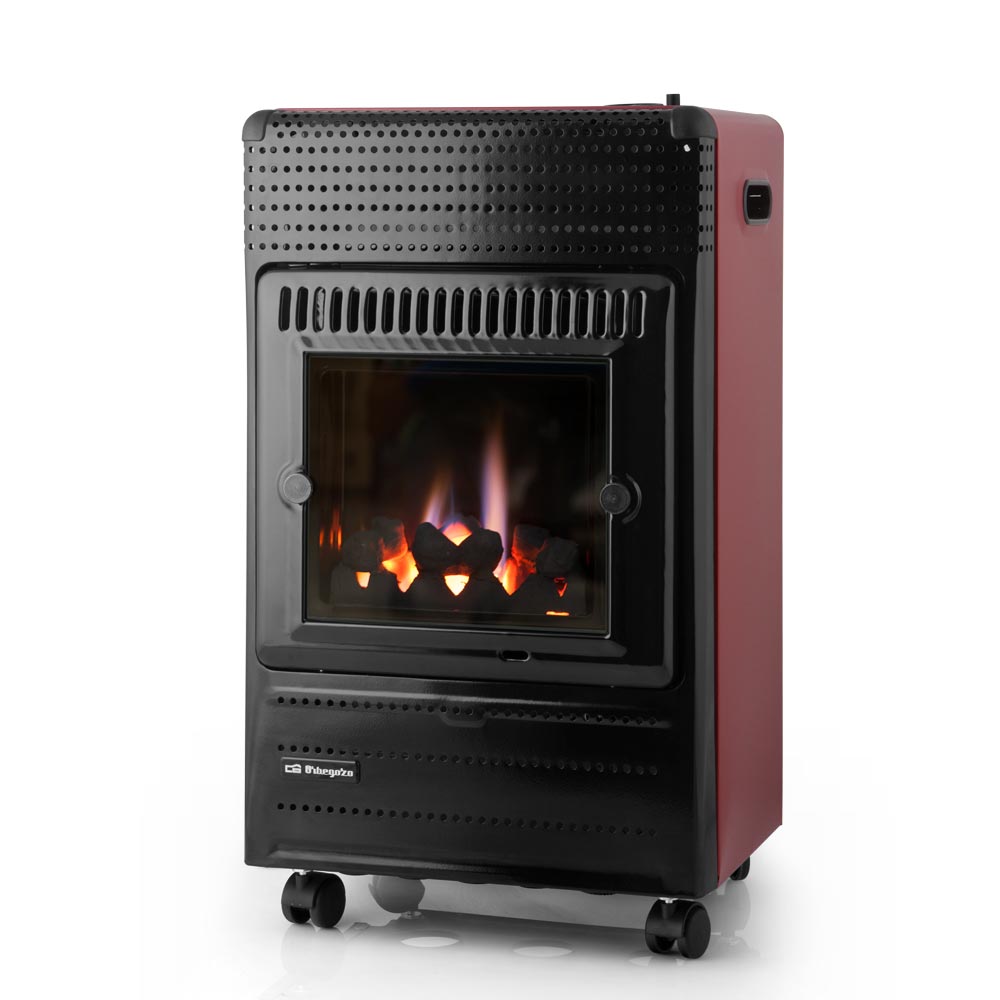
The blue flame heater works by convection: it heats the air of the whole room and spreads it around, with a visible blue flame behind a glass panel that also looks very nice. It is the most powerful of the three for large spaces, and depending on the model it covers big rooms of up to about 50 m². If what you want is to heat the entire living room of an open-plan house, this is the one for you.
In stock we have the Orbegozo HBF 95 blue flame, 3500 W with fire effect (around €165) and the Orbegozo HBF 100, 3800 W with tempered glass (about €194). The latter, with its glass and black finish, has a more refined look and sits well in the living room without shouting garage heater.
Quick guide: which technology for your room and how you use it
If you are in a hurry, this table settles the decision. The rule is simple: think first about which room and how you use it, and the technology follows.
| Technology | Ideal for | Advantage | Limitation |
|---|---|---|---|
| Catalytic (H 55) | Bedroom, living room where you spend the day sitting | Gentle, even heat, no flame and no noise | Slow to warm up; uses a little more oxygen |
| Ceramic / infrared (HCE 73, HCE 74) | Kitchen, workshop, an armchair, warming one spot quickly | Immediate, directional heat | Does not heat the whole room, only what is in front of it |
| Blue flame (HBF 95, HBF 100) | Large living room, open-plan house, big spaces | Plenty of power, heats all the air (up to ~50 m²) | Bulkier and more expensive; overkill for a small room |
Put bluntly: bedroom or sitting room, catalytic. Kitchen, workshop or a quick warm-up, ceramic. A really big living room, blue flame. And if you have a house with several rooms, it is not unreasonable to combine two, for example a ceramic one for the quick blast in the kitchen and a blue flame one for the living room.
What is not negotiable: safety and ventilation in a stone house
I am not going to frighten you here, but I am not going to soften anything either, because I have spent my whole life selling and fitting these heaters and I know what happens when they are used badly. Every butane heater uses oxygen from the room and releases water vapour and CO2 when it burns the gas. That is not a defect, it is physics: it is how it works. The risk is real, but perfectly manageable if you respect four things.
- Always ventilate, with a window left open a finger's width at least. You are not throwing the heat away, you are renewing the air and stopping CO2 from building up. In a well-sealed stone house, this matters even more.
- Do not leave it on while you sleep. You switch it on to warm the room before going to bed and then you switch it off. Sleeping with the gas heater running is the one mistake you cannot make, however cold the house is.
- Do not use it in bathrooms or in small closed bedrooms without ventilation. Small, airtight spaces are exactly where oxygen drops fast.
- Have a CO detector at home. It is not compulsory, but for what it costs it is the best peace of mind you can buy, especially if there are elderly people in the house.
The ODS, the hose and the regulator: the check before lighting
Modern heaters, like the Orbegozo models we sell, come as standard with an ODS or atmosphere analyser: a safety device that cuts the gas automatically if the oxygen in the room drops below a safe level. It is the safety net that the old ones did not have. They also have an anti-tip device, which cuts the gas if the heater falls over. Buying a modern one, even if it costs a little more than a second-hand one from an acquaintance, means buying precisely that.
And then there is what depends on you, not on the heater:
- The regulator must be the one approved for butane and in good condition. Do not improvise with one you have left over from something else.
- The hose has an expiry date printed on it. Look for it. If it has expired, or if the hose is cracked or hard, change it before lighting. It is a part that costs a couple of euros and spares you a big upset.
About the famous drying effect, it is the other way round from what people think. Many people think butane dries the air, and it is exactly the opposite: when it burns, butane produces water vapour, so if anything it humidifies the air a little. The dry-throat feeling comes from electric heaters, those red-hot elements that toast the air, not from butane. I have heard it explained wrongly a thousand times; now you know.
And now the honest fact that almost nobody tells you about real cold: below about 5 °C, the liquid butane in the bottle does not turn to gas well and the heater gives less heat or can even go out. That is why, on January nights in the upland areas of the Almanzora, you may find the heater does not draw. It is not broken, it is the cold. In those areas propane holds up much better, but be careful, because propane comes in its own bottle, not in the usual orange butane one. In the rest of the valley, ordinary butane is more than enough.
What to check before taking a butane heater home
When someone comes to the counter, these are the questions I ask before selling them anything. Go through them yourself too:
- Power according to the square metres. As a rough rule, allow around 100 W per square metre in a normal house, and raise the figure if yours is poorly insulated, which in the Almanzora is usual. For a bedroom, a catalytic or ceramic heater is plenty; for a large living room you need the blue flame.
- Weight and whether it has wheels. If you are going to move it from one room to another, bear that in mind. The HCE ceramic heaters weigh around 13 kg and are easy to handle on wheels, but check whether there are steps or whether the person moving it is not very strong.
- Whether the regulator is included or sold separately. Always ask before leaving the shop, so you do not get home and find you cannot connect it to the bottle.
- Approval. It should carry the CE mark, ODS and anti-tip. The Orbegozo models have all of this covered.
- Where you will put it. Away from curtains, sofas and anything that could catch fire, with free space around it and in a spot you can ventilate.
The Orbegozo models available at Híper Ocio
These are the five we have, with an approximate price and who each one is for. They are portable appliances: you can come and see them at the Albox shop and take them away, or order them. I am not promising free national shipping specifically for heaters or a van with installation (that is for large white goods); this is a heater that fits in the boot of your car.
- Orbegozo H 55 (catalytic, 3000 W), around €140. For bedrooms and sitting rooms where you want gentle, silent heat.
- Orbegozo HCE 73 (ceramic, 4200 W), about €106. For an immediate blast of heat in the kitchen, the workshop or a corner.
- Orbegozo HCE 74 (ceramic, 4200 W), around €100. Practically a sister to the previous one, with the same philosophy of direct heat.
- Orbegozo HBF 95 (blue flame, 3500 W, fire effect), about €165. For heating a whole living room with the blue flame on show.
- Orbegozo HBF 100 (blue flame, 3800 W, tempered glass), around €194. The most powerful and the one with the most refined finish, for large living rooms and for anyone who also wants it to look good.
Why buy it at Híper Ocio
We are a family shop in Albox, on Avenida 28 de Febrero, founded in 1923. Antonio Martínez Rosado is the fourth generation at the helm, and in a hundred years this business has sold and repaired more than enough gas heaters to tell you knowledgeably which one suits you and which does not. We are an official Orbegozo point of sale, so the machine you take home is what it says it is, with the manufacturer's backing.
You can come to Albox to see them in person and ask without any commitment; for us that is normal. All the appliances carry the 3-year legal guarantee required by Spanish law, and if you prefer to spread the payment, financing is available without any fuss. If something does not work out, you have 30 days under our returns policy. For any question, or to reserve one, write to us on WhatsApp at 623 04 44 20 and we will look after you.
Frequently asked questions
Is a butane heater dangerous?
Not if it is used properly. The risks are real, because it uses oxygen and releases CO2 and water vapour, but they are perfectly manageable: always ventilate with a window slightly open, do not leave it on when sleeping, do not use it in bathrooms or small closed rooms, and buy a modern one with ODS and anti-tip. A CO detector at home gives you extra peace of mind.
Can I leave it on while I sleep?
No, never. You switch it on to warm the room and switch it off before going to bed. Sleeping with a butane heater running is the mistake you must not make, however cold the house is.
Does butane dry the air?
On the contrary. When it burns, butane produces water vapour, so if anything it humidifies the air a little. The feeling of dry air and a dry throat is typical of electric heaters, not of butane.
Why does my heater give less heat in January?
Because below about 5 °C the liquid butane in the bottle does not turn to gas well, so the heater gives less heat or even goes out. It usually happens on the cold nights in the upland areas of the Almanzora. It is not broken, it is the cold. In those areas propane holds up better, although it comes in a different bottle from the usual orange one.
When do I change the regulator hose?
The hose has an expiry date printed on it. If it has expired, or if it is cracked or hardened, change it before lighting the heater. It is a cheap part that spares you trouble, and the regulator must be approved for butane.
Do you sell butane at Híper Ocio?
No. We sell the heaters, but not the gas. The butane bottle is supplied by the local distributor (Repsol or Cepsa) or you can get it at petrol stations in the valley.