Pyrolytic or hydrolytic oven: which to choose (2026 figures)
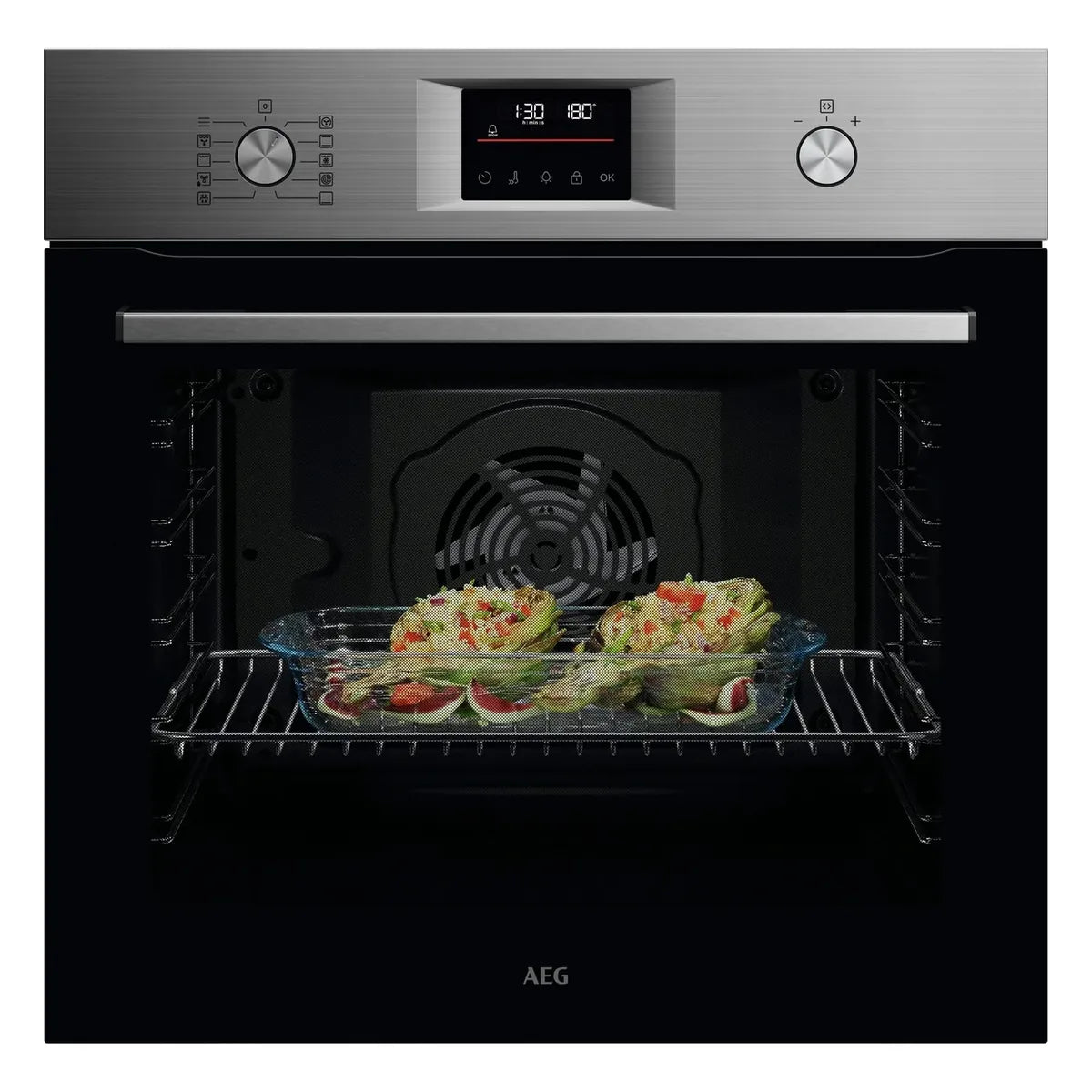
Sunday afternoon in Albox. The lamb has been in for three hours, the house smells wonderful and lunch has turned out perfectly. You open the door to take out the tray and there it is, as always: the fat that spattered during roasting, stuck to the enamel walls, burnt and black. Standing there with a scourer in your hand on a Sunday in August is when you really choose an oven. Before that, it is all spec sheets.
The question we hear most at the counter is exactly that: pyrolytic or hydrolytic oven, which to choose. And it is almost always framed the wrong way, because these are two systems that neither play in the same league nor solve the same problem. One burns the grime away at almost 500 degrees; the other softens it with warm steam and then you wipe it off with a cloth. Getting it right depends on three things about you: how you really cook, how much scrubbing by hand you are prepared to do and how much you want to spend (when you buy it and every time you run the cycle).
Here we explain the four systems available (pyrolytic, hydrolytic, catalytic and traditional multifunction), give you the specific figures for each one (temperature, consumption, time and approximate cost per cycle) and tell you frankly what we stock and who each option is worth it for. We have been a family shop in Albox since 1923; we care more about you getting it right than about selling you the most expensive model, because the customers who get it right come back.
Updated October 2026. This guide incorporates the one we had on pyrolytic, hydrolytic and catalytic ovens, so you have everything in one place. Here is what is in our catalogue today, with this week's prices. Among the manual-clean ovens with units in store: the Artica AHB6203X 62 L conventional oven (€159.99), the Wonder WHM86500X stainless steel multifunction (€199.99), the Infiniton CB6516 65 L (€211.99), the Beko BBIE18300W 72 L with steam function (€279) and the Balay 3HB5131N3 71 L (€359). The pyrolytic Infiniton TBPYE27 (€383.99) and Infiniton PYE7028 (€391.99) are in our catalogue, but currently have no units in store: please ask us about lead times before deciding.
What each system does inside (and why "self-cleaning" does not mean the same thing on all of them)
The word "self-cleaning" is printed on the boxes of appliances that work in very different ways. Before looking at prices, it is worth knowing what actually happens inside each one.
Pyrolytic: burning everything down to ash
This is the most effective system. The oven heats up to around 450-500 °C and burns off any residue (grease, caramelised sugar, splashes) until it is reduced to grey ash. When the cycle ends (1 to 3 hours depending on the model and intensity), you wipe the inside with a cloth and it looks like new, including the baked-on grease and burnt sugar that no other system fully removes. The door locks automatically for the duration, because at those temperatures it must not be opened. The price of that effectiveness: it draws a lot of power (around 3,000-3,500 W during the cycle), it needs good insulation and it makes the appliance more expensive.
Hydrolytic (aqualysis): low-temperature steam
Nothing is burnt here. You pour water (sometimes with a few drops of detergent or vinegar) into the tray or the cavity, start the programme (around 30 minutes) and the oven generates steam at around 70-90 °C, without going above about 200 °C. The steam softens the dirt and you then wipe it away with a cloth. It uses far less energy than a pyrolytic oven, but it is less effective on heavily baked-on dirt and means you have to finish off by hand and be consistent: if you let grease build up for weeks, steam will not work miracles.
Catalytic: panels that absorb grease while you cook
It has porous enamelled panels on the walls that absorb and oxidise grease during normal cooking, from around 200 °C. There is no separate cycle to start. The downside: it does not clean sugars or the base of the oven, and over the years the panels become saturated and have to be replaced, which has a cost.
Traditional multifunction: you clean it by hand
No self-cleaning of any kind. It is the cheapest to buy and, with a good degreaser and a bit of elbow grease, it stays in perfect condition. For anyone who uses the oven little or does not mind scrubbing, it is a very sensible option that is sometimes dismissed because it is not fashionable. You will find real examples in our cooking collection.
The figures that matter: temperature, kWh, time and cost per cycle
This is the table that hardly anyone shows you clearly. Figures checked as of August 2026; consumption and cost are approximate and depend on the model, the intensity of the cycle and your electricity tariff.
| System | Process temperature | Power during the cycle | Duration | Consumption per cycle (approximate) | Finishing by hand |
|---|---|---|---|---|---|
| Pyrolytic | 450-500 °C | 3,000-3,500 W | 1-3 h | ~2 to 5 kWh | Just a wipe with a cloth |
| Hydrolytic | 70-90 °C (steam) | Low | ~30 min | Very low | Yes, with a cloth |
| Catalytic | From ~200 °C (while cooking) | Normal cooking power | No separate cycle | No extra cycle | Base and sugars, yes |
| Traditional | No process | — | — | 0 | Everything by hand |
What a pyrolytic cycle really costs. This is what worries people most, and it is hardly ever worked out. If a cycle uses between 2 and 5 kWh and you take an approximate electricity price of around €0.15/kWh, each self-clean costs you roughly €0.30 to €0.75. With a more expensive tariff, say €0.25/kWh, it would rise to a range of about €0.50 to €1.25. In other words: although pyrolytic ovens have a reputation for being power-hungry, an occasional clean costs less than a coffee. The expensive part is not the cycle; it is the extra price of the appliance.
The hydrolytic oven, with its short low-temperature cycle, uses a fraction of that: practically what it costs to heat half a litre of water. As a mental summary: pyrolytic = maximum effectiveness with a small but real cost per cycle; hydrolytic = an almost negligible cost in exchange for manual work and consistency.
How much more a pyrolytic oven costs and when it pays off
A pyrolytic oven needs better insulation and more robust electronics, so within the same brand and capacity it is usually considerably more expensive than the same oven in a traditional version. The honest question is not "is it better?" (it is), but "will you get your money's worth from that extra cost?". You do not need a spreadsheet to answer it, just two figures of your own:
- How many heavy roasts you do a month. Lamb, suckling pig, rack of ribs, trays that spatter grease all over the walls. That is where a pyrolytic oven genuinely saves you time and effort.
- How much you value your time (and your back) spent scrubbing. Removing burnt-on grease from an oven by hand means 20-40 minutes of scourer, degreaser and awkward posture, and you have to repeat it every so often.
The rule of thumb we give at the counter: if you cook greasy roasts several times a month, a pyrolytic oven pays off, because the extra cost is "paid back" in time and convenience within one or two years of heavy use. If you switch the oven on to heat up a frozen pizza and little else, you will never get that extra cost back. Note the important point: what decides it is not the consumption of the cycle (that is a matter of cents, as you have seen), but the purchase price compared with how often you will really use the self-cleaning.
Heat, noise and safety during the cycle: what to expect at home (and in August)
A detail that matters in Almería and that the brochures leave out: a pyrolytic cycle in August heats up the kitchen. You are taking the oven to almost 500 °C for one or two hours and, however well insulated it is, some heat radiates into the room. The sensible thing here is to schedule the self-clean first thing in the morning or at night, with the window open, and not at three in the afternoon on an August day with the house shut up.
Everything else you will notice during the cycle is normal, not a fault:
- The door locks automatically and will not open until the temperature drops. That is the safety system doing its job.
- The cooling fan is louder than usual: there is a background hum while the process lasts.
- You may notice a slight smell the first few times, especially if a lot of grease had built up. Air the room and it goes away.
- It is advisable to remove the runners and trays that the manufacturer specifies before starting the cycle, because they can discolour at those temperatures.
None of this is a problem; it is simply good to know before you buy so that you do not get a fright on the first Sunday.
Which oven, depending on how you really cook
Forget abstract profiles. See which of these three describes you and you will have your answer.
The weekend roaster
Lamb, ribs, large trays, guests. You cook big and greasy, and the last thing you want on a Sunday evening is to battle with the enamel. Your oven is a pyrolytic one. If you are looking for the best in insulation, functions and finish, have a look at the AEG 72-litre pyrolytic oven. If you want the effectiveness of pyrolytic cleaning without moving up to the top range, the Infiniton 70-litre pyrolytic oven is a very reasonable entry point.
The everyday cook
You use the oven almost every day, but you cook lighter food: chicken, vegetables, gratins, the occasional sponge cake. You make it dirty, but you do not leave it in a terrible state. Here a mid-range pyrolytic oven gives you peace of mind without thinking about cleaning, and the Infiniton PYE7028 70 litres in stainless steel and black glass is more than up to the job. If you are consistent with the cloth, a good traditional oven will also do and you save the extra cost.
The occasional oven user
You switch it on to reheat, for frozen food and for the odd treat. Paying the extra for a pyrolytic oven makes no sense at all. Go for a traditional multifunction, such as the Infiniton CB6516 65 litres or the Infiniton CA6516 70 litres with 8 functions: you spend less when buying and you clean it in two minutes because it hardly gets dirty. You can compare everything in our built-in ovens collection.
What we stock at Híper Ocio (and what we do not), plainly
Time to be clear. At Híper Ocio we mainly stock pyrolytic and traditional multifunction ovens, because they are the two systems we genuinely recommend to most people around here: pyrolytic for those who cook heavily, traditional for those who use the oven little or do not mind scrubbing.
Hydrolytic and catalytic are sound systems that you will find in other brands and ranges, which is why we have explained them with the same rigour. But we are not going to oversell them: hydrolytic requires consistency and finishing by hand, and catalytic falls short with sugars and the base, as well as needing its panels replaced over the years. For typical use in a home in the Almanzora, with its Sunday roasts, we are more convinced by a well-chosen pyrolytic or traditional oven. If you would like to browse everything we have at your leisure, the full home appliances collection is there for you.
Buying and installing it in the Almanzora: space, power supply and guarantee
A built-in oven is not a toy that arrives in a parcel: it is an appliance that has to be fitted into the cabinet and connected properly. That is why we only sell, deliver and install ovens in the Valle del Almanzora, the Levante Almeriense and Los Vélez, with our own van. We do not supply them outside that area, and we would rather tell you upfront before you make your purchase.
Before buying, especially if you are renovating, have three details to hand:
- The measurements of the built-in space. Most are standard (around 60 cm), but measure it anyway: width, height and depth of the cabinet.
- The available electrical power. A pyrolytic oven can draw 3,000-3,500 W during the cycle; make sure your wiring and RCD can cope without tripping.
- The ventilation of the cabinet, so that the oven can breathe and dissipate heat properly, especially during self-cleaning.
If you have any doubts, send us the measurements and we will tell you what fits. The legal guarantee in Spain is 3 years, and here we stand behind what we sell with the face and name of a family that has been in Albox since 1923. If you need to spread the cost, you can finance it with Aplazame over up to 12 months interest-free (minimum amount according to Aplazame's conditions); the details are on our financing page. And if something does not suit you, our returns policy allows 14 days. For specific questions, message us on WhatsApp at 623 04 44 20 and we will look into it.
Quick questions with answers in figures
How much does a pyrolytic cycle use?
Between 2 and 5 kWh per cycle depending on the model and intensity. At an approximate price of €0.15/kWh, that is around €0.30 to €0.75 per clean, depending on your tariff.
How long does each system take to clean?
Pyrolytic, between 1 and 3 hours. Hydrolytic, around 30 minutes plus finishing by hand. Catalytic has no separate cycle: it cleans while you cook.
At what temperature do pyrolytic and hydrolytic ovens clean?
A pyrolytic oven reaches around 450-500 °C to burn off residue. A hydrolytic oven works with steam at around 70-90 °C, without the oven going above about 200 °C.
Is pyrolytic better than hydrolytic?
It is more effective, especially with heavily baked-on grease and sugar, and involves hardly any manual work. Hydrolytic uses much less energy but requires finishing by hand and consistency. It depends on how much and how you cook.
When is it worth paying the extra for a pyrolytic oven?
If you cook greasy roasts several times a month, it pays for itself in time and convenience within one or two years of heavy use. If you use the oven little, a traditional multifunction is better value.
Do you install ovens throughout Spain?
No. We only sell, deliver and install ovens with our own van in the Valle del Almanzora, the Levante Almeriense and Los Vélez.