How to Play Carcassonne and Which Version to Buy
It is half past eleven at night in a house in the Almanzora valley. On the table there are coffee cups, a plate of breadsticks and an open cardboard box with a medieval map half built. The brother-in-law, who an hour and a half ago had said "board games are a bore, that's for kids", has spent the last five minutes arguing heatedly because someone is about to steal a field of farmers that he had "been sure of from the very start". Nobody has looked at their phone for a good while. Nobody has noticed the time passing.
We have heard that scene in the shop a thousand times, told by customers who come back for an expansion or for another box to give as a gift. And almost always the game behind it is the same: Carcassonne. A German game from the year 2000, winner of the Spiel des Jahres (the "Game of the Year", the biggest prize in the industry) in 2001, with the rare gift of hooking even the person who swears blind that this isn't for them.
At Híper Ocio we are an official Devir retailer, the publisher that brings it out in Spanish, and we have spent years selling it, explaining it at the counter and playing it at home. So this is the guide we wish someone had given us: what it is, how it really plays turn by turn, what scores, the classic mistakes of a first game and, most important when you are standing in front of the shelf, which version to buy depending on who you will be playing with. No smoke and mirrors.
What Carcassonne is and why it hooks even people who "don't play board games"
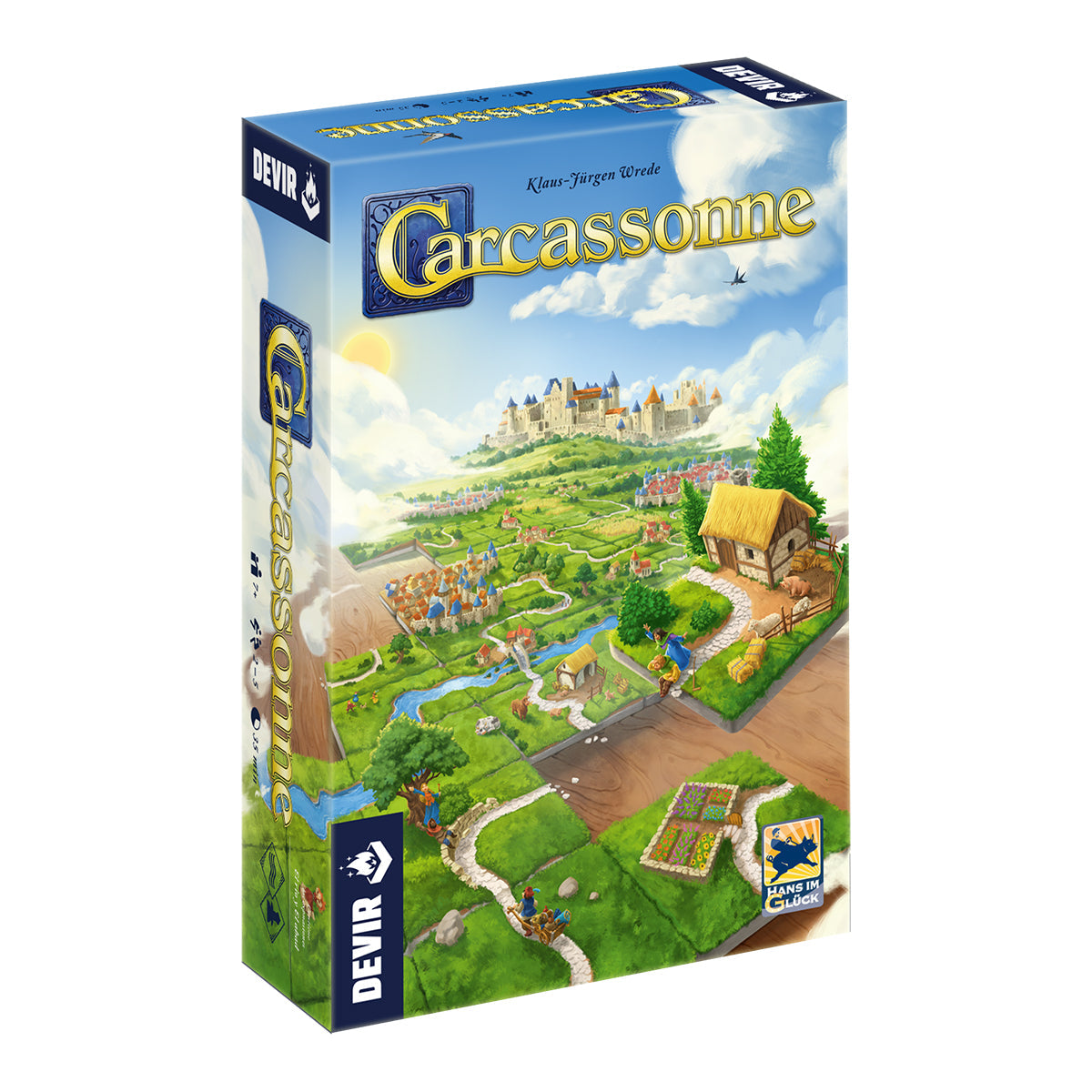
Carcassonne is a tile-laying game. In other words: between you, you build a medieval landscape on the table, piece by piece, with roads, walled cities, fields and monasteries, and you place your little figures (the famous meeples) to claim those constructions and score. When the tiles run out, whoever has the most points wins. That's it. That is the essence, and it fits in two sentences.
It was designed by Klaus-Jürgen Wrede and first published in 2000. In Spanish it is published by Devir, and it is one of the best-selling "modern" games in history. But the facts don't explain why it hooks. What hooks is this: the rules can be explained in five minutes, but every turn has a real decision in front of it. Do I close this city myself, or let someone else close it and steal their spot? Do I put a farmer down now, knowing I won't get it back until the end of the game, or do I keep it for later?
In the industry this is called a "gateway game" or bridge game: the one used to take someone across from Ludo and Monopoly to modern board games. And Carcassonne is the king of that category. That is why it works on the sceptical brother-in-law: it doesn't ask him to read a twenty-page manual, it asks him to place a tile. By the third round he is already working out who can ruin his city.
What is in the box and what you need to start (spoiler: nothing else)
One of the things that reassures people most at the counter is this: the base box comes with absolutely everything you need to play the first game and the next hundred. There is nothing else to buy. Inside you will find:
- 72 terrain tiles: the thick cardboard pieces with bits of road, city, field and monastery that fit together one after another.
- 40 followers (meeples): 8 per colour, in 5 colours (yellow, red, green, blue and black). These are your little wooden figures, the ones you place to score.
- A scoring board to keep track of points, with one meeple of each colour acting as a marker.
- The rulebook.
And that's all. You don't need dice, cards, an app or batteries. A table and from two to five people. That is the whole kit. When someone asks me "so can I play with this, or am I missing something?", the honest answer is: with this you will be playing for years. You can find it in the Devir Carcassonne base box.
How to play, turn by turn: draw a tile, fit it in and decide whether to place a meeple
Here is the heart of the game, and it is so simple that it is almost embarrassing how well it works. On your turn you always do three things, in this order:
- You draw a tile from the pile, which is face down, so it comes out at random. You don't choose: you get the one you get and you make the best of it.
- You place it on the table, fitting it next to a tile that is already down. The only rule is that it has to match: city with city, road with road, field with field. It is like dominoes, but in two dimensions. You can turn the tile any way you like until it fits.
- You decide whether to place a meeple (this is optional). You can put ONE of your figures on the tile you have just placed, and only on that one. Depending on where you put it, it plays a different role, which we will see in a moment. If you aren't interested, you place none and you pass the turn.
The trick of the whole game is in point 3. You start with 8 meeples and only those. Each one you place stays "at work" on the board and does not come back to your hand until the construction it sits on is finished and scores. So managing your meeples, when you release them and when you get them back, is basically the entire game.
A meeple can play four roles depending on where you leave it:
- Knight, if you stand it up in a city.
- Thief, if you stand it up on a road.
- Monk, if you put it on a monastery tile.
- Farmer, if you lay it down on a field.
And the turn passes to the next player. Draw, fit, decide. Over and over, until the pile of tiles runs out and the final count is made. There is no hidden mechanic: what looks simple is simple. The depth lies in when and where you release each little figure.
What scores and how it is counted: roads, cities, fields and monasteries
This is the part worth having clear, because it is where games are won and lost. There are four ways to score and each works differently:
- Roads (thief): a road scores when it is closed at both ends (by a junction, a city or a monastery). It gives you 1 point per tile that makes it up. These are modest points, but quick and safe, and as soon as it scores you get the meeple back.
- Cities (knight): a city scores when it is completely walled in, that is, closed on every side with no gaps. It gives 2 points per tile, plus 2 extra points for each shield that appears inside it. Big cities are the biggest source of points... and also the biggest risk, because if you don't manage to close one before the tiles run out it is worth much less.
- Monasteries (monk): you put the meeple on the monastery tile and it scores when it is completely surrounded, with all 8 tiles around it in place. It gives 1 point for the monastery itself and 1 for each tile around it: up to 9 points. It is a quiet, very profitable move, ideal for beginners because it doesn't depend on anyone else.
- Fields (farmer): the most misunderstood of the four. The farmer you lay down on a field never comes back: it stays there until the end of the game. It only scores in the final count, and gives 3 points for each completed city that touches that field. It can be a fortune or it can give you almost nothing. It is the long-term bet.
Important, so that nobody argues at half past eleven: roads, cities and monasteries give the meeple back to your hand as soon as they score, during the game, and you can use it again. Farmers do not: they stay lying down until the end. That is why the brother-in-law in the introduction was fighting over a field. Fields are decided in the final count and win entire games when nobody was watching them.
The 3 beginner mistakes that ruin your first game (and how to avoid them)
After explaining this game hundreds of times, the slip-ups are almost always the same three:
- Releasing all your meeples at the start. The classic. You put a figure on every tile you place and, by the fourth round, you have none left in your hand, watching the others build while you can't claim anything. Solution: place meeples with some thought, keep a few back and prioritise constructions that will close soon, because those give you the figure back quickly.
- Insisting on a giant city that never closes. It is exciting on paper and ruinous in practice. A huge city half walled in when the tiles run out is worth half, and on top of that it has kept a meeple blocked for half the game with no way of using it. Solution: medium-sized cities that you can close. Ambition, yes, but under control.
- Forgetting about fields. Beginners ignore the farmers the whole game and in the final count discover that a rival gets 15 or 20 points in one go with two well-placed farmers. Solution: plant at least one farmer in a field that touches several cities, even if it hurts to "lose" that meeple for the rest of the game.
How to teach it to children and grandparents without anyone getting overwhelmed
The usual worry of the buyer is: "how do I explain it to my mum or my 8-year-old without them nodding off?". Good news: Carcassonne can be explained in five minutes if you do it in the right order. This is the script we give in the shop:
- Don't explain the scoring at the start. Teach only how to draw a tile and fit it in (city with city, road with road). Let them play two or three turns just placing pieces. It sinks in instantly.
- Then bring in the meeples with the most visual part: "the one you put in the city is a knight, the one on the road is a thief". Leave the fields and farmers for later, as they are what confuses people most.
- Score the first construction out loud. When someone closes a road or a city, count the points together, tile by tile. That is when it clicks. The penny drops and you don't need to explain any more.
- With grandparents: the tiles and meeples are big, easy to see and easy to handle, there is no text to read and you set the pace. It works wonderfully after a long Sunday lunch.
- With little ones under 7: don't force the base game here. There is a version made to their measure, and I will tell you about it in the very next section.
Which Carcassonne to buy by age and group: base game, Junior, Niebla and Expansiones Reunidas
And now we come to the question that causes the most doubtful faces in front of the shelf. There are four boxes in the Carcassonne family that look very alike on the outside and that are not the same and are not for the same thing. Let's tell them apart once and for all:
- Carcassonne - Classic Board Game (base): this is the one in this guide. Ages 7+, from 2 to 5 players, competitive, the gateway game par excellence. If you are unsure, this is the one you want. It is also the starting point for everything else.
- Carcassonne Junior (trilingual): for ages 4+, simpler and cooperative and family-oriented. It is NOT an expansion or a "cut-down" version of the base game: it is a game in its own right, made for little ones who aren't ready for the classic yet. If you are going to play with children of 4, 5 or 6, this is your box, not the base game.
- Niebla en Carcassonne: a cooperative game set in the Carcassonne universe. Careful here, because this is where people most often get it wrong: it neither replaces nor expands the base game. It is a different proposition, where everyone plays together against the game itself, for anyone who knows the world and wants something collaborative instead of competitive.
- Carcassonne Expansiones Reunidas: a compilation of expansions to extend the base game. This is NOT something to buy on its own to get started: you need to have the classic already. It is the next step, for when the base game has become too small for you.
To make it impossible to go wrong, this is the cheat sheet we use at the counter depending on who is going to play:
- Family with little ones aged 4 to 6: Carcassonne Junior. Cooperative, simple and right for their age.
- Family with children aged 7 or over: Carcassonne base. The classic, which grows with them and never feels too small.
- Couple who want a game for two: Carcassonne base. It works very well with two; in fact it is more tactical and direct.
- Group of adults or friends: Carcassonne base, and if you have mastered it and it feels like too little, Expansiones Reunidas.
- Large group: Carcassonne base only just reaches 5 players.
- Anyone looking for something collaborative, everyone against the game: Niebla en Carcassonne.
When to expand it, price, delivery and guarantee before you buy
We tell you this with a shopkeeper's honesty: almost nobody needs expansions in the first year. The base box has plenty of life in it for dozens and dozens of games, and most people who buy the classic don't come back to the shop for more until quite a while later, if they come back at all. Don't let anyone sell you an expansion pack "just in case" on the same day you buy the game. You don't need it.
When DOES it make sense to move up to Expansiones Reunidas? When you notice the base game has become too small for you: when you have mastered it, you play often and you fancy adding new rules and elements to give it a twist. That is the moment. Not before.
On prices, being frank and without making up exact figures: a base Carcassonne is around €25-35; the Junior version usually comes in a little below; and the expansion compilations, as they bring a lot of content, go above. If we mention financing, it is only this: Klarna is available at checkout. Nothing more.
Why buy it at Híper Ocio
Without inflating anything, these are the real reasons:
- We are an official Devir retailer, the publisher that brings out Carcassonne in Spanish. It is not an odd import or an edition in another language: it is the official product in Spanish.
- Free national delivery across Spain from €49.99. As it is a board game there are no strange restrictions by area: it reaches you just the same in Almería, in Galicia or in Girona. Bear in mind the minimum amount for free delivery: if you only take the base game, rounding the order up with another box from the family often works out worthwhile.
- 3-year legal guarantee and 30 days for returns if something doesn't suit you, according to our returns policy.
- We are a real shop, a family one, in Albox since 1923 and now in its fourth generation. If you have doubts before buying, write to us on WhatsApp at 623 04 44 20: there is a real person on the other end who has played this and will tell you straight which box suits you.
And going back to that table at the start: at the end of the night, the brother-in-law who said board games were a bore was the one who asked "shall we play another?". That is Carcassonne. A medieval map, some little wooden figures, a Sunday lunch that drags on and a perfectly healthy argument over a field of farmers. I can't think of a better way to spend twenty-odd euros.
Frequently asked questions
How many players does Carcassonne take?
The base box is for 2 to 5 players. It works very well with two (more tactical and direct) as well as in a big group of up to five.
From what age can you play?
The base Carcassonne is recommended from age 7. For little ones aged 4 to 6 there is Carcassonne Junior, a simpler, cooperative version made to their measure.
How long does a game last?
Roughly between 30 and 45 minutes, depending on the number of players and how much thought goes into each turn. It is an after-lunch game that doesn't drag on forever.
Do I need expansions to start?
No. The base box has everything you need for years of games: 72 tiles, 40 meeples, scoring board and rulebook. Almost nobody needs expansions in the first year.
What is the difference between Niebla en Carcassonne and Expansiones Reunidas?
They are different products. Niebla en Carcassonne is a cooperative game set in the universe of the game, which neither replaces nor expands the base game. Expansiones Reunidas is a compilation of expansions to extend the base game, and you need to have the classic already.
Is it easy to explain to someone who doesn't play board games?
Yes, that is its great virtue. The basic rules can be taught in about five minutes: draw a tile, fit it in and decide whether to place a meeple. It is the gateway game par excellence for hooking anyone who says this isn't for them.