Back to school 2026: educational games that reinforce schoolwork without feeling like homework
Every September the same conversation happens at our counter. A mum or dad comes in, usually in a hurry, and says some version of this: «the teacher said to practise reading at home», «he's only just getting by with his times tables», «her English is terrible». And then comes the real question, the one that matters: «but how do I do it without it turning into a battle?».
Because the problem is almost never the content. Revision workbooks exist, they are cheap and they are well made. The problem is that at six in the evening, after six hours of lessons and another hour of homework, a seven-year-old has nothing left in the tank for more paper. And you don't feel like fighting either. So it either gets done badly, gets done late, or doesn't get done at all.
The alternative we have been recommending in the shop for years is neither magic nor fashionable pedagogy: sit down for fifteen minutes and play something that, without saying so, trains exactly the same skills. Reading words, adding quickly, organising ideas, keeping attention. Here is what we have in stock right now in Albox, why each one works and what age it really suits. Nothing inflated.

Why a game works where a worksheet doesn't
It isn't that the worksheet is bad. It's that it asks for something the child no longer has at that hour: sustained voluntary effort with no immediate reward. A game, on the other hand, brings in three things a worksheet doesn't have:
- Turns. The child waits, watches what the others do and comes back. That cycle trains sustained attention far better than twenty minutes of silence in front of a sheet of paper.
- Repetition that doesn't feel like repetition. In one game of dominoes a child does fifty mental operations. Put them in a column and they give up at the fifth.
- An adult sitting there. This is what weighs most and what is said least. Half the effect isn't in the game: it's in someone sitting opposite for fifteen minutes.
That said, an educational game doesn't replace school or fix a real learning difficulty. If you suspect dyslexia, dyscalculia or a serious attention problem, the thing to do is talk to the teacher and the school's counsellor. A game is reinforcement and habit, not a diagnosis. Let's be clear about that before going on.
Reading and writing: from first letters to spelling
This is the category we are asked for most in September, and the one that goes wrong most often if you buy by the age on the box instead of by where the child really is.
Ages 3 to 5: recognising letters, not reading
At this age the aim is not reading, it is for the letter to stop being a strange drawing. The Diset Yo Aprendo – Mis Primeras Letras (€23.99) does exactly that: self-correcting pieces that only fit if the letter is the right one, so the child corrects themselves and you don't have to say «no» fifteen times. It is the classic Diset format and it works because it takes the adult out of the role of corrector.
The Cayro Mi Primer Juego de Palabras (ref. 161), at €21.99, is the next step: letter tiles used to build simple words with the help of animal pictures. It is designed from age 4 and is one of the ones that stands up best to use, because Cayro's cardboard is properly thick.

Ages 6 to 9: fluency and vocabulary
Here the child can already decode, but reads slowly and with little expression. What is needed is a bigger bank of words and more speed, not more phonics. The Cayro Formapalabras Travel Metal Box (€11.99) is probably the best value for money on this whole list: FSC wooden letters in a small metal tin that fits in a handbag and can be played anywhere. When it becomes too easy, there is the bigger version, the Formapalabras Metal Box 756 (€19.99), which is a proper crossword-style word game for the whole family.
And for working on speaking and story structure —what the school report calls «finds it hard to organise ideas when writing»— the Creahistorias by Educa Borrás at €9.99 is the cheapest and most worthwhile buy in this article. A spinner, characters, settings, and the child has to build a coherent story out loud. Ten euros.
Age 9 and up: agility and healthy competition
Palabreando (€14.99) is an electronic game from Educa: one topic, one letter, twelve seconds. It sounds simple and it hooks older children as much as younger ones, which is exactly what you want so that the game gets played again without you having to suggest it.
Numbers and mental arithmetic without tears
Mental arithmetic is pure training. There is no shortcut: you have to do a lot of sums. The only thing you control is whether those sums are done willingly or dragged out.
The Cayro Mi Primer Rummiclasic (ref. 7044), €17.99, adapts the age-old rummy for children: runs, sets, comparing numbers. One game is dozens of number decisions in a row. When the child grows, the natural step is the large 6-player Rummi Classic (€22.99), which is already the grown-up game and takes the whole table at Christmas.

The other winner is dominoes. The Cayro Educational Triangular Domino (€14.99) swaps the rectangular tile for a triangular one: instead of matching two ends you have to match three, so the load of calculation and spatial awareness goes up without changing rules the child already knows. If you prefer the traditional format in a metal tin, there is the Triangular Domino 754 with 56 tiles (€19.99) or the Travel Metal Box at €11.99 to take out and about.
A shopkeeper's aside: ordinary dominoes are fine too. You don't need the triangular one. We stock it because it lasts more games before getting boring, not because the classic teaches less.
For money, change and coins —which is real-life maths and children are terrible at it— the Diset Children's Cash Register (€14.99) is still unbeatable from age 3-4. They play shop, you hand them the notes, and the sums take care of themselves.
English: what really moves the needle in primary school
Let's be honest about this. A board game isn't going to make anyone bilingual. What it does do, and it is no small thing, is fix vocabulary and take away the fear of speaking out loud, which is where half of primary-school children get stuck.
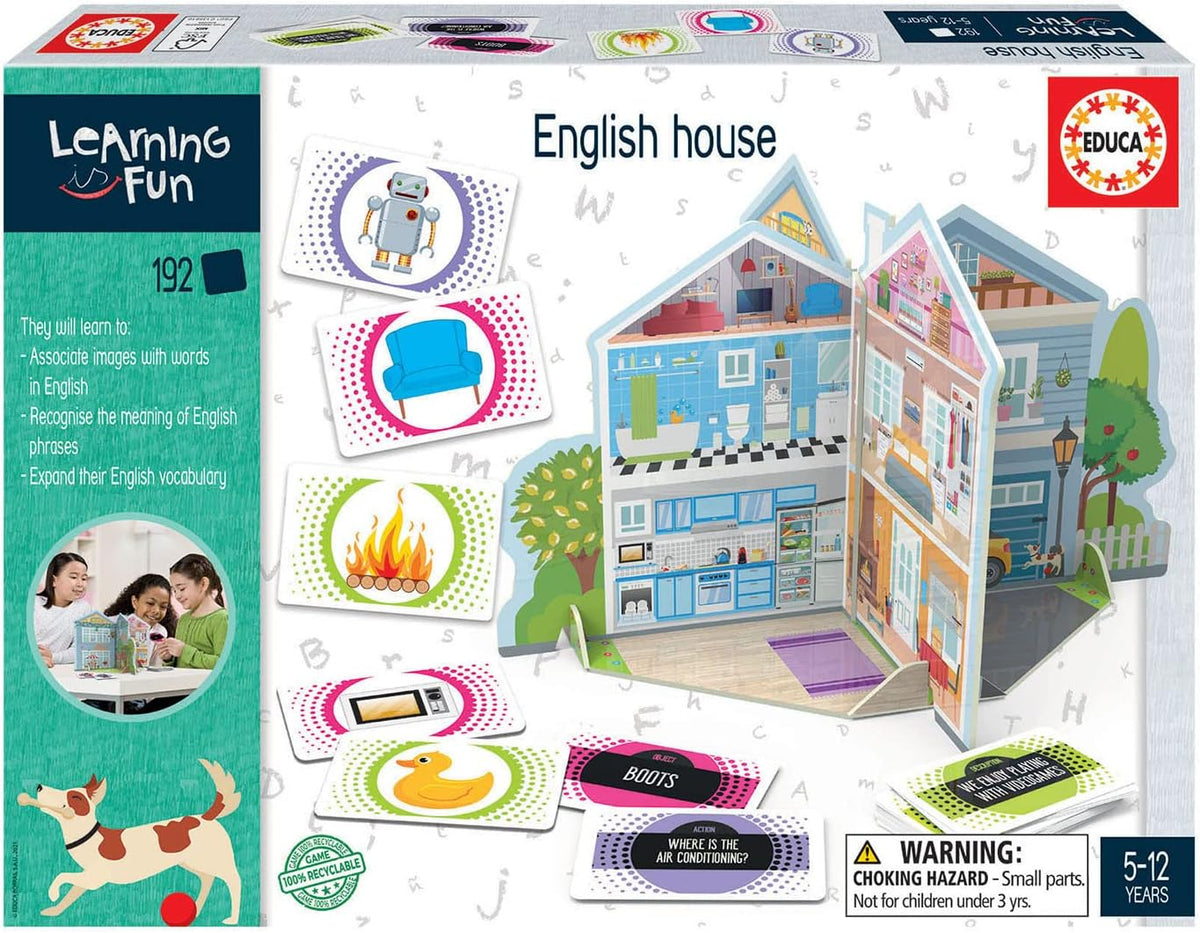
The English House by Educa Borrás (€14.95) works with 192 cards organised by topic —house, food, colours, animals— for children aged 5 to 12. It is one of the best-selling products in this category in the shop and one of those with the fewest returns, which is usually the best sign.
If you want something with audio, so the child hears the correct pronunciation and not their own —or mine— the Educa Touch Junior Aprendo Inglés (€21.99) is a touch-screen electronic game with activities by level. And in the same area there is the Lexibook bilingual Stitch laptop (€39.99), with 124 activities in Spanish and English: less serious as pedagogy, but a six-year-old with a keyboard and Stitch on the screen will play on their own for half an hour, and that counts too.

Attention, logic and concentration: what shows most in class
If the teacher tells you «he gets distracted», «she doesn't finish her tasks» or «he struggles to follow instructions», this is the section that interests you most. And oddly enough, you don't need «educational» games here: the classics are better.
Chess is the obvious example. The Cayro Mi Primer Ajedrez (ref. 169), €17.99, has large pieces and a board with coordinates, designed for ages 4-8. If the child already knows how to move the pieces and wants something that will last for years, the FSC-certified wooden Chess and Draughts set (€16.89) is a purchase that stays in the house for ever, and the Wooden Chess 633 (€19.99) with a solid 30×30 cm board is the serious format.
For deduction and asking useful questions —a hugely underrated classroom skill— there is Cayro's Mi Primer Quién es Quién (€16.95). And for pure visual attention and processing speed, the Educa Lince Disney (€19.99) or its version with 150 Stitch images (€24.99): finding one picture among hundreds, against the clock, is exactly the muscle used when copying from the board.
If you would rather solve it with a single purchase, Cayro's Set of 5 Classic Plus Wooden Games (€24.99) comes with chess, draughts, parchís, noughts and crosses and dominoes in solid wood. Twenty-five euros for five games that don't break.
Science and curiosity: for the child who asks about everything
There is a type of child who couldn't care less about letter and number games, but spends the afternoon turning over stones in the yard. With that child, forcing reading gets nowhere; coming in through curiosity does.
La Casa de los Insectos by Clementoni (€19.99) is an observatory with transparent compartments and a magnifying glass for catching a bug, looking at it for a while and letting it go. And La Ciudad de las Hormigas (€21.99) is the classic ant farm for observation, from age 7. A realistic warning: it needs the child to stay interested for several days and someone at home to remember the ants. If that isn't going to happen, better to choose something else.

For geography, which carries quite a lot of weight in years 3 and 4 of primary school, the Educa 1500-piece Political World Map puzzle (€14.99) is a weekend family project; the 3000-piece one (€24.99) is already one for adults with patience. In both cases the child ends up knowing where Mongolia is without anyone ever having asked.
And for the child who needs to do things with their hands, the Gran Juego de Magia by Borras (€20.99) with more than 100 tricks works on something no workbook touches: speaking in public without going blank.
School supplies that aren't school supplies
A short section, but one that sells itself in September. Clementoni's Pen Laboratory (€28.99) and Highlighter Laboratory (€29.99) kits let children make their own pens and highlighters. Is it essential? No. Does it make an 8-year-old want to get their pencil case out? A lot more than you'd think. There is also the Create your Stitch pens version at €23.99 and the Pen Creator Message (€29.99).
For the youngest ones starting nursery or infant school, Cayro's coloured wooden blocks (€19.99) are still the toy with the best ratio between what it costs and the hours it lasts. And the Educa Frozen Design Table (€19.99) is a light table for tracing and drawing, working on line control and fine motor skills just when it is needed.
Cycling to school: the part nobody talks about
In towns like Albox, Cantoria, Arboleas or Olula many children walk or cycle to school, and September is when you discover that last year's bike has become too small. The quick rule: 14 inches for ages 4-6 (about 95-110 cm in height) and 16 inches from age 5-6.
In 14" we have the Toimsa Paw Patrol (€134.99), the Blue Ice (€110.99) and the Unicornio Mágico (€109.99), all with stabilisers. In 16" there is the Toimsa Spiderman (€149.99). And the helmet is not optional: the Toimsa children's helmets are €17.99.

If the bike stretches the budget right in September, which is the worst month of the year for a family's wallet, on the website you can pay for it in instalments with Klarna. You will find the details on our financing page.
How to set up fifteen minutes a day that work
Buying the game is the easy part. Getting it used is the hard part. Here is what we have seen work in real homes:
- A fixed, short time. Fifteen minutes after the afternoon snack, before homework. Not after, when they are already worn out.
- One game at a time. If you put four boxes in front of them, they choose and end up playing none. One this week, another the next.
- You really play. You don't supervise: you play, and sometimes you lose. The moment the child notices you are correcting rather than playing, it's over.
- Stop before they get tired. Ending the game while they still want more is what makes them ask for it tomorrow.
- No prizes for winning. The game is the prize. If you bring in external rewards, you turn it into homework under another name.
And if it isn't working after two weeks, change the game without making a drama of it. Not every child comes in through the same door: some get hooked on words, some on numbers and some only on ants.
Why Híper Ocio
We are a family shop in Albox, open since 1923, now run by the fourth generation with Antonio Martínez Rosado at the helm. We belong to the Toy Planet chain and are an official authorised retailer of LEGO, Cayro, Toimsa, Panini, Asmodee, Devir and Ninco.
What that means in practice, without frills:
- The stock you see on the website is the real stock. If it says we have it, we have it.
- You can come to the physical shop —Avenida 28 de Febrero s/n, Albox— to open the box, touch the pieces and see the size before deciding. No screen gives you that.
- On toys and games we offer free delivery across Spain from €49.99.
- You have 30 days to return items under our returns policy.
- If you are torn between two games for your child's age, message us on WhatsApp at 623 04 44 20 and we will tell you what we really think, even if it is «neither of them, buy the nine-euro one».
A warning so nobody gets confused: household appliances and televisions are only supplied in the Valle del Almanzora, Levante Almeriense and Los Vélez area, delivered in our own van. For toys and games like the ones in this article, delivery across Spain is available.
Frequently asked questions
From what age does an educational game make sense?
From 2-3 years old there are already useful formats, such as wooden blocks or shape sorters. But the real leap comes around 4-5, when the child understands turns and simple rules. Before that age, what helps most is handling and building, not following instructions.
Do educational games help if my child has learning difficulties?
They help as reinforcement and as a habit, never as a substitute. If there is a suspicion of dyslexia, dyscalculia or ADHD, the first step is to talk to the teacher and the school's counsellor so they can assess. A game helps the child practise without getting frustrated, but it doesn't diagnose or fix an underlying problem.
What should I buy if I can only spend ten or fifteen euros?
With that budget, Educa's Creahistorias (€9.99) for speaking, Cayro's Formapalabras Travel (€11.99) for reading, or the Educational Triangular Domino (€14.99) for arithmetic. All three give the most value per euro on the whole list.
Do you deliver across Spain?
Yes, for toys, board games and small appliances, with free delivery from €49.99. Large appliances and televisions are only delivered, in our own van, to the Almanzora, Levante Almeriense and Los Vélez area.
Can I pay in instalments?
Yes: at checkout you can choose Klarna, which shows you the instalment options available for your purchase before you confirm. It makes sense mainly for purchases like a bike; for a fifteen-euro game it isn't worth it.
What if I get the wrong game for their age?
You have 30 days to return it under our returns policy. But before buying, the quickest thing is to ask us: tell us the age and what the teacher said, and we will point you in the right direction. It saves us both the trip back.