How to Choose a Jigsaw Puzzle: Pieces, Brand and the Detail Almost Nobody Checks (2026 Guide)
A jigsaw puzzle is one of the few products in the shop that people buy with a very clear idea (“I want a thousand-piece one”) and almost never do the sums that matter: where are you going to build it? Every autumn it is the same. September arrives, the weather cools, a table-top project sounds appealing, and a week later someone comes back asking whether we have a board, because the 2,000-piece puzzle doesn't fit on the dining table.
It is also not obvious what separates a €9.99 puzzle from an €11.99 one that looks identical. There are real differences (cardboard thickness, anti-glare finish, how the pieces are cut, whether they lock with a click or slide about), but none of them is printed on the box, so we will tell you.
This guide is what we explain to anyone who stands in front of the puzzle display not knowing where to start: how many pieces suit your real experience, which brand does what, how much space each size takes up, and how to build and store a puzzle so it doesn't end up in a bag at the back of a cupboard.

How many pieces to choose
The honest answer doesn't depend on how clever you are, but on how long you are willing to keep a table occupied. These are approximate hours for an adult with no previous experience, building in short sessions:
- 500 pieces: 4-8 hours. A relaxed weekend. The perfect size for getting back into the habit, or for a gift that doesn't commit anyone to much.
- 1,000 pieces: 10-20 hours. The worldwide standard and the one we sell most. Spread over a few evenings, about two weeks.
- 1,500 pieces: 20-30 hours. This is already a project: you need to be able to leave it built.
- 2,000 pieces: 30-50 hours. A month of evenings. The image really starts to matter here.
- 3,000 pieces or more: from 60-80 hours. This is a hobby, not a pastime.
If it is your first adult puzzle, don't start with 1,000 even if the price tempts you. A well-chosen 500 gets finished and leaves you wanting more; a badly chosen 1,000 sits half-done in the living room and makes you feel guilty. We have very affordable options in that range: the Jumbo 500 Venice at €7.99, the Ravensburger 500 Mundo de Mariposas at €8.99 or the Educa Borrá 500 Pequeño Ciervo at €8.99.
The image matters more than the number
Two 1,000-piece puzzles can have very different levels of difficulty. What makes one harder:
- Large areas of a single colour (sky, sea, snow, sand). A landscape with half a sky of plain blue is far harder than a city scene full of detail.
- Repeated patterns. Flower fields, crowds, mosaics.
- Works of art with a narrow palette. The 3,000-piece Guernica is a good example: in black, white and greys, the shape of the piece counts as much as the picture.
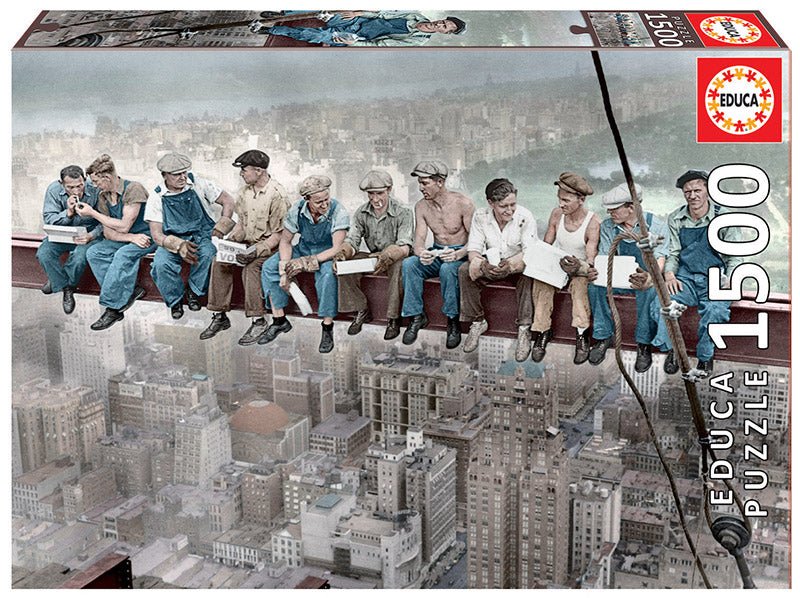
And the other way round: a very varied image, with lots of colours and small objects, practically builds itself even with many pieces. That is why the 1,500-piece Almuerzo en Nueva York (€14.99) is easier to live with than its number suggests: it is a black-and-white photograph, yes, but full of detail and with very clear structural lines.
The detail almost nobody checks: how much space it takes once built
Here is the real problem. These are the approximate dimensions for each format:
- 500 pieces: about 49 × 36 cm. Fits on any table.
- 1,000 pieces: about 68 × 48 cm. Already takes up half a dining table.
- 1,500 pieces: about 85 × 60 cm.
- 2,000 pieces: about 96 × 68 cm. Needs a table of its own.
- 3,000 pieces: about 120 × 85 cm.
- 4,000 pieces: about 136 × 96 cm. Here we are talking about a board or the floor.
- 6,000 pieces: about 168 × 119 cm.
And watch out for two special formats. The Jumbo panoramic puzzles, such as the Hudson Bridge in New York at €11.99, have the same 1,000 pieces but in a very elongated format: they take up less depth and a lot more width, which makes them ideal for hanging in a corridor and rather awkward to build on a small square table.
A practical rule: add 15-20 cm on each side to the finished size so you have room to sort pieces. If the numbers don't work out, either buy a size smaller or accept that you will build it on a board you can lift away.
Brand by brand: what sets them apart

Ravensburger
The benchmark for cutting quality. Its Softclick die-cutting makes the pieces lock with a noticeable click: you can lift a whole section without it falling apart. Thick cardboard, an anti-glare surface finish and very little cardboard dust in the box. If you plan to frame the puzzle, it is the safe choice.
In our catalogue we have the 1,000-piece Van Gogh “El Café de Noche” and the 1,000-piece Eiffel Tower, both at €11.99, and the 1,500-piece Windmill on the Baltic Sea at €16.99.
Educa Borrá
A Spanish brand from Barcelona with more than a century of history. It rules the large formats: if you are looking for 3,000, 4,000, 6,000 or more pieces, almost the whole market is theirs. Its big practical advantage is that it includes Fix Puzzle glue in the large boxes, and the ratio of pieces to price is unbeatable.
From our catalogue: the 2,000-piece Mount Fuji at €15.99, the 3,000-piece Guernica at €22.99 and, in the lovely and affordable 1,000 range, the Jardín Precioso and the Unicornios en la Playa by Vincent Hie, both at €9.99.

Jumbo
A Dutch brand, distributed here by Diset. Its strength is photographic European landscapes and panoramic formats, at a very reasonable price: most of its 500-piece puzzles are €7.99 and its 1,000-piece ones €11.99. Good cardboard, decent cutting, without the sophistication of Ravensburger but very honest for what they cost.
Clementoni
Italian. It stands out for licences and pop culture: we have the 1,000-piece Money Heist and the 1,000-piece The Witcher, both at €9.99. They also make the National Geographic Kids children's range, which works very well as a gift with something to learn.
Puzzles for children: which size for which age
The rule is different here. For children it is not about hours, but about the child finishing it and wanting to do it again:
- 1-3 years: wooden inset puzzles with knobs, 4 to 9 pieces. The Toy Planet animal inset puzzle with sounds (€16.99) or the 4 wooden puzzles in 1 (€14.99).
- 3-5 years: 24 to 60 pieces, preferably two puzzles per box so there is something new. The Educa 2×48 Aeropuerto y Tren (€7.99) is a classic.
- 6-8 years: 100 to 200 pieces. The Clementoni 104 National Geographic Kids Space Explorer or the 180 Ocean Expedition, at €7.99.
- 9-12 years: 300 to 500 pieces, or 3D lenticular puzzles if you want the surprise factor: the Prime 3D Superman vs. Doomsday (€9.99) changes image depending on the angle. We explain how they work in this article about lenticular puzzles.
How to build it without losing your patience
There is no magic, only method. The one that works:
- Tip everything out and turn every piece face up before you start. It is boring and it is 20% of the work.
- Separate the edge pieces. Build the frame first: it gives you the real dimensions and a physical reference.
- Sort by colour and by texture into trays, box lids or plates. Without sorting, a 1,000 turns into a 2,000.
- Tackle the areas with the most information first (faces, signs, objects) and leave the sky or the sea for the end, when those are the only pieces left.
- Look at the shape of the piece, not just the colour. In single-colour areas, group by the number and orientation of the tabs: four outward, two and two, three and one. It is what the fast builders do.
- Good light, from above. A lamp from the side casts shadows that hide the relief of the cut.
Keeping it, hanging it or going back in the box

If you want to frame it, you need glue made for the job. The Diset puzzle glue costs €4.99 and is plenty for a 1,000-piece puzzle. Three things worth knowing first:
- It is applied on the picture side, spread with the spatula supplied, in a thin layer. If you put on too much, the cardboard soaks it up and warps.
- Build on something you can move (foam board, a thin board) before gluing. Peeling a glued puzzle off the dining table ends badly for both of you.
- Leave it to dry for 4-6 hours, lying flat and away from draughts. Then, if you like, a second layer on the back gives it real rigidity.
If you prefer to take it apart and store it, put the pieces into bags by area instead of all loose together. You will be grateful next time you build it, and so will whoever inherits it.
The big ones: from 4,000 to 24,000 pieces

This territory is almost a monopoly of Educa Borrá. The 4,000-piece Librería Vintage (€37.99) is the most rewarding of the range: lots of detail, lots of colour, very little plain area; it builds better than many 2,000s.
Above it, the 6,000-piece Entrando en la Habitación (€54.99) and the 9,000-piece The Garden of Earthly Delights (€74.99), the complete Bosch, which measures around 192 × 138 cm once built. And at the top, “Vida”, with 24,000 pieces (€149): more than four metres long, supplied in four separate bags, and you will not build it in one sitting or in an ordinary room. We say it plainly because it is sometimes bought as a spectacular gift without thinking about where it will end up.
If you are going for one of these, two tips: build it in blocks on separate boards, and decide before you start what you will do with it when you finish.
Why Híper Ocio
We are a family shop in Albox, on Avenida 28 de Febrero, open since 1923 and now run by the fourth generation, with Antonio Martínez Rosado at the helm. We are part of the Toy Planet chain, and the puzzle display has been in the same spot in the shop for decades.
- You can see them before you buy. Holding the box, with the image at real size and the dimensions printed on the back, avoids 90% of surprises.
- We tell you whether it will fit. Ask us about the size of your table before you ask about the price. It is the useful conversation.
- Delivery across Spain, free from €49.99. Puzzles do travel: they are toys, not large appliances.
- Returns: 30 days under our returns policy.
- Real stock. What you see listed is in the shop or in our warehouse in Albox. If only one unit is left, the product page will say so.
If you are torn between two, send us a photo of the table where you will build it by WhatsApp on 623 04 44 20 and we will tell you which one fits.
Frequently asked questions
How long does a 1,000-piece puzzle take?
Between 10 and 20 hours for someone without much practice, spread over several sessions. With experience and a very detailed image, it can drop to 6-8 hours. A landscape with large areas of plain sky or sea can double that time even with the same number of pieces.
How much space does a finished 1,000-piece puzzle take up?
Around 68 × 48 cm in most brands. Add 15-20 cm on each side so you can sort pieces while you build: in practice you need a surface of at least 100 × 80 cm.
Which puzzle brand is better, Educa or Ravensburger?
It depends on what you are after. Ravensburger has better die-cutting and an anti-glare finish, and it is the choice if you are going to frame it. Educa Borrá dominates the large formats (from 2,000 pieces upwards), gives you more pieces per euro and includes glue in many large boxes. Neither will disappoint you with a standard 1,000.
From what age can a child do puzzles?
From one year old, with wooden inset puzzles of 4 to 9 pieces with knobs. Around the age of 3, cardboard puzzles of 24 to 48 pieces work, and from 6 you can move up to 100-200. The key is that they finish it: a puzzle that is too hard discourages more than it teaches.
How do you glue a puzzle to frame it?
With glue made specifically for puzzles, applied to the front in a thin layer with a spatula, on a base you can move (foam board or a thin board). Leave it to dry for 4-6 hours lying flat. A second layer on the back gives it enough rigidity to hang without a frame.
Is a puzzle of more than 4,000 pieces worth it?
Only if you have permanent space and you treat it as a project lasting months. A 4,000 takes up about 136 × 96 cm and a 9,000 almost two metres in length. If space is the problem but you want the challenge, it is better to chain several 2,000s than to be left halfway through one enormous puzzle.
Do you deliver puzzles across Spain?
Yes. Puzzles and the rest of our toys are delivered across mainland Spain, with free delivery from €49.99. The restriction to delivery by our own van only affects household appliances and televisions.