Is an Air Fryer Healthy? Acrylamide and Electricity, No Scares
The other day a lady from Albox came into the shop with her phone in her hand and the face of someone who hasn't slept well. She had read a headline saying that the air fryer causes cancer, and she had come to return the one her daughter had given her for her birthday. "Antonio, I don't want it, they say it's poison." I sat her down, gave her a glass of water and we talked for twenty minutes. She left with the air fryer under her arm and a clear head. This article is that conversation, put in writing.
Because every other day a news story comes out. One month the air fryer is the healthiest thing in the world and everything you put in it makes you slimmer; the next month it is a gadget that is going to kill you. The truth lives somewhere in the middle. We have been selling kitchen equipment in this house since 1923, four generations now, and we have learned one thing: when something becomes fashionable, the noise drowns out the facts.
So let's look at what the OCU, the AESAN and real nutritionists say, not the ones in the headline. Yes, it reduces fat compared with frying in oil. Yes, it can produce less acrylamide if you control the temperature. But it does not turn an ultra-processed food into healthy food by magic. With that, you can decide sensibly, without anyone selling you smoke.
Is it healthier than frying in oil? What the OCU measured
Let's start with what has actually been measured, which is what matters. The OCU compared an air fryer with an oil fryer cooking the same food in both. In its tests, the fat left on the plate drops clearly with the air fryer, especially with potatoes and vegetables. In rough numbers, we are talking about potatoes going from around 6% fat to under 2%, and vegetables such as courgette following a similar line. That is a big reduction, well over half.
With lean meat, on the other hand, the difference narrows a lot. Unbreaded chicken hardly absorbs any oil when fried, so the air fryer doesn't have much of an advantage there: the final fat is low with both methods. In shop-counter terms: with potatoes and vegetables the difference is large; with chicken breast, the method hardly matters.
As an order of magnitude, different nutrition analyses speak of oil reductions ranging from a quarter to practically all of it, depending on what you cook, because the air fryer only uses the oil you choose to add, a spoonful or a spray, not litres with the food floating in it. I won't give you a single percentage because there isn't one: it depends on the food.
Now, a shopkeeper's honesty: frying in olive oil is not a sin. The OCU itself says so. The problem with traditional frying is not good oil, but too much oil combined with sustained high temperature. The air fryer usually comes out healthier, but with a different flavour and a different texture. Anyone looking for the churro-stall potato of a lifetime should know they won't find it quite the same here.
What acrylamide is and why you shouldn't obsess over it
Let's get to the word that scares people. Acrylamide is a compound that forms when starchy foods (potato, bread, cereals, coffee) are cooked above 120 °C in dry heat. It is the famous Maillard reaction, the one that browns toast and tans a potato. Frying, baking and toasting produce it; boiling or steaming does not, because water doesn't go above 100 °C.
The International Agency for Research on Cancer (IARC, part of the WHO) classifies it in Group 2A, "probably carcinogenic to humans". And here is the nuance that almost nobody tells you: that classification rests mainly on studies with laboratory animals. Studies in people have not shown a causal link between acrylamide in food and cancer. "Probable from what we see in rats" is not the same as "confirmed in humans".
The EFSA, the European food safety authority, put it in writing in its 2015 assessment: as it is a genotoxic substance it does not set a completely safe daily level, but it concludes that the levels we are exposed to do not pose an acute public health problem. Where it does look closely is at small children, who, because of their low body weight, receive a proportionally higher dose. That is the group to watch, not the adult who eats some chips on a Sunday.
To put the scare in perspective: according to the AESAN, a good part of the acrylamide adults in Spain take in does not come from the air fryer, but from everyday foods. Potato products weigh in, but so do coffee and bread, which contribute a significant share of daily exposure. In other words, your morning coffee adds up. Nobody runs off to return the coffee maker.
The "air fryer equals cancer" headline and the rule that does matter
The lady from Albox got her scare from one of those viral stories that went around social media. The real story is duller than the headline, as almost always. The underlying idea is true: if you use the air fryer badly, at very high temperatures and leaving the food dark brown or nearly burnt, it can produce as much acrylamide as frying, or more. But the headline turned "if you use it badly" into "the air fryer gives you cancer", and that is something else.
The fact-checkers who looked into the hoax agreed on one thing: there is no evidence that air fryers are more dangerous than other high-temperature cooking methods. Acrylamide is a problem of frying, baking and toasting in general, not a defect exclusive to this appliance. Your grandmother's oven produces it too.
As for the figures on "how much less acrylamide", I ask you to be wary of round numbers. You will see "up to 90% less" repeated out there compared with deep frying, but that is the best case, with temperature and time very well controlled. The studies that have measured this give mixed results: some find notable reductions, others much more modest ones, and one even found more acrylamide in the air fryer than in the oven when cooking at a high temperature. The honest lesson is that "90% less" is not a universal law, but a ceiling.
What matters most is not the brand of the appliance, but the temperature. Lower acrylamide has been measured when cooking at 175 °C than at 195 °C. Twenty degrees less matters more than the logo on your air fryer. That is why the AESAN has a rule that fits in two words: golden, not brown. An appetising golden colour is fine; dark toasted brown is where acrylamide builds up. It applies to the air fryer, the oven and the frying pan.
And then there are the practical tricks, which we like more than theory in this house:
- Soak the raw potato in water for about 10 minutes before cooking it. It takes away part of the asparagine, which is the precursor of acrylamide. A basin, water, ten minutes, drain and dry well. Free.
- Cook at a lower temperature and for less time. There's no need to go flat out: 175 °C does the job with less acrylamide than 195 °C.
- Don't keep raw potatoes in the fridge. Below 8 °C their sugars shoot up and they then generate more acrylamide when cooked. Keep them somewhere cool and dark, not in the fridge.
As a framework for industry there is EU Regulation 2017/2158, which sets reference levels for factories making chips and crisps. They are not sales limits, but control indicators for manufacturers. At home, the colour rule and the soaking are all you need.
What NOT to put in (and what turns out beautifully)
This is the question that reaches the shop's WhatsApp most often. People buy the air fryer and want to put everything in it, but some things don't work because of how the appliance operates: hot air at high speed blowing from above. Keep that in mind and you will understand for yourself what goes well and what doesn't.
What turns out beautifully:
- Potatoes, chicken wings and drumsticks, fish, croquettes and turnovers.
- Firm vegetables such as courgette, pepper or broccoli.
- Anything frozen and precooked: breaded ham and cheese escalopes (san jacobos), fish fingers, bagged croquettes.
- Gratins such as lasagne or macaroni, and even some pastries.
What gives trouble and is better left out:
- Liquids such as soups, creams or custards. The fan moves them, they splash and spill. Don't even try.
- Raw pasta and rice: they need water to cook and in the air fryer they dry out or stay raw. Already boiled pasta, for gratinating, yes; raw, no.
- Thin leafy vegetables such as spinach or rocket. The air makes them fly about and burns the edges before they cook.
- Very fatty foods such as bacon or cured sausage: they release fat, give off smoke and leave the bottom in a mess.
- Liquid batters such as tempura: the air blows the batter away before it sets. For coating, use breadcrumbs that stick instead.
"Oil-free" is marketing, and what you put in matters more than the appliance
Don't let the label fool you. Many are sold as an "oil-free fryer", and that is half the truth. They don't fry by immersion, true, but for the potato to come out crisp and golden you almost always need a spoonful of oil or a couple of sprays. Nutritionists agree: "oil-free" is a brochure phrase, not a kitchen reality. And that's fine: a drizzle of olive oil is good fat. We are talking about a spoonful, not half a litre. That is where the real saving is.
But this is where the lady from Albox opened her eyes. I told her: look, the air fryer has no superpowers. If you put in broccoli, broccoli comes out; if you put in an ultra-processed nugget, an ultra-processed nugget comes out, and it doesn't become healthier by spinning in the air. Nutritionists have been saying it for a while:
- Boticaria García (Marián García, a doctor of pharmacy) points out that chips made in an air fryer are still not healthy: they generate less acrylamide and less fat, which is good, but the breaded coating is still unhealthy no matter how much of an air fryer you have.
- The nutritionist Luis Zamora sums it up like this: it seems that everything you put in the air fryer is healthy, but it isn't, it depends on what you put inside.
- The Spanish Academy of Nutrition and Dietetics says much the same: the air fryer is healthy as long as we put healthy food in it. Using less oil does not make up for eating processed food every day, with excess salt and sugars.
The air fryer is a good tool, and one of those that uses the least oil. But health is not in the gadget, it is in what you buy and how many times a week you repeat it. Fish, vegetables and chicken breast come out wonderfully. The bag of frozen breaded food is more convenient than the frying pan, but it is still what it is.
Does it use a lot of electricity? The air fryer against the oven
Another counter question, and all the more so with the bills what they are. The news is good: the air fryer is among the cheapest things to run in the kitchen. I'll give you the numbers at today's electricity price, which in 2026 sits between €0.12 and €0.17/kWh (to round it, many media outlets use €0.15/kWh).
- Air fryer: a 1,500 W one used for half an hour consumes about 0.75 kWh, around 11 to 15 cents per use.
- Electric oven: about 3,000 W for one hour, with its preheating, comes to 3 kWh, about €0.45 per use.
In a real test by Xataka with chicken wings, the air fryer used between 0.2 and 0.3 kWh and the oven between 1 and 1.2 kWh for the same dish: four or five times more. The OCU, measuring two hours of use a week over a month, produced this ladder: air fryer €1.80, oven €2.80, oil fryer €3.20 and induction hob over €4 a month. The air fryer is the cheapest.
Why does it use less than the oven? It has less power (700 to 2,000 W against the oven's 2,000 to 5,000 W). It heats a small space almost instantly. And it saves the 10 to 15 minutes of preheating that the oven does eat up. What takes 25 minutes in the oven can be ready in 15 or 18 in the air fryer.
An honest caveat: this advantage holds for portions for one to four people. If you are going to cook for a big table, the air fryer makes you work in batches, and the oven, which takes everything at once, can come out more efficient per batch. Before buying, think about how many of you there are at home. In the air fryer collection you can see the sizes we carry.
You don't need the most expensive one to eat healthily
I'll say it plainly because I see it every week: to eat healthily you don't need the €250 air fryer with wifi, a double basket and a recipe app. All that paraphernalia is fine if you like tinkering, but it doesn't cook any healthier than a simple one. Acrylamide doesn't know how much you paid. What you really need to look at is this:
- Capacity for your home, which is criterion number one. For one or two people, 3 to 5 litres is plenty; for a family, 5.5 litres or more. And be careful: the usable basket is always smaller than the litre figure of the body, and if you fill it to the top the food stops coming out crisp. If you want to fine-tune the exact litres for how many of you there are, we break it down in our guide to choosing an air fryer by number of diners.
- Enough power. The 1,700 to 2,000 W range is more than enough for everyday use with medium batches.
- A basket that is easy to clean and, better still, dishwasher-safe. If it leaves grease stuck on, that is when the smoke and the fried smell appear.
- Just the right number of programmes. With a few automatic ones and the ability to adjust the temperature by hand you have plenty.
To start without overspending, two models we stock that are more than enough for healthy cooking at home:
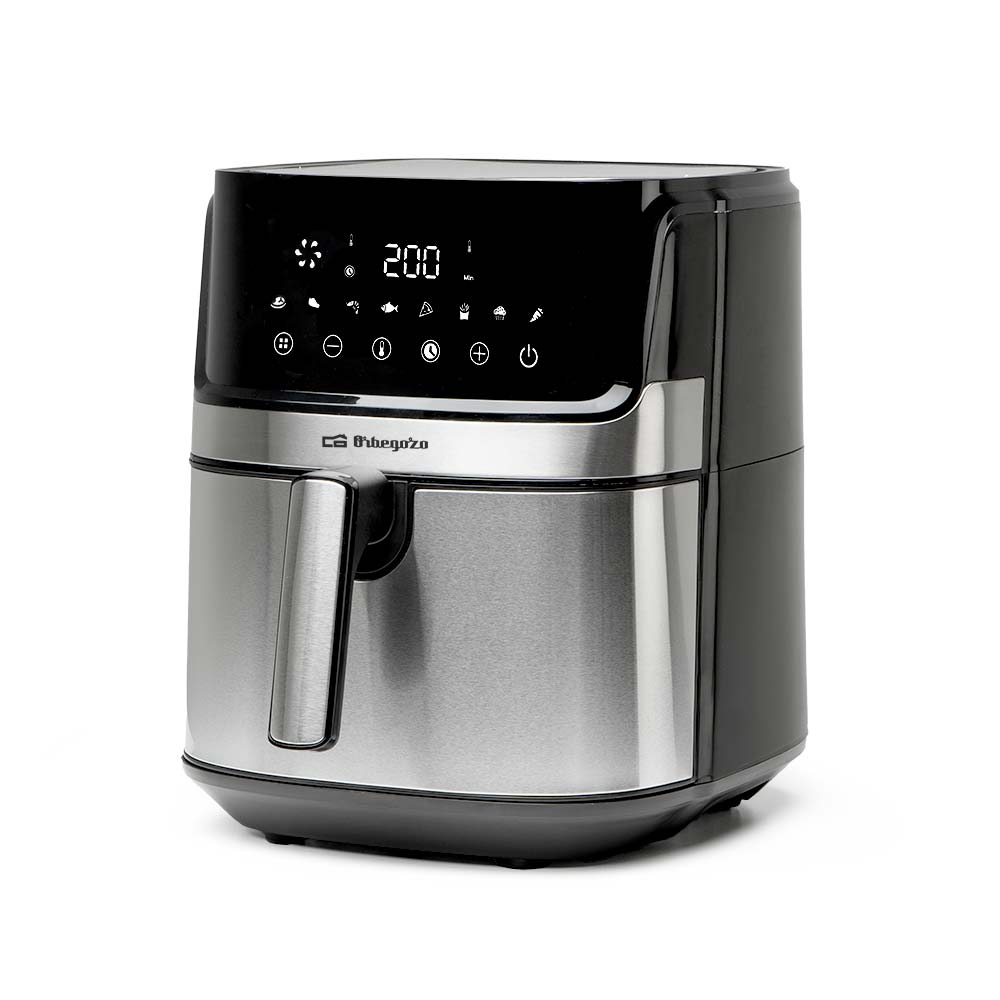
- The Orbegozo FDR 67, 5.5 litres and 1,700 W, with 8 programmes. Size for a couple or a small family, plenty of power and no complications.
- The Orbegozo FDR 6510, 6.5 litres and 1,700 W, with a touch panel. A little bigger, for a family and for making full menus without so many batches.
Either of them cooks vegetables, fish and chicken breast just as healthily as a €250 one. If you want to compare more options, have a look at the small appliances collection.
Why buy your air fryer at Híper Ocio
Without inflating anything, that isn't my style. We are a family shop in Albox, in Almería, open since 1923 and now in its fourth generation. The air fryer is a small appliance, so national shipping is free from €49.99, and air fryers are well above that threshold.
The guarantee is 3 years, the one required by law in Spain, with no small print. You have 30 days to return it if you change your mind, and you can check the conditions in our returns policy. And if you prefer to split the payment, financing with Klarna is available at checkout.
If you would like to see it in person before deciding, or ask anything with no obligation, we are in the physical shop at Avenida 28 de Febrero s/n, in Albox, or on WhatsApp at 623 04 44 20. We will tell you which one you need for your home, no bigger and no more expensive than necessary.
Quick questions
Does the air fryer cause cancer?
There is no evidence that it is more dangerous than frying, baking or toasting. Acrylamide, which is what causes concern, is produced by any dry cooking above 120 °C, not by this appliance in particular. Used sensibly, that is, browning to golden without burning, it is one of the methods that generates the least fat and the least acrylamide.
Can I cook raw potatoes in the air fryer?
Yes, and they turn out well. The trick: peel, cut, soak the potatoes in water for 10 minutes, drain and dry them, and add a spoonful of oil. Cook until they are golden, not brown. And don't keep them raw in the fridge before cooking.
Are frozen precooked foods healthy if I make them in the air fryer?
They come out with less fat than in the frying pan, but an ultra-processed breaded coating is still ultra-processed. The air fryer does not turn it into healthy food. For everyday meals it is better to rely on fish, vegetables and lean meat, and keep frozen food for now and then.
Do I really need to add oil?
A little, yes, if you want it to come out crisp. A spoonful or a couple of sprays is enough. "Oil-free" is a marketing phrase; the reality is that it uses far less than frying, not none.
Does it use a lot of electricity?
Little. Half an hour of air fryer comes to around 11 to 15 cents, against 45 cents for an hour of oven for the same dish. It is among the cheapest things to run in the kitchen, above all because it needs no preheating.
Do I have to cook in batches?
It depends on the size and on how many of you there are. For one or two people, no. For a family, if you overfill the basket the food stops coming out crisp, so sometimes it is worth doing two batches or choosing a model with more litres. It is not advisable to go below 5.5 litres if you are a family.