
TV wall mount: fixed, tilting or full-motion, which to choose for your TV and your wall (2026 guide)
You buy a new TV, take it out of the box and realise that the feet it comes with don't fit your unit, or that there's no spot in the living room where it won't be in the way. That's when many people start thinking about hanging it on the wall. And that's where the doubts begin: fixed or with an arm? What is this VESA thing? Will my wall hold it?
We get this question in the shop almost every week, and the mistakes are always the same: mounts that can't take the weight of the TV, VESA sizes that don't match, plastic wall plugs in a partition wall that can't hold them. This guide gives you the know-how to get it right first time, with the models we have in stock right now and their real prices. Many are cheap (some under €15), so the aim is not to spend more, but to choose the right one.

The three types of wall mount and when each one makes sense
Almost all wall mounts fall into one of these three families. The main difference is how much the TV can move once it is hung.
Fixed mount: the cheapest and the neatest
The TV sits flat against the wall, a few centimetres away, with no movement. It is the cheapest option and the most discreet, and on a solid wall it is also the safest, because there are no arms acting as a lever. It works when the sofa is right in front of the TV at a reasonable height, and you never need to turn the screen.
As a reference, the Genium GSPF86 is a fixed mount for screens from 37 to 86 inches and up to 75 kg, for around €15. If your TV is smaller, the Engel AC0570E (32 to 65 inches, up to 35 kg, extra-flat) costs €12.90, and the Genium GSPF75 goes as low as €9.90. For very large screens, the One For All WM2610 covers 32 to 84 inches for around €20.
Tilting mount: the most underused and the one that avoids the most problems
It is a fixed mount with a small vertical angle. What is it for? Two things: hanging the TV a little higher than ideal (above a fireplace, a tall sideboard, or in a bedroom with the TV facing the bed) by tilting it down, and avoiding reflections from a window or a lamp. If you are going to hang the TV above eye level, a tilting mount is almost a must.
In stock we have the Genium GSPIN75 (32 to 75 inches, up to 45 kg, VESA from 75x75 to 400x400 mm) for €14.90. For larger screens, the Genium GSPIN86 goes up to 86 inches and 75 kg for €19.90. And for monitors or small TVs, the GSPIN43 (13 to 43 inches) costs €10.90.

Full-motion mount: when the TV needs to move
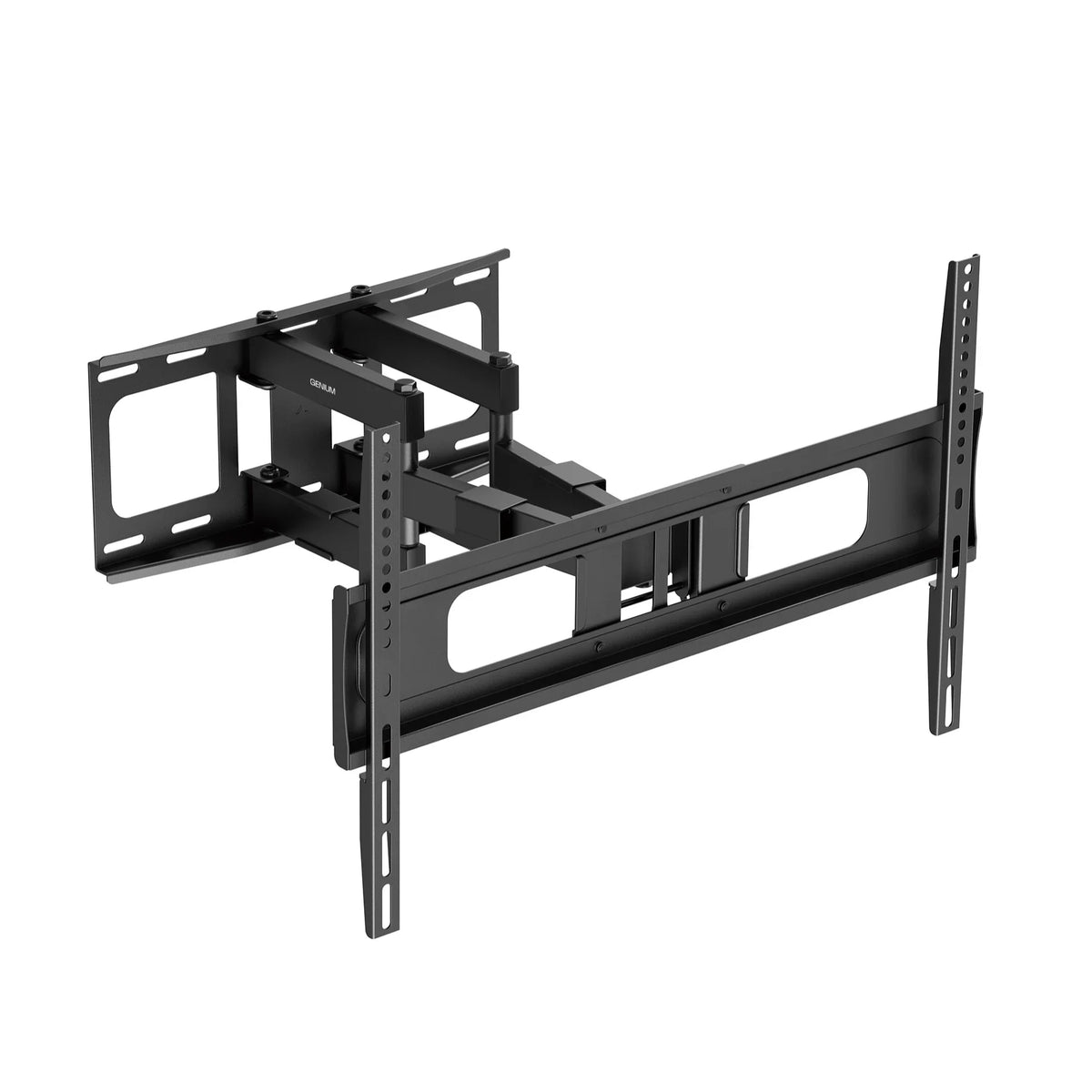
With one or two arms, the screen pulls away from the wall, swivels sideways and can be angled. It makes sense in L-shaped living rooms, kitchen-diners where you want to watch the TV from both the table and the sofa, or in corners. It is also the only option if you need to reach the back often to plug in cables.
The price goes up (€45-55) and so do the demands on the wall: an extended arm with a 55-inch TV puts considerable leverage on the anchors. Among the models we have: the Genium GSPART86 (double arm, 37 to 86 inches, up to 60 kg) for €45.90, the double-arm Engel AC0593E (26 to 65 inches) for €44.99, and the One For All WM2453 (32 to 65 inches, two arms, 15º tilt) for €49.99. If the TV is small, the One For All WM2241, with a single swivel arm for screens from 13 to 40 inches, costs €22.90.

VESA and weight: the two figures that are not negotiable
Before looking at the price, you need to check two details of your TV. Both are in the manual or the manufacturer's data sheet.
- VESA pattern: this is the distance in millimetres between the four threaded holes on the back (for example 200x200 or 400x400). The mount must support that pattern. Good mounts cover a range (the GSPIN75 goes from 75x75 to 400x400), but large TVs may need 600x400 or more, and in that case you have to check the mount's data sheet.
- Weight: the mount must hold more than the TV weighs, with some margin. If your TV weighs 25 kg, a 35 kg mount is reasonable; a 30 kg one leaves you little cushion, especially if it is full-motion.
A third point, less obvious: the inch sizes listed for a mount are only a guide. What counts is VESA and weight. A budget 43-inch TV weighs little, but some 55-inch OLED models weigh quite a bit more than a 65-inch LED. Always check the real weight.
The wall: what almost nobody asks about and what matters most
The best mount in the world is no use on a wall that can't hold it. These are the most common cases around here.
Solid brick or concrete
The ideal case. The wall plugs that come with the mount are usually enough for medium-sized TVs, but with the right drill bit and a quality plug the hold is excellent. Even so, if you are going to hang a full-motion mount with a large TV, it is best to use metal plugs or larger-diameter coach screws.
Hollow brick
Very common in homes in the area. Standard plugs grip badly because the brick has cavities. The right approach is to use chemical anchors or expansion plugs made specifically for hollow brick. With a fixed mount and a light TV you can get by; with a full-motion mount, we don't recommend it without the right anchoring.
Plasterboard (drywall)
Here you need to find the metal or wooden studs behind the board and screw into them, or use anchors designed for plasterboard loads (such as metal butterfly anchors) for moderate weights. For a full-motion mount, the sensible thing is to fix it to the structure. If you don't know what is behind the wall, it is better to ask before drilling.
In any case, use a cable and pipe detector before drilling. And if you have doubts about your type of wall, it is better to have an installer or someone you trust take a look: hanging a 20-kilo TV badly is a real risk.
Height and distance: where to hang it so you don't end up with a stiff neck
The general rule that works: the centre of the screen should be at eye level when you are seated, which on a sofa is usually between 100 and 115 cm from the floor. Many people hang the TV too high, at the height they would hang a picture, and then complain of neck pain.
If for reasons of space the TV has to go high, a tilting mount makes up for part of the problem. If it has to go low (a bedroom with a low bed, for example), a fixed mount works well. As for viewing distance, for 4K screens the comfortable distance is close to 1.2-1.5 times the screen diagonal, although everyone has their own taste.
The floor option: when you can't or don't want to drill
In rented flats, with walls that can't hold the weight, or when you want to move the TV around, there is the floor stand. The TC002 universal floor stand has a metal base, an adjustable-height central pole and takes TVs of up to 43 inches. It costs €69.95, quite a bit more than a wall mount, but it needs no building work and can be moved. For TVs larger than 43 inches, for now we recommend the wall or a properly sized TV unit.

Cables, HDMI and other details worth planning
A wall mount leaves the TV only a few centimetres from the wall. Before hanging it, connect everything it will need: HDMI, aerial, power, soundbar or console. Right-angle connectors (at 90 degrees) help when the gap is narrow. If you have a full-motion mount, leave some slack in the cable for the arm's full movement; otherwise you will end up straining the HDMI every time you turn the screen.
If you want to hide cables, there are cable trunking strips that can be painted the colour of the wall. For an even cleaner installation, you can recess sockets and aerial outlets behind the TV, although that is already building work.
Quick summary: which mount for each situation
- TV in the living room facing the sofa, normal height: fixed. From the GSPF75 (€9.90) to the GSPF86 (around €15).
- TV a little high or with window reflections: tilting. GSPIN75 (€14.90) or GSPIN86 (€19.90).
- L-shaped living room, corner or two viewing areas: full-motion. Genium GSPART86 (€45.90) or Engel AC0593E (€44.99).
- Small TV in the kitchen or bedroom: WM2241 (€22.90) or GSPIN43 (€10.90).
- Without drilling: TC002 floor stand (€69.95), up to 43 inches.
Why Híper Ocio
We are a family shop in Albox founded in 1923, with the fourth generation at the helm, and we have been selling appliances and televisions for decades. That means we know the accessory matters almost as much as the appliance: a good TV badly hung is a problem. That is why we tell you how things stand: many of these models have only a few units left, and if the one you need is not available, we would rather recommend another that does fit than sell you one that won't work. Mounts are shipped across Spain, with free shipping on orders from €49.99. Televisions and appliances, on the other hand, are only sold in the Almanzora, the Levante Almeriense and Los Vélez, with delivery in our own van. You have 30 days to return items under our returns policy. If you are unsure which VESA or weight you need, message us on WhatsApp at 623 04 44 20 with your TV's model and we will tell you which mount suits it.
Frequently asked questions
How do I know what VESA my TV has?
Look at the four threaded holes on the back and measure the horizontal and vertical distance between them in millimetres. It is also in the manual or the manufacturer's data sheet, in formats such as 200x200 or 400x400.
Will a 32-65 inch mount suit any TV of that size?
Not necessarily. The inch sizes are only a guide. What you need to check is that the mount supports your TV's VESA pattern and that its load capacity is clearly above its weight.
Is a fixed mount or a tilting one better?
If the TV is at eye level, the fixed one is cheaper and more discreet. If it goes higher or has window reflections, the tilting one is worth the price difference, which is usually only a few euros.
Can I hang a TV on a plasterboard wall?
Yes, but you have to fix it to the studs or use anchors made for plasterboard, and for a full-motion mount we recommend anchoring to the structure. If you don't know what is behind the wall, ask before drilling.
What height should I hang the TV at?
The usual rule is for the centre of the screen to be at eye level when you are seated, normally between 100 and 115 cm from the floor in a living room.
Can I set up a mount without drilling?
With a floor stand, such as the TC002 for TVs of up to 43 inches, yes. For larger screens, we recommend a wall fixing or a suitable TV unit.