Toys for 6 to 9 Year Olds: A Guide by Age and Development

Last Saturday a grandmother came into the shop on Avenida 28 de Febrero with a crumpled scrap of paper in her hand. "It's for my grandson, he's turning 7 and his mum has told me no screens." She had written down the name of a game she had seen in an advert, but she didn't know whether it would suit him or whether he would outgrow it. We talked for ten minutes, and not once about the game on the paper: we talked about the boy. Did he already read confidently, did he have the patience to wait his turn, did he play alone or was he always glued to his older sister? She left with something different from what she had come in for. And three weeks later she came back to tell us he never put it down.
We see that scene almost every week, and it always starts from the same muddle: people buy by the box. They glance at the "+6" in the corner, see whether the picture is nice and go ahead. The problem is that there is a gulf between a 6-year-old and a 9-year-old. In those three years a child goes from taking first steps with simple rules to handling real strategy, proper logic and precise handicrafts. Giving a good gift is not about hitting the latest trend: it is about hitting the right age and what the child is learning to do right now.
So in this guide to toys for 6 to 9 year olds we are going to do what we do at the counter: sort by exact age (6, 7, 8-9) and by the specific milestone each toy works on, drawing on school-age development and on the AIJU Guide, the serious reference in Spain. Specific categories, examples you can search for by name and the reason behind each one. No fluff.
What changes between ages 6 and 9: the milestones worth knowing before you buy
Before we go age by age, keep the overall picture in mind. It is the one we use so we don't get it wrong, and it comes from child development across the whole school stage (ages 6 to 11):
- Fine motor skills. At 6 children enjoy drawing, painting, making necklaces and putting models together. It is pure hand precision. From there the hand becomes far more skilful: they write faster, draw better and move on to finer handicrafts.
- Logical thinking and a sense of reality. Between 6 and 7 comes the urge to make sense of everything. The child wants to understand why things are the way they are, and that is the doorway to strategy and science.
- Self-control and respect for rules. Learning to wait for a turn, to concentrate and to follow rules. Without this no board game works, and it is trained precisely by playing.
- Social play. From 6 to 11, group play is what matters. The child separates from the adult, treats others as equals and applies the same rules to everyone. They learn to compete and to cooperate, to win and to lose.
The shopkeeper's rule is simple: buy for the milestone, not for the wrapping. If the child is right in the middle of the fine-hands phase, a craft kit will delight them even if it isn't the flashiest thing in the window. If they are already itching to know "how does this work?", a science kit will last them months. And if what draws them is measuring themselves against their siblings, a good family board game is worth more than ten solo toys.
Age 6: fine motor skills and first games with rules
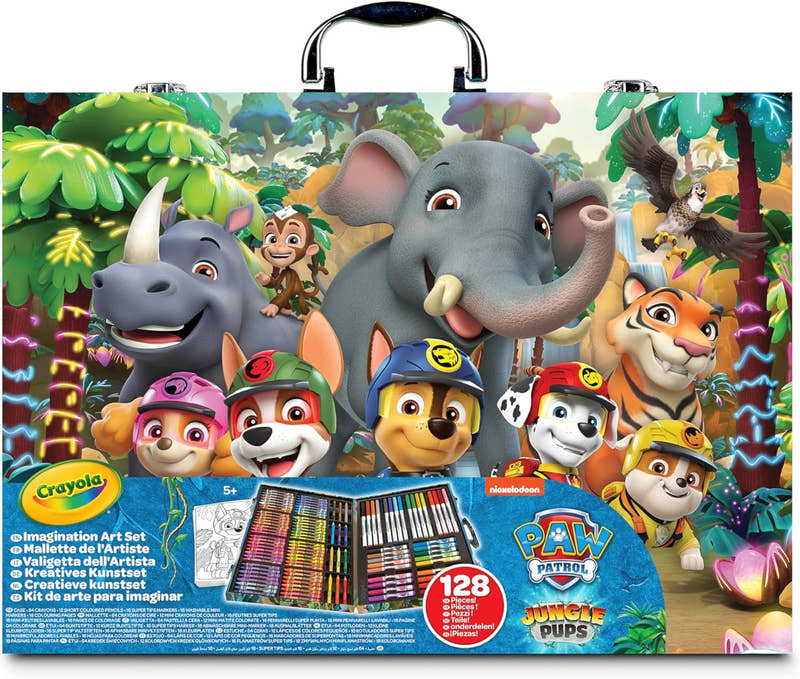
A 6-year-old's hands are in full swing. They love drawing, painting, threading beads to make bracelets, cutting out and building simple models. All of that, which looks like a pastime, is good fine motor work: it prepares the hand for writing and for the finer tasks that come later. That is why at this age craft kits, painting sets and threading games are as safe a choice as they are unassuming.
But age 6 brings another big change: it is the age at which children start on their first board games with real rules. Here are two names we recommend almost with our eyes closed:
- Catan Junior (from age 6). The children's version of the Devir classic. An island with treasure where you trade, build and expand. It sounds like little, but it brings the child into strategic thinking without their noticing: deciding, planning, negotiating a little.
- Ticket to Ride: First Journey (from age 6). You build train routes by collecting coloured cards. It is explained in five minutes and hooks you from the first game. That balance between "easy to understand" and "I want to play again" is just what is needed at this age.
The box states one age, and sometimes the real one is different
Here is a trick that avoids a lot of failed gifts. The classic Ticket to Ride, the one for adults, is +8. The "First Journey" version is +6. Same spirit, same brand, two different ages for a specific reason: the children's version simplifies the rules so that a 6-year-old can follow them without getting frustrated. It isn't marketing, it is design planned by age.
The lesson: don't rely only on the number in the corner. When the child is at the lower end of the range, check whether a "Junior" or "First Journey" version exists. And the other way round: if the child is already 9 and finds it easy, the adult version may suit them better. The age on the box is a guideline, not a sentence.
Age 7: logical thinking, a sense of reality and first strategies
At 7 the child wants to understand everything. It is the age of "why?" raised to the nth power, and in play that means they can already handle more complex rules, plan a couple of moves ahead and start to really enjoy strategy. Self-control also improves: they know how to wait their turn and take a defeat better, within reason.
What works at this stage:
- Chess. Explicitly recommended for the 6-8 range, both from the paediatric field and by AIJU itself. The child doesn't need to become a champion: chess trains anticipation, patience and thinking before moving. We usually start with a multi-game board such as the Toy Planet wooden 3-in-1 Parchís, Chess and Draughts set: that way the child alternates chess with lighter games of parchís or draughts and doesn't get overloaded. The wood, besides, stands up to whatever is thrown at it.
- Dixit. A favourite at this age. It plays with creativity and visual language: you have to evoke, interpret images and tell stories. It is one of those games where the child measures up to the grown-ups on equal terms, because it isn't about reading fast but about imagining.
- Tile games and mental arithmetic. Cayro Rummi Classic (up to 6 players) is a family classic that suits this age wonderfully: combining numbers, making runs, adding up and planning. It works on logic and arithmetic without feeling like maths homework.
- Building with more steps. Sets with more detail and longer sequences. At 7, fine coordination is good enough to put together things that were impossible at 5, and following instructions is, at heart, following an ordered logical sequence.
Ages 8-9: advanced fine coordination, science and bigger challenges
At 8 and 9 the child already has very good fine motor skills, reads and writes confidently and starts to get the hang of maths. Their ability to concentrate has grown and they can stick with longer projects. It is the age to raise the bar: more pieces, more science, challenges that aren't solved at the first attempt.
Here come the categories that are moving the most in 2026:
- STEM / STEAM kits. Science, technology, engineering, art and maths. They fit this range perfectly: experiments, kitchen-table chemistry, circuits, growing plants. The child builds, tries, makes mistakes and understands why. Exactly what their mind is asking for.
- Robotics and smart blocks. Physical blocks that combine with an app to introduce programming and basic logic. It sounds like a lot, but it is designed so that an 8-year-old picks it up through play: sequences, cause and effect, computational thinking with their hands and not in front of a passive screen.
- Higher-level building. Here LEGO rules. Sets with more pieces, more functions and a story that gives you plenty to invent after building. The LEGO City Water Police Investigation Missions (60355) sets small missions and challenges, and the LEGO City Stunt Challenge: Knockdown (60341) adds action and a motor, which thrills children at this age. Build first, then play: two toys in one.
- Radio control. At 8-9 the child already has the hand-eye coordination to steer a remote-controlled car with some flair. The Ninco NincoRacers Aquabound 2 amphibious 4WD RC goes over land and water, and that "works in the puddle and in the street" factor is what gets them out to play. Movement, fresh air and no screen.
- Complex puzzles. Puzzles with more pieces and solo logic games. They work on patience, observation and the tolerance to be stuck for a while without getting it.
Social play (6-11): why competing and cooperating as a family matters as much as the toy
This is the part the box doesn't tell you. From 6 to 11, group play is fundamental to development. It is when the child separates from the adult, starts treating companions as equals and understands that the rules apply to everyone alike. There they learn something no app teaches: to compete and to cooperate, to feel success and also failure without their world collapsing.
That is why, when a parent asks us "what should I buy?", the best answer is often not a solo toy but a game for the whole family. One game on a Sunday does three things at once: it trains the child's self-control (waiting for a turn, taking a defeat), it gets language and negotiation going, and it sits you all around the same table. And if the game is cooperative, it also teaches them to row together towards a common goal.
- For healthy competition: light strategy games (Catan Junior, Ticket to Ride) and tile games (Rummi).
- For laughing together: imagination games like Dixit, or bluffing games, where part of the fun is in misleading the others.
- For learning through role play: games such as ¿Qué me pasa, doctor? by Toy Planet, which put the child in everyday situations and make them reason and care for others. Social play and empathy in the same box.
What the AIJU Guide adds when choosing by age
If there is one seal to trust in Spain, it is the AIJU Guide. Its recommended toys don't come from an advert: they go through studies of suitability for use, psychopedagogical analysis and real tests with families and experts. When you see that backing, you have a big reliability shortcut, and we use it as a cross-cutting filter for all ages.
This year the Guide also carries a message that goes beyond "which toy to buy" and has to do with the balance between screens and play. The underlying idea, according to what they themselves gather from the opinion of health professionals, is twofold:
- A large majority of children spend more time in front of screens than health experts recommend, and a good share of health professionals link excessive screen use with more problems in child development.
- The areas that suffer most are attention, eye health, self-control, sleep, social relationships and diet.
- The positive side: both specialists and families agree that play with toys is a healthy alternative, able to prevent some of those effects.
Translated to the counter: screens aren't the devil, but at this particular age, 6 to 9, when attention, self-control and relationships are being forged, play with toys does a job that screens don't do. Children who spend more time reading, drawing or playing freely tend to communicate better and manage their emotions with more ease. As AIJU itself sums up, playing is the main activity for today's child to become a balanced adult. That is why a good toy chosen by age is not a whim: it is an investment in development.
Summary table: age, milestone and recommended toy
| Age | Milestone it develops | Recommended toy |
|---|---|---|
| 6 years | Fine motor skills and first games with rules | Crafts, necklaces and threading, Catan Junior, Ticket to Ride: First Journey |
| 7 years | Logical thinking, sense of reality, first strategies | Chess and multi-game boards, Dixit, Rummi, building with more steps |
| 8-9 years | Advanced fine coordination, science, bigger challenges | STEM kits, robotics and smart blocks, higher-level LEGO, radio control, complex puzzles |
| 6-11 (cross-cutting) | Social play: competing and cooperating | Family, cooperative and educational role-play board games |
A 2-minute mini-checklist before you pay
Before heading to the till, ask yourself these five questions. It is what we go through with every customer:
- Replayability: can it be played many times without getting boring, or is it over in one afternoon?
- Alone or in a group: does the child play more alone or with siblings and friends? Choose accordingly.
- Game length: does it suit their real patience? A one-hour game at age 6 can be too much.
- Materials: wood and good cardboard last; flimsy plastic breaks the first time.
- AIJU seal: if it has it, it carries an endorsement that it is designed and tested for that age.
Why Híper Ocio
We are a neighbourhood shop that has been selling since 1923. Fourth generation, now led by Antonio Martínez Rosado, with the physical shop at Avenida 28 de Febrero s/n, in Albox. We are not an algorithm: when you come in and tell us the child's age and what they are like, we tell you honestly what fits, even if it sometimes means the cheapest product or warning you that what you had written down is too young or too advanced for them. We would rather you got it right than sell you more.
We work as an official LEGO point of sale and with serious brands such as Cayro, Asmodee, Devir, Ninco and Toimsa, as well as the Toy Planet line. On the website you get free national shipping from €49.99 on toys, the 3-year legal guarantee required by law in Spain and 30 days for returns under our policy; and if you need to split the payment, you can use the Klarna financing available at checkout. If you are unsure about a gift, message us on WhatsApp at 623 04 44 20 and we will guide you as we would at the counter. No more, no less.
Frequently asked questions
Is the age printed on the toy's box a reliable guide?
It works as a guideline, but it is not a law. Many games have a "Junior" or "First Journey" version with simplified rules: for example, Ticket to Ride: First Journey is +6, while the adult version is +8. Look at the child's real development (whether they read confidently, whether they can handle rules, whether they have patience) rather than just the number in the corner.
Which board game is best to start with at age 6?
The two that work best as an introduction are Catan Junior and Ticket to Ride: First Journey, both recommended from age 6. They are explained in a few minutes, hook you from the first game and introduce strategy and taking turns without frustrating the child.
At what age can a child start with chess?
Chess is explicitly recommended for the 6 to 8 range. To start without pressure, a multi-game board (parchís, chess and draughts) works very well: the child alternates chess with lighter games and gradually gets a taste for it.
Are STEM and robotics toys good for this age?
Yes, they fit especially well from 8 to 9, when the child has better fine coordination and more concentration. Science kits, educational robotics and smart blocks work on logical thinking and the curiosity to understand how things work, which is exactly the milestone of that age. It is one of the categories with the most pull in 2026.
Do toys really help with the screen problem?
According to the AIJU Guide, a large majority of children spend more than the recommended time in front of screens and a good share of health professionals link that excess with more developmental problems. At the same time, both specialists and families agree that play with toys is a healthy alternative able to prevent some of those effects, especially in attention, self-control and social relationships.
What guarantee and shipping do toys have?
The legal guarantee in Spain is 3 years. National shipping is free from €49.99 on toys, and you have 30 days for returns under our policy. If you have doubts before buying, you can write to us and we will advise you.