How to choose an air conditioner for your home in 2026: a complete guide
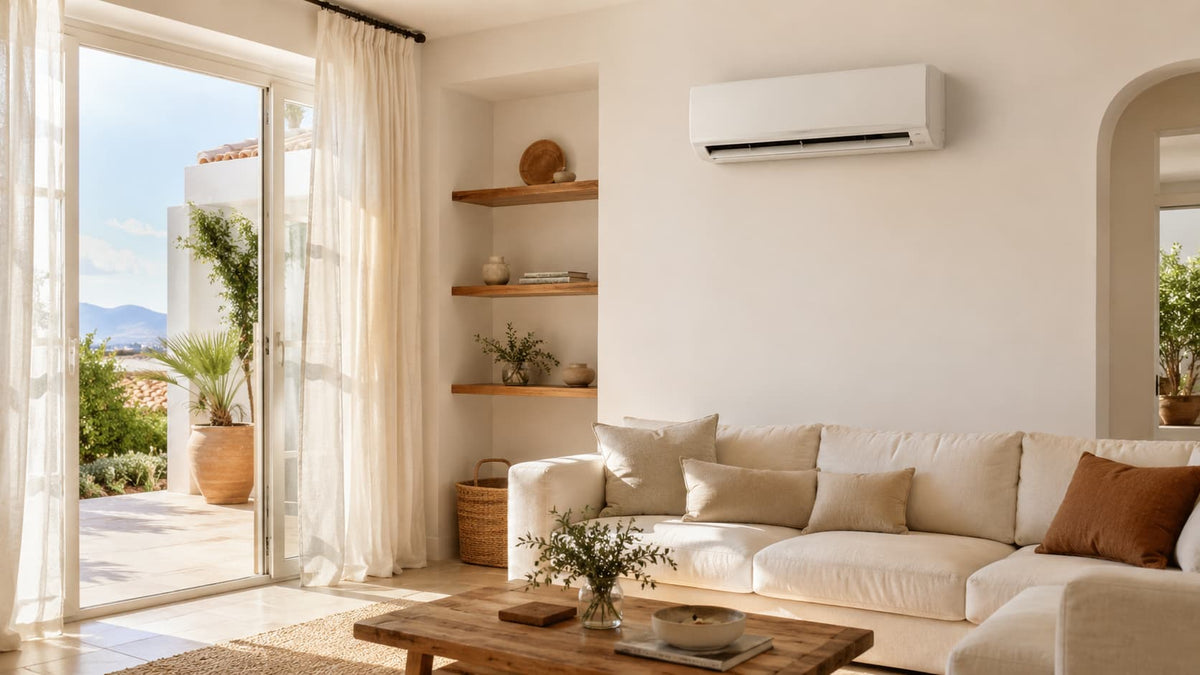
Summer arrives in Valle del Almanzora and Levante Almeriense, and with it, the question that is repeated every season in thousands of homes in the area: what air conditioner do I need for my house? With temperatures easily exceeding 40 °C in July and August, choosing the right air conditioning equipment is not a whim; it's a decision that directly affects your comfort, your electricity bill, and your wallet for the next ten years.
In this guide, we explain everything you need to know before buying an air conditioner in 2026: from how to calculate the power you need to what the energy label means, including the real differences between technologies and the most common mistakes to avoid.
First: how many square meters do you need to air condition?
The most important question before looking at any model or price is this: how much area does the equipment need to cool? The rule that is still valid in 2026 is simple: approximately 100 frigories per square meter. Expressed in kilowatts, which is how most household appliances are expressed today:
- Up to 20 m²: a 2.5 kW unit like the Beko BEHPG095 is sufficient
- Between 20 and 30 m²: 3.5 kW (the most common size for living rooms — see Beko BEHPG125)
- Between 30 and 50 m²: 5 kW like the Beko BEHPG185
- More than 50 m²: 7 kW or higher, or consider a multi-split system
Note: these figures are indicative for homes with standard insulation. If your house has a lot of direct sun exposure, high ceilings, or poor insulation — something common in old constructions in the area — it is advisable to go up one power level to avoid overworking the equipment. Equipment that constantly runs at its limit consumes more, makes more noise, and lasts less.
The energy label: what really matters on your bill
In 2026, the European energy label for air conditioners ranges from class A to A+++ (on the re-scaled 2021 scale, which is the current one). The difference in consumption between an A+ and an A+++ unit can exceed 30%, which, in an area with summers as long as those in southeastern Spain, translates into real and significant savings over the years.
The practical recommendation is not to buy anything below A++ for cooling. The initial extra cost compared to a less efficient unit is usually recouped in two or three seasons of intensive use, and from then on, each year represents net savings. In areas like Valle del Almanzora, where air conditioning runs for four or five months a year with virtually daily use, the numbers add up very quickly.
Inverter technology: no longer optional
If you've ever heard of inverter technology and aren't quite sure what it means, here's the short explanation: an inverter unit continuously adjusts the compressor's power according to the actual needs of the room, instead of turning on and off at full power. The result is quieter operation, lower electricity consumption, and a more stable temperature.
In 2026, practically all units on the market are inverter, but it's worth checking because there are still some low-end models that are not. A non-inverter unit may seem cheaper on paper, but in terms of accumulated electricity consumption, it ends up being more expensive in less than a season.
Refrigerant gas: R32, the current standard
All equipment sold in Spain today uses R32 refrigerant gas, which replaced R410A due to its significantly lower environmental impact. This is not something you need to actively manage as a user, but it's worth knowing that if the unit ever needs a gas refill, the cost and availability of R32 are good in the current market. Beware of offers for old equipment using R22: it is prohibited throughout the EU, and its maintenance is a problem.
Split 1x1, multi-split or portable: what's your case
The 1x1 split — one indoor unit and one outdoor unit — is the most common solution for homes that need to air condition one or two rooms independently. It offers the perfect balance between cost, efficiency, and ease of installation for most homes.
The multi-split connects several indoor units to a single outdoor unit. This is the option when you want to air condition the entire house with a single outdoor unit (very useful in communities where outdoor unit space is limited), although the initial cost is higher, and if the outdoor unit fails, the whole house loses cooling.
The portable unit is the no-installation solution: it requires no installation, can be moved from room to room, and doesn't require community permits. Ideal for rental apartments or as a temporary supplement. The downside is that it consumes much more than a split to cool the same area and tends to be noisier. For intensive summer use in a permanent home, it's not the smartest long-term option.
What extra features are worth considering in 2026?
The market has evolved a lot in recent years, and some features have gone from being premium to being common even in mid-range models:
Integrated WiFi — Allows you to control the unit from your mobile, program it so the house is cool when you arrive, and turn it off if you forgot. In 2026, it is almost standard in the mid-to-high range and increasingly common in the mid-range. It's worth having.
Heat mode — Modern splits also work in winter as heat pumps, with much higher efficiency than traditional electric radiators. While winters in Almería are not extreme but are cool, having this function can eliminate the need for another heating solution for many homes.
Filters and purification — Many units include filters that retain dust, allergens, and bacteria. In areas with frequent haze or suspended dust, as often occurs in the southeast of the peninsula, these types of filters provide real value.
Silent mode — Especially relevant for bedrooms. The best units go down to 19–22 dB indoors, which is practically inaudible. If the unit will be in the room where you sleep, this detail is worth checking.
Installation: the most underestimated factor
One of the most important decisions is not the model but who installs it. A poorly executed installation can void the manufacturer's warranty, reduce equipment performance, generate unnecessary noise and vibrations, or even cause problems with building regulations. The installing technician must be registered with RITE (Regulations for Thermal Installations in Buildings) and issue the corresponding installation certificate.
It is also advisable to always ask about after-sales service: what happens if the equipment has a problem during peak season, how quickly they can attend to an incident, and if they have spare parts in stock for the brands they install. In July, at 42 °C, you cannot afford to wait three weeks for an external technician to arrive. You can add our professional installation service directly to your cart along with the equipment.
Summary: key points before deciding
Before finalizing your choice, ensure you have clear answers to these questions:
- How many square meters does the unit need to cool? (and if there are factors that advise stepping up a power level)
- Is the unit inverter and does it have a minimum A++ label?
- Does it use R32 refrigerant gas?
- Do you need WiFi, heat mode, or special filters?
- Will the installation be carried out by a RITE-certified technician who offers an installation guarantee?
- Are you clear about the after-sales service in case of a breakdown?
If you have doubts about which equipment best suits your home or would like a no-obligation quote for Valle del Almanzora and Levante Almeriense, we are here to help you. We have been in the sector for decades and are well aware of the air conditioning needs of the area.