Split, Portable, or Cassette: Which is Right for Your Home?
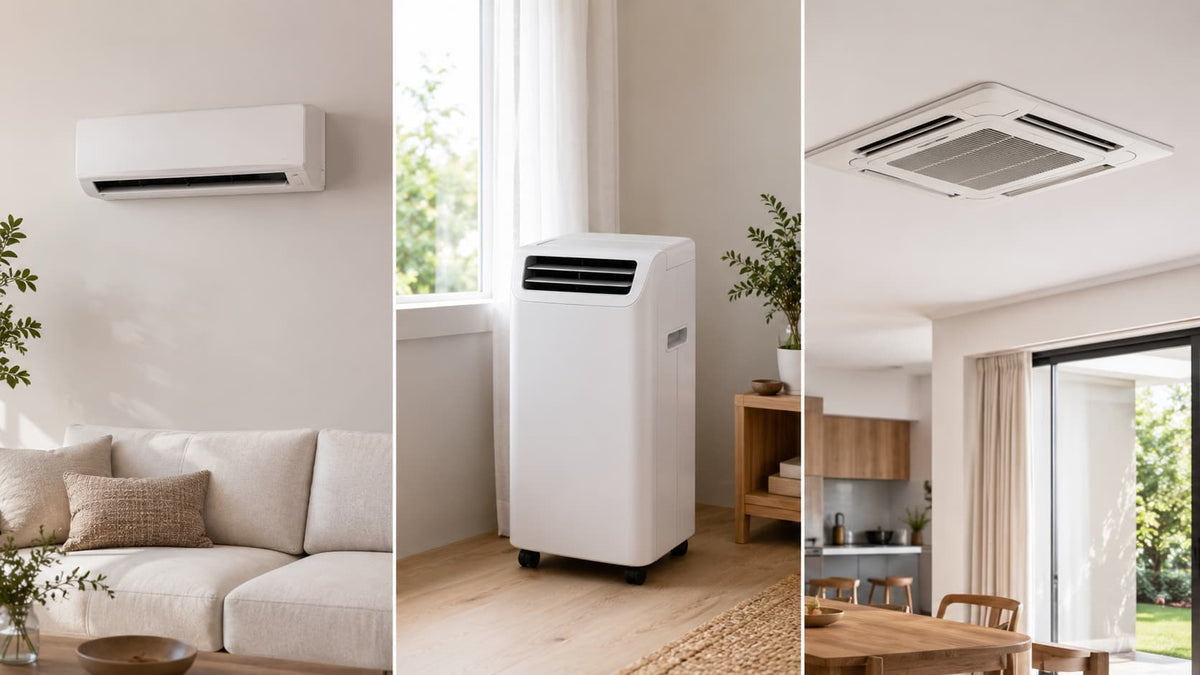
Not all air conditioners are the same or serve the same purpose. Before deciding which model to buy, it's a good idea to be clear about which type of system fits your home, your habits, and your specific situation. The wrong choice can not only lead to unnecessary expense but also years of discomfort: a unit that is too small and never quite cools, one that is too bulky for a rental apartment, or one installed in the wrong place that causes problems with the community.
This comparison helps you decide between the three most common options in the Spanish domestic market: the 1x1 split system, the portable air conditioner, and the cassette unit. For each, we explain how it works, when it makes sense and when it doesn't, and which user profile or home it best suits.
The 1x1 split: the solution for most
The split system is the most widespread domestic air conditioning system in Spain for a simple reason: it offers the best balance between efficiency, quietness, price, and results. It consists of two units – an indoor unit that distributes cool air inside the room and an outdoor unit that expels heat outside – connected by a copper pipe that passes through the wall.
The indoor unit is mounted on the wall, usually at height, and distributes air uniformly throughout the room. The outdoor unit is installed on the facade, terrace, or patio. Installation requires making a small hole in the wall and fixing both units, so a RITE certified technician is necessary.
Advantages of the split system
It is the most energy-efficient system of the three: with A++ or A+++ labels on most current models, its consumption per hour of use is much lower than that of an equivalent portable unit. It operates with inverter technology that continuously adjusts power, which translates into quietness, temperature stability, and savings on the electricity bill. In addition, modern split systems also function as heat pumps in winter, eliminating the need for another heating system.
In the Almanzora Valley and the Levante Almeriense, with summers of four to five months of intensive use, the difference in consumption between an efficient split unit and an equivalent portable unit can easily amount to €150-200 per year in electricity. In three seasons, the additional installation cost is more than amortized.
Disadvantages of the split system
It requires professional installation and construction work (a hole in the wall). In rental apartments, this can be a problem if the landlord does not authorize it. In communities of owners, the outdoor unit on the facade may require approval. And if you want to cool several independent rooms, you need a unit per room or switch to a multi-split system.
Who the split system is for
For any homeowner who regularly uses air conditioning during the summer. It is the default option unless there is a specific reason to rule it out. We have models available from 2,200 frigories for rooms up to 4,500 frigories for large living rooms.
The portable unit: total flexibility, limited efficiency
A portable air conditioner is a self-contained unit on wheels that does not require permanent installation. It plugs into the mains, connects to the outside via a flexible hose that is routed through a window or door, and starts working in minutes. No drilling, no technician, no authorization from anyone.
This simplicity comes at a price: the portable unit is considerably less efficient than a split unit of equivalent power. The heat exhaust hose never seals perfectly, some of the cold air is lost, and the motor works in the same space it wants to cool, generating residual heat. The result is that a 3,000 frigorie portable unit consumes more and cools less effectively than a 3,000 frigorie split unit.
Advantages of the portable unit
Zero installation and zero dependence: you buy it, plug it in, and it works. It can be moved from room to room or taken to another home. It doesn't require permits, doesn't make holes in the wall, and doesn't need a technician. The entry price is lower than that of an installed split unit. For those who rent, move frequently, or need to cool a space temporarily and without commitment, it's the most sensible option.
What models we have available
We have four portable options for different needs and budgets:
- Artica AAP07EWF — 1,800 frigories, WiFi, cooling only — The most compact and economical option, ideal for small rooms up to 15 m². With mobile control. €249.
- Artica AAP09EWF — 2,200 frigories, WiFi, cooling only — A step up in power for rooms up to 20 m², same WiFi connectivity. €269.
- Aspes AAAP900F — 2,200 frigories, cooling only — Compact and efficient solution from the Aspes brand, designed for hassle-free mobility. €279.
- Artica AAP1229BC — 3,000 frigories, cooling and heating — The most complete: more power and heat pump function for winter use. Ideal for living rooms up to 25 m². €349.
Disadvantages of the portable unit
Higher electricity consumption for the same cooling result. More noise than an equivalent split unit, as the compressor is inside the room. The exhaust hose limits real mobility and requires a window or door to be partially open. Some models accumulate condensed water that needs to be emptied periodically. For intensive use over several months a year, the initial purchase savings are quickly lost on the electricity bill.
Who the portable unit is for
Tenants without authorization to install a split unit, users who need temporary or occasional air conditioning, and anyone who wants a second unit for a secondary space without undertaking construction work. It is not the recommended option for a main residence in an area with summers like those in Almería.
The cassette unit: power and discretion for large spaces
The cassette unit is a type of split system where the indoor unit is recessed into the ceiling instead of on the wall. The grille is flush with the false ceiling and distributes air in four directions simultaneously, allowing it to uniformly cover much larger areas than a conventional wall-mounted split unit.
It is the usual solution in commercial premises, offices, meeting rooms, and larger homes with an existing false ceiling. In the domestic sphere, it makes sense in large living rooms, open-plan spaces, or country houses where a uniform result is desired without the indoor unit being visible on the wall.
Advantages of the cassette unit
360-degree air distribution from the ceiling, which eliminates the cold and hot spots common with wall-mounted split units for large areas. Aesthetically, it is very discreet: only the grille is visible on the ceiling. Energy efficiency is comparable to that of a wall-mounted split unit of a similar range. Ideal for spaces over 40-50 m² where a conventional split unit would not be able to distribute air correctly.
Disadvantages of the cassette unit
Requires a false ceiling for recessing, which makes it unfeasible in many homes. Installation is more complex and costly than that of a wall-mounted split unit. Maintenance (filter cleaning) is somewhat more laborious as it is in the ceiling. And its equipment price is higher than that of an equivalent split unit in power.
Who the cassette unit is for
Owners who are renovating or building and can plan for a false ceiling, commercial premises, and open-plan homes or those over 50 m² where discretion and homogeneous air distribution are desired.
Quick comparison: which to choose for your case
You are a homeowner, use air conditioning several months a year, and want maximum efficiency → 1x1 Split. No discussion.
You rent or need air conditioning without construction work → Portable. Accept the higher consumption as the cost of flexibility.
You have a large space, are renovating, and can install a false ceiling → Cassette. The investment is worthwhile if the area justifies it.
You want to cool several rooms from a single outdoor unit → Multi-split. We haven't covered it in detail here, but it's the natural evolution of the split when there are two or three rooms to cool.
If after reading this you have doubts about which one best suits your specific home, consult us without obligation. We have been installing equipment in the Almanzora Valley and the Levante Almeriense for decades and have first-hand knowledge of the conditions of each type of construction in the area.