Which TV to Buy in 2026: Screen Size by Viewing Distance, QLED vs LED and Which Model to Choose
Almost everyone walks into the shop asking about the brand and the screen size. And almost nobody asks the one thing that really decides whether they will still be happy with the TV three years from now: how far away people sit, how much light comes in through the window and what they will actually watch on it. It has happened to us a thousand times: someone takes home a beautiful 65" for a living room where the sofa is a metre and a half away, and two weeks later tells us it "looks odd". It doesn't look odd: it is simply too close.
In 2026 the market has become much simpler in one way and more complicated in another. On the one hand, 4K is now the standard from 43 inches up, and no serious manufacturer sells anything else for the living room. On the other, the labels have multiplied to the point of absurdity: QLED, NanoCell, Mini LED, QNED, Crystal UHD, ULED... Almost all of them describe the same basic thing (an LCD panel with LED backlighting) with different layers and improvements on top. Knowing which ones matter and which are marketing can save you between €100 and €300.
This guide is written from the shop counter, not from a spec sheet. We tell you what to look at, in order of importance, which models we have right now and what price range each type falls into. One important warning before you go on: we only sell televisions in our local area — Valle del Almanzora, Levante Almeriense and Los Vélez — because we deliver them ourselves in our own van. We do not ship televisions nationwide. If you are outside that area, this guide will still help you decide, but you will need to buy from a shop near you.

The first thing is not the brand: it is the distance to the sofa
Measure from where people sit to where the screen will be. With a tape measure, in metres. That number decides the size, and the size decides almost everything else.
With 4K content, the practical rule we use is between 1.2 and 1.7 times the screen diagonal. In round numbers:
- 32 inches (81 cm): 1.2 to 1.6 m. Bedroom, kitchen, guest room.
- 40-43 inches (102-108 cm): 1.6 to 2.2 m. Small living room or large bedroom.
- 50 inches (126 cm): 1.9 to 2.5 m. The sweet spot for many flat living rooms.
- 55 inches (139 cm): 2.1 to 2.8 m. By far the best-selling living room size.
- 65 inches (164 cm): 2.5 to 3.3 m. Living rooms in village houses, which are plentiful here.
- 75-85 inches (189-214 cm): 2.9 to 4.3 m. Genuinely large living rooms, not "large" as in the brochure.
Two honest caveats. First: nobody has ever regretted an extra inch if the distance allows it; the usual complaint is the opposite, "it has turned out too small". Second: if you will watch a lot of digital terrestrial TV (TDT) and channels of average quality, a huge screen very close up will show you every flaw in the signal, not fix it. 4K shows on Netflix, on pay-TV football and on Blu-ray; on the TDT news it shows less than you are told.
And measure the furniture too. More than once the TV has fitted the gap by millimetres but the feet ended up off the unit. On many models the feet are at the edges, not in the centre: note the total width and the distance between the feet before you buy.
4K, Full HD and HD: when each one makes sense
The short rule: from 43 inches up, 4K without question. Below 43, 4K stops being noticeable at normal distances and you would be paying for a number your eyes cannot tell apart.
For a bedroom or a kitchen, a 32-inch HD or Full HD set does its job perfectly well and costs half as much. The Infiniton INTV-32P410 32" HD is €129.99 and is a simple TV with no Smart TV, for anyone who only wants TDT and an HDMI port for the decoder. If you also want apps, the Infiniton 32GS630 with Android TV (€169) brings Netflix, YouTube and the rest built in, with WiFi and Bluetooth. And the Genium GTV32HD with WebOS, at €159.99, is the one people ask us for most for a bedroom: LG's system is the easiest to use for older people, and that matters a lot here.
An in-between case that people forget: 40-inch Full HD sets. The Philips 40PFS6050 (€219, made to order) suits large bedrooms or small living rooms where 43" no longer fits and 32" falls short.
LED, QLED, NanoCell, Mini LED: what each label really means
This is where everyone gets lost, so let us be clear. In a consumer television there are only two types of panel: LCD and OLED. Everything else is layers and improvements applied on top of an LCD.
- LED (or Crystal UHD, or simply "4K"): LCD with conventional LED backlighting. It is the basic option and the cheapest. It works well in living rooms that are not flooded with light.
- QLED: not a different panel. It is a layer of quantum dots that turns the backlight into purer colours. Can you tell the difference? Yes: more vivid colours and more brightness, especially with HDR content and in bright rooms. Does it always justify the extra cost? In a dark room, not much. In a living room with a south-facing window — the norm here — quite a lot.
- NanoCell (LG): a nanoparticle filter that cleans up the colour. A similar idea to QLED, carried out differently.
- Mini LED / Neo QLED / QNED: here there is a real step up. The backlight is divided into thousands of tiny LEDs that switch on and off by zone. The result: much better blacks and far higher contrast. It is the best you can buy in LCD, and you notice it most when watching films at night.
- OLED: each pixel switches off on its own. Absolute black and the best contrast there is. In return: lower peak brightness and a higher price for the same size.
How we sum it up in the shop: if your living room has a lot of natural light, put brightness first (QLED, Neo QLED). If you watch films at night with the blinds down, put contrast first (Mini LED or OLED). If it is a second TV or you are tight on budget, a decent 4K LED will last you and will do just fine.

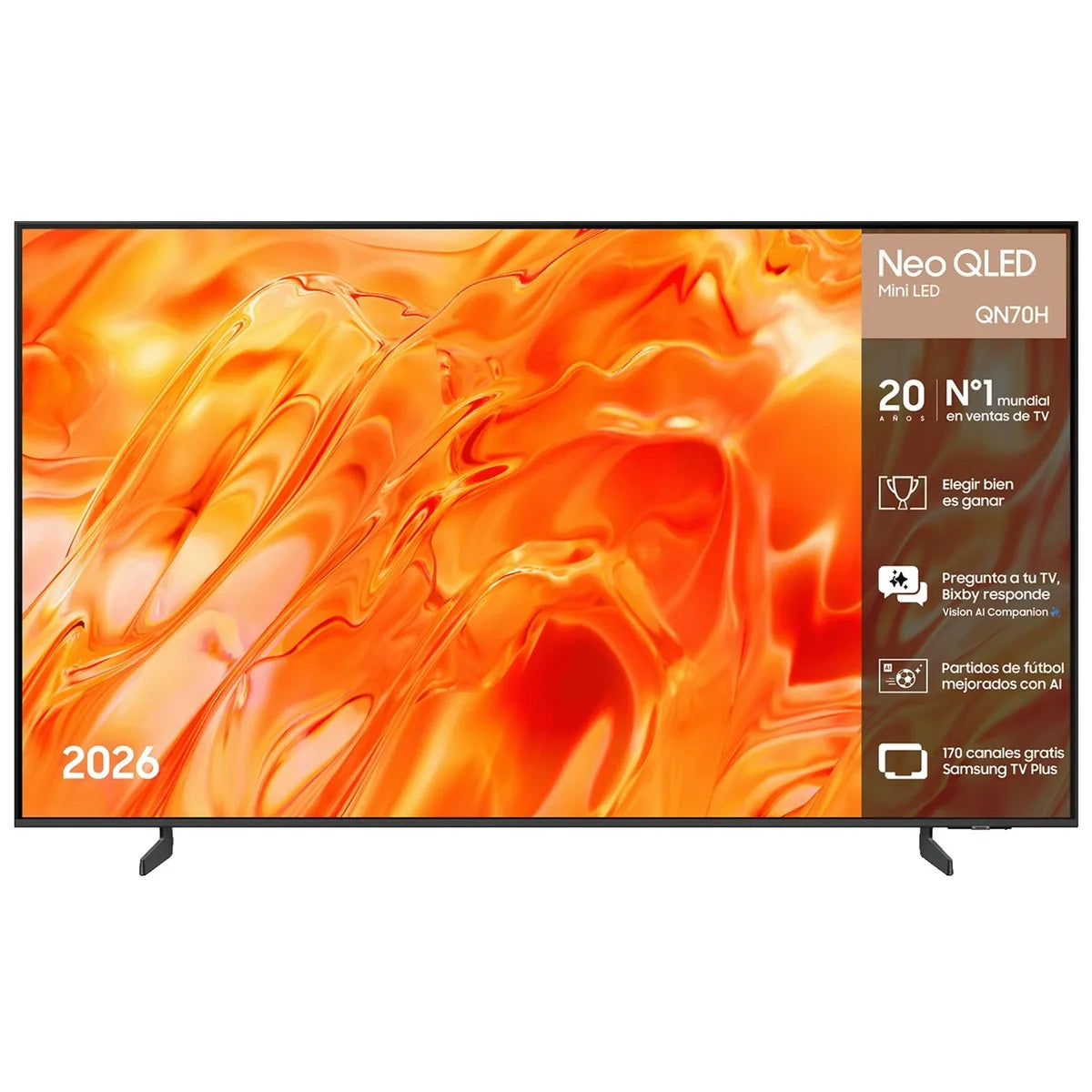
In 55 inches we have three very different routes today, and all three are defensible: the TCL 55P61K with Google TV for €369 if you want 4K without frills; the LG 55NU8E0B3LA NanoCell for €449 with an α7 Gen9 processor and webOS 26; and the Samsung TQ55QN70H Neo QLED for €559, which is where Mini LED comes in. The difference between the first and the third is €190, and you notice it mainly in dark scenes and in very bright living rooms. If you only watch TV in the afternoon and series, the €369 one will look great to you.
The operating system matters more than you think
You will switch the TV on five thousand times. You choose the panel once; you put up with the menu every day. The four systems you will see:
- webOS (LG and Genium): the cleanest and the easiest. The pointer remote is a blessing for anyone who does not get on with technology.
- Tizen (Samsung): fast, tidy, very polished. Good integration with Samsung phones.
- Google TV (TCL, Philips, Sony): the one that recommends the most content, and the best if you use Chromecast or have everything in the Google ecosystem.
- Android TV: the predecessor of Google TV, still found on more affordable models. It works, with more apps than anyone, but it is the least responsive.
Practical advice: if the TV is for your parents or grandparents, webOS. No discussion. It saves us half of the "I can't get back to normal TV" phone calls.
The details people find out too late
HDMI 2.1. It only really matters if you will connect a PlayStation 5 or an Xbox Series X and want 4K at 120 Hz. If your console is a Switch 2 or you play little, don't pay for it.
Panel refresh rate. 60 Hz native versus 100/120 Hz. For films and series it makes no difference. For football and video games, 100/120 Hz is welcome in fast movement. Beware of brochure phrases such as "motion 800": that is not the real refresh rate of the panel.
VESA mount. If you will hang it on the wall, check the VESA size (200x200, 300x300, 400x400...) before buying the bracket. And check that the wall can take it: the plasterboard partition in a modern living room needs specific anchors.
Sound. All flat TVs sound mediocre, some more than others. It is physics: you cannot fit a decent speaker into two centimetres of thickness. If sound matters to you, count a soundbar in your budget from the start instead of finding out later.
TDT and HEVC. Any television we sell today tunes the current HD TDT without any trouble. If your problem is an old TV that stopped picking up channels, we explained it at the time in this article on why channels disappear.

Which television to buy, case by case
Bedroom or kitchen (up to 1.6 m away)
32 inches, HD, and that's it. The Genium GTV32HD at €159.99 with webOS is our default recommendation. If you don't need apps, the Infiniton 32" at €129.99 does the job.
Small living room or flat (2 to 2.5 m)
43 or 50 inches in 4K. The TCL 43T69C (€299) and the Samsung TU50U7025F 50" (€329) are the two best-balanced options we have right now for price and size. Both made to order, delivered in 3-5 working days.

Standard living room (2.5 to 3 m)
55 inches. The three routes we have already covered: TCL €369, LG NanoCell €449, Samsung Neo QLED €559. If your living room faces south and has a large window, step up to the QLED even if it stretches the budget; if not, save your money.
Large village-house living room (3 m or more)
65 inches at least. We have immediate availability on the Genium GTV65UHD 65" for €479 and on the Genium GTV65QLED for €499.99. For a €20 difference, the QLED panel is worth it. If you want a top-line brand, the Hisense 65A6S QLED with Dolby Vision (€489) or the TCL 65C6K PRO (€719) are made to order.
When the TV is part of the decor
The Samsung The Frame 43" (€639) and the 50" one (€749) solve a very specific problem: the black rectangle, switched off, in the middle of the living room. With the matte finish it looks like a painting. It is an indulgence, we say so plainly, but it is an indulgence that the people who buy it love.

Delivery and installation: how we do it
We deliver televisions with our own van in the Valle del Almanzora, the Levante Almeriense and Los Vélez. That means the TV does not travel with a courier company with twenty handlings along the way: it leaves our warehouse and arrives at your home. It is the reason we do not ship televisions or large appliances nationwide: we could not guarantee that they arrive in good condition.
Toys and small appliances we do ship across Spain, with free shipping from €49.99.
If you need to split the payment, you can pay in instalments with Klarna at checkout. And if you choose the wrong model, you have 30 days to withdraw under our returns policy — the cost of the return is yours, so it is better to get it right the first time, which is why we write guides like this one.
Why Híper Ocio
We are not cheaper than a marketplace on every model, and we won't pretend we are. What we do is this: we tell you when a TV is too big for your living room even if it would suit us to sell you the big one, we bring it to you and leave it working, and if in two years you have a warranty problem you know where the door is and who will look after you.
We have been in Albox since 1923. Antonio Martínez Rosado is the fourth generation at the helm. We are at Avenida 28 de Febrero s/n, and we are still here, with real names and surnames. If you have questions about a specific model, write to us on WhatsApp at 623 04 44 20 and we will answer with what we know, not with whatever leaves the most margin.
Frequently asked questions
How many inches do I need for a normal living room?
It depends on the distance to the sofa, not on the room. Between 2.1 and 2.8 metres, 55 inches is the ideal size. Between 2.5 and 3.3 metres, 65 inches. Measure with a tape measure before deciding: it is the figure most people skip and the one that causes the most regrets.
Is it worth paying more for a QLED?
If your living room has a lot of natural light, yes: QLEDs give more brightness and colours that don't wash out in the afternoon sun. If you mostly watch TV at night or with the blinds down, a good 4K LED will give you a very similar picture for quite a bit less money.
What is the difference between QLED and Mini LED?
QLED improves colour through a layer of quantum dots. Mini LED replaces the backlight with thousands of tiny LEDs controlled by zone, which greatly improves blacks and contrast. Mini LED (Neo QLED at Samsung, QNED at LG) is a real step up in quality; QLED is a colour improvement.
Do you ship televisions across Spain?
No. Televisions and large appliances are only delivered in the Valle del Almanzora, the Levante Almeriense and Los Vélez, in our own van. Toys and small appliances we do ship across Spain, with free shipping from €49.99.
Can I finance the purchase of a television?
Yes: at checkout you can choose Klarna, which shows you the instalment options available for your purchase before you confirm. You can read the details on our financing page and apply directly at checkout.
Do I need HDMI 2.1 if I have a console?
Only if you have a PlayStation 5 or an Xbox Series X and want to play at 4K and 120 Hz. With a Nintendo Switch 2, an earlier console or casual use, the HDMI 2.0 on any current television will serve you perfectly and you save the extra cost.