
Built-in or freestanding microwave: 2026 guide (cut-out sizes, litres, power and grill)
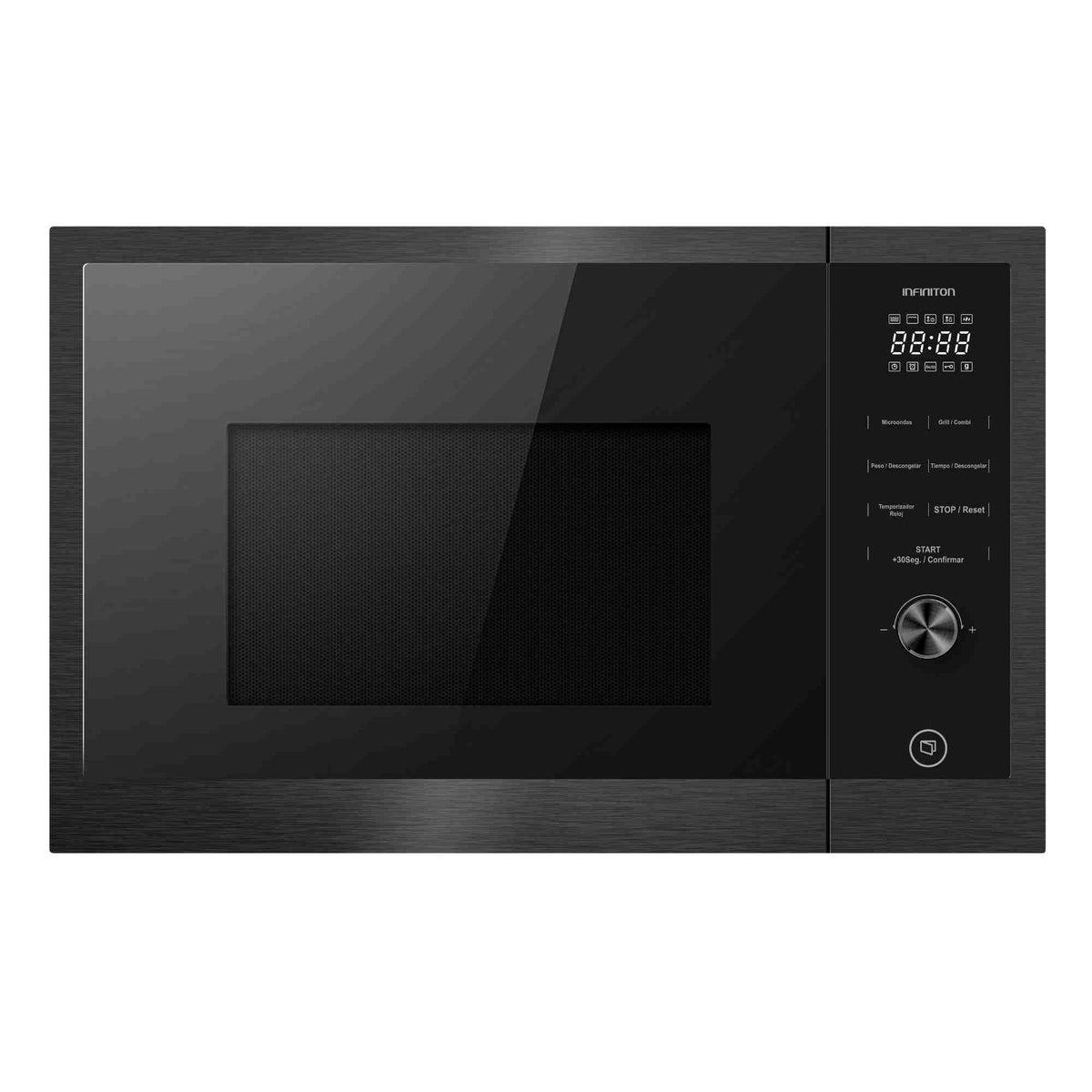
There is a scene that repeats itself in our shop almost every week. Someone who is renovating their kitchen walks in, with the units already fitted by the carpenter, and shows us a photo of the gap on their phone. The question is always the same: “Will a microwave fit here?”. And the honest answer, quite often, is “it depends on whether the gap was made for a microwave or for whatever space was left over”.
The microwave is probably the appliance that most people buy wrongly. Not for lack of information, but because two decisions are made at different moments: built-in or countertop is decided when you design the kitchen, and which model to buy is decided three months later, when there is no going back on the measurements. If those two decisions do not talk to each other, you end up with an appliance that does not fit, a gap that looks badly finished, or a 25-litre microwave where a normal dish from home will not go in.
In this guide we tell you what we tell people at the counter: what to really look at, which numbers matter and which are marketing, and which specific models we have right now for each case. Nothing inflated. We are an official Infiniton point of sale and we have been selling white goods in Albox since well before the microwave existed, so we have seen enough kitchens to know where people go wrong.

Built-in or freestanding: the question that comes first
A built-in microwave (also called integrated) is designed to go inside a unit: a tall column, a wall unit above the oven or under the worktop. It has a perimeter trim that finishes the front against the wood, the ventilation grille is at the front or on the sides, and the whole thing sits flush. A freestanding microwave sits on the worktop, on a shelf or on a wall bracket, and needs free air at the sides and at the back.
The price difference is real and worth knowing beforehand: a decent built-in starts at around €190-230, while a freestanding one with similar features costs between €50 and €140. You are paying for the trim, the forced ventilation system, the finish of the front, and the fact that the appliance has to get rid of heat inside a closed unit without cooking itself.
Our practical recommendation:
- Kitchen being renovated, with a column or unit already planned → built-in. It is the only way to make it look right and not lose worktop space.
- Kitchen you are not going to touch, an improvised gap, or a rented flat → freestanding. It saves €100 to €200 and you take it with you if you move.
- Small kitchen with no room on the worktop → freestanding + wall bracket. It is the cheapest solution that really works.
The measurements: this is where 90% of mistakes are made
This is the important part, and it is where almost nobody looks closely enough. The size of the appliance is not the size of the gap. Each manufacturer gives two different things: the outer dimensions of the microwave and the dimensions of the built-in recess, and they are not interchangeable.
Standard 60 cm column
This is the most common in Spanish kitchens. The unit is 60 cm wide on the outside and the inner gap is around 56 cm. The height of the recess for a microwave is usually between 36 and 38 cm, and the depth around 37-40 cm.
A concrete, checkable example: the Infiniton IMW-1625 needs a gap of 36.7 × 55.8 × 37 cm (height × width × depth) and has a 19.5 mm trim that finishes the front. If your carpenter left 35 cm of height, it will not go in. If he left 40, it fits but you will have a visible joint at the top that needs covering with a trim piece.
When the unit is already built
If the gap already exists, measure three things and write them down: usable height, usable width and usable depth from the front of the unit to the real back (watch out for back battens and the socket box). That last one gives the most surprises: some units have the socket mounted on the back wall, which steals 4-5 cm, and the microwave no longer closes flush.
With those three measurements written down, in the shop we can tell you in thirty seconds which models fit. Without them, it is a lottery.
Weight and support
A 25-litre built-in weighs around 19-20 kg. The Infiniton IMW-GBK25, for example, weighs 19.5 kg, with appliance dimensions of 38.8 × 59.5 × 40.1 cm. A 16 mm chipboard shelf resting on four plugs will not hold that: the unit has to be made to carry it. If you are going to build it into an older unit, check the supports before buying.

Litres: 20, 23 or 25 (and what really fits in each)
The litres of a microwave refer to the volume of the cavity, not the plate. What really matters to you is the diameter of the turntable, because that limits the size of the dish you can put in.
- 20 litres — 24-25.5 cm turntable. Fine for heating individual plates, mugs, milk, a lunch box. It is the format for students, couples or a second home. A standard 26-27 cm dinner plate already touches the sides.
- 23 litres — turntable of about 27 cm. The sweet spot of price and usefulness for a normal family. A dinner plate fits comfortably, plus a small dish.
- 25 litres — 30-31.5 cm turntable. Here a small oven dish and a large plate fit without touching the walls. It is what we recommend if you are going to use the grill properly or if there are four or more at home.
Put in terms of what we stock: the Infiniton MW-HW2070, 20 litres in white is €49.99 and does its job perfectly as a microwave for heating food. If you want to step up, the Infiniton MW-AF23C80, 23 litres is €139.99 with a 1,000 W grill, a 27 cm turntable and an LED display. And among the built-ins, the three 25-litre models we carry all have a turntable of 30 cm or more.
Power: the watts you see and the ones that matter
There is a widespread confusion here that is worth clearing up. On a microwave box you can see two very different figures:
- The microwave power (what heats the food): normally 700, 800 or 900 W. This is the one that decides how quickly it heats.
- The power consumption (what it draws from the socket): it can be around 1,200-1,400 W. It appears in large type on some data sheets because it sounds better.
When the data sheet of the MW-AF23C80 says “1300 W”, that is consumption, not heating power. By contrast, the IMW-SS25L declares 800 W of microwave and 1000 W of grill: those are the working figures.
How much power do you need? For normal home use, from 700 W upwards is more than enough. The difference between 700 and 900 W on a plate of food is about 20-30 seconds. It is not a reason to pay €60 more.
What does matter is the number of power levels (look for 5 at least, 8 is comfortable) and that it has defrost by weight, not just by time. Defrosting by weight works noticeably better with meat and fish.
Grill: when it is worth it and when it is a button you will never press
To be honest: many people buy a grill and never use it. But when it is used, it is used a lot. The rule we give in the shop is simple: if you have a large oven and switch it on without a second thought, the microwave grill is surplus to requirements. If you have no oven, or it annoys you to heat 70 litres to brown two tomatoes, the grill is the best investment in the purchase.
The quartz grill (the one fitted to the three built-ins we carry) heats faster than the classic element and, being housed in the ceiling of the cavity, leaves the interior smooth and much easier to clean. At 1,000 W it really browns: fish, gratinated vegetables or a sandwich all come out well.
What a microwave grill does not do: it does not replace an oven. It does not bake, it does not make sponge cake, it does not roast a whole chicken. If that is what you were after, what suits you is a 70-litre multifunction oven such as the Infiniton CA6516 (€269) or a Beko BBIE18300W 72-litre oven with steam function (€279), with the microwave next to it for reheating.

Finish: stainless steel, black glass or white
It seems like a minor aesthetic question and it is just the opposite: in a kitchen column, the microwave sits right next to the oven, and if the finishes do not match you notice it from the living-room door.
- Stainless steel — the safe bet. It matches 80% of the ovens on sale. The IMW-1625 is the one we recommend when the column already has an oven with a steel front. €190.
- Dark inox — the dark tone of designer kitchens, but with the fingerprint resistance of steel. The IMW-SS25L at €229 is the one that is going into the most new kitchens in the area.
- Black glass — the cleanest-looking, because the IMW-GBK25 opens with a touch sensor, with no handle or pull. The front is continuous. It is also the most expensive of the three, €299, and the one that shows fingerprints most. You decide whether it is worth it.
- White — practically only in freestanding these days. It is still the cheapest: the MW-HW2070, 20 litres at €49.99.
If you are not going to build it in: the wall bracket option
It is the least well-known solution and the one that solves the most problems in small kitchens. A wall bracket for microwaves such as the 40 kg Wurko costs €14.99, has an extendable arm up to 45 cm and gives you back half a metre of worktop. For a freestanding microwave of 20 or 23 litres (which weigh between 11 and 15 kg) the load capacity is more than enough.
An important warning: a freestanding microwave cannot be built into a closed unit. It needs free ventilation gaps at the sides and at the back; if you put it in a made-to-measure cabinet it overheats, the magnetron suffers and the guarantee no longer covers you. We see it several times a year and it always ends badly.

Mistakes we see every month at the counter
- Measuring the gap from outside the unit. Always measure inside, and the depth up to the real stop.
- Forgetting the socket. It has to stay accessible and outside the area of the appliance. If it is at the back, it steals depth.
- Buying a freestanding one to build in. You save €100 and ruin the appliance in two years.
- Choosing 25 litres because “the bigger the better”. If the gap is 36 cm high, a 25 L built-in may not fit. Better a 20 L that fits well than a 25 L that does not go in.
- Paying for consumption watts. The 1,400 W on the box does not heat any faster.
- Not looking at the turntable. If your plates are 28 cm, a microwave with a 24.5 cm turntable will bother you every day.
Why Híper Ocio
We are not going to tell you that we are the cheapest, because we are not always. What we do is this:
We tell you whether it fits before selling you anything. Bring the measurements of the gap and we will tell you which models fit and which do not, even if the answer is “none of the ones I have”. We would rather lose a sale than have you take it home and come back with the appliance in the boot.
We deliver and install white goods ourselves. With our own van, in the Valle del Almanzora, the Levante Almeriense and Los Vélez. It is not an outside agency leaving it in your doorway: it is our own people, who carry the microwave up and leave it built in. Outside that area we do not sell white goods or televisions, and we say so clearly before you pay.
We are an official Infiniton distributor, with a 3-year guarantee handled by us. If something fails, we do not send you to a phone number in Madrid: you come to the shop on Avenida 28 de Febrero and we deal with it here.
You can pay in instalments with Klarna. For a complete kitchen, where the microwave is one more piece, it is often the difference between doing it now or in a year’s time.
And if you have doubts about the measurements, send us a photo of the gap with the tape measure in place by WhatsApp on 623 04 44 20. It is the quickest way to sort it out. We are a family shop in Albox since 1923, today with Antonio Martínez Rosado as the fourth generation at the helm, and we still serve people the same way: looking at the specific case.
Frequently asked questions
What size is the gap for a standard built-in microwave?
In a 60 cm column, the usual recess is around 36-38 cm high, 56 cm wide and 37-40 cm deep. As a real reference, the Infiniton IMW-1625 needs 36.7 × 55.8 × 37 cm. You must always check the specific built-in measurement of the model, not the size of the appliance.
Can I build a freestanding microwave into a unit?
It is not recommended and in practice it voids the guarantee. Freestanding microwaves dissipate heat through the sides and the back; if you close them into a unit, they overheat and the magnetron degrades. If the gap is closed, you need a built-in model.
How many litres do I need, 20, 23 or 25?
For one or two people who only reheat, 20 litres is enough (turntable of about 24-25 cm). For a family, 23 litres is the most reasonable balance. 25 litres makes sense if you are going to use the grill properly or put in large dishes: the turntable goes beyond 30 cm.
Is a grill worth having on a microwave?
It depends on whether you have an oven and whether you use it. If you switch on the large oven without a second thought, the microwave grill will be surplus. If you have no oven or want to brown small portions without heating 70 litres, a 1,000 W quartz grill is what you will appreciate most. That said, it does not bake: it does not replace an oven.
Do you deliver and install the microwave at home?
White goods appliances, including built-in microwaves, are delivered with our own van in the Valle del Almanzora, the Levante Almeriense and Los Vélez. We do not offer nationwide delivery of white goods. You can also collect it from our physical shop on Avenida 28 de Febrero, in Albox.
What guarantee do they have and what if I change my mind?
Infiniton appliances come with a 3-year official guarantee against manufacturing defects, handled by us as an authorised distributor. For returns, you have 30 days under our returns policy. Please note that a built-in microwave that has already been fitted and drilled is not considered to be in its original condition.